Discourses From the East
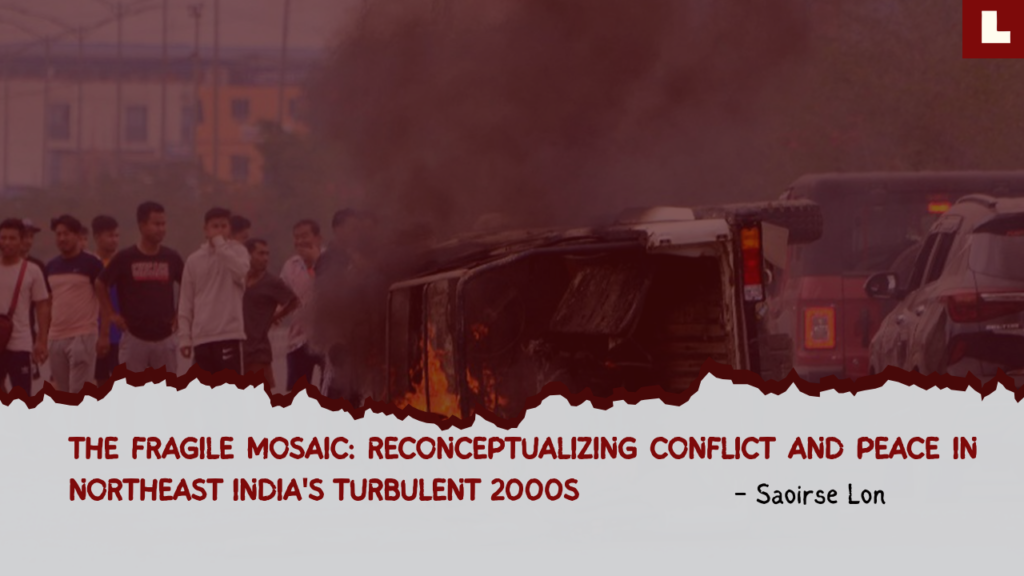

If the 1990s in Northeast India constituted a period of acute kinetic proliferation, the early 2000s were characterized by a process of sociopolitical entrenchment. This epoch witnessed the dissipation of the romanticized narrative of insurgency, yielding instead to a grittier, more visceral reality. A retrospective analysis of the decade precludes an interpretation of the regional turmoil solely through the traditional dyadic framework of State versus Non-State Actors. The defining characteristic was fundamentally more intricate: a Mixed Ethnicity Complex, representing a volatile superposition of competing territorial claims where historical narratives, geographical imperatives, and identity politics converged.
The Burning Assembly: A Nexus of Complexity
The abstract theoretical construct of this complex manifested into brutal praxis on the humid afternoon of June 18, 2001, in Imphal, Manipur. Preceding this event by mere days, the Government of India had unilaterally declared a ceasefire extension with the NSCN-IM, crucially omitting specified territorial limits. For the Naga populace, this action signified a validation of their historical claims and a significant step towards the unification of their ancestral homelands. Conversely, within the Imphal Valley, this identical geopolitical articulation was immediately construed as an existential threat to the territorial integrity of the state of Manipur.
The response was instantaneous and intensely visceral. Thousands mobilized into the urban centers. The visual iconography of that month remains indelible, specifically the Manipur State Assembly edifice engulfed in conflagration, the atmosphere choked with an opaque plume of black smoke, culminating in the tragic loss of eighteen civilian protestors.
This incident encapsulates the operational dynamics of the Mixed Ethnicity Complex. It did not constitute a direct confrontation with the sovereign authority of New Delhi; rather, it was a violent collision between two distinct, indigenous conceptualizations of a homeland. The June uprising demonstrated that the establishment of peace in the Northeast is not a zero-sum condition. A concession granted to one ethnic constituency within a shared geographical space is frequently perceived as an act of aggression against another. The ancestral domain of one group almost invariably overlaps with the critical periphery of another.
The Geography of Fear
The violence characteristic of the 2000s was not exclusively vertical (State-subaltern) but significantly horizontal (inter-communal). The aspiration for exclusive ethnic homelands transmuted neighbors into adversaries and established non-demarcated internal boundaries within administrative districts, unrepresented by official cartography.
This phenomenon was acutely pronounced in the hills of Karbi Anglong during the Karbi-Dimasa clashes of 2005. The underlying causality of this violence was not ideological but demographic. It precipitated a massive surge of internal displacement, which remains a significant, often unacknowledged, humanitarian crisis of the era. Testimonies derived from the relief camps established in Diphu during that winter offered a stark socio-economic profile: makeshift urban agglomerations of plastic tarpaulins lining arterial highways; reports of entire villages rendered vacant, granaries abandoned, and a generation of children whose primary recollection of ‘home’ was a densely occupied scholastic facility repurposed as a shelter. This represented the spatial and social balkanization of the Northeast, a fractured geopolitical landscape where security was fundamentally contingent upon linguistic identity.
The Iron Fist and Civil Resistance
The State’s counter-response to this fragmentation was a contradictory amalgam of military coercion and nascent diplomatic outreach.
On the one hand, Peace Operations remained inextricably linked with Counter Insurgency methodologies. The sustained imposition of the Armed Forces Special Powers Act fostered an environment of operational impunity. The 2004 Manorama Devi incident stands as the socio-political watershed moment of the decade. It transcended mere statistical significance, representing a brutal violation that catalysed the iconic protest at the gates of Kangla Fort, where women publicly disrobed in a desperate, non-violent assertion of human dignity against the apparatus of militarized state power.
Yet, the 2000s concurrently signaled a strategic pivot. The realization solidified within the central policy echelons in New Delhi that a definitive military victory was unattainable against adversaries embedded within the social fabric. The adoption of formal ceasefire frameworks initiated the crucial process of structured dialogue. The most effective agents of peace in this period were frequently not military personnel but indigenous civil society organizations, such as the Naga Mothers’ Association, various student unions, and literary bodies, which intervened to mitigate the trust deficit when formal state mechanisms proved inadequate.
The Decadal Legacy
What constitutes the enduring scholastic legacy of the early 2000s? It underscores the principle that peace in Northeast India is not a terminal state but a process of continuous, dynamic negotiation. The observed deceleration in conflict intensity towards the conclusion of the decade was not achieved because the underlying Mixed Ethnicity Complex had been resolved. It resulted, rather, from the mutual exhaustion of the stakeholders, both state and non-state, succumbing to the protracted strain of armed conflict.
Also Read: No Full Stop for Tully: The Eternal Rhythm of a Vernacular India
In contemporary regional analysis, the reverberations of those years are still palpable. While territorial borders may exhibit greater quiescence, the deep-seated fault lines persist. The empirical lesson derived from the ashes of the Imphal Assembly and the internal displacement sites of Diphu is unambiguous: Peace operations that fail to incorporate the intricate, overlapping matrices of ethnic identity are predicated for failure. Authentic and durable stability only emerges when the endeavor to impose rigid, exclusive lines upon mixed communities is abandoned in favor of constructing resilient institutional frameworks capable of functioning without such categorical distinctions.