
Discourses From the East
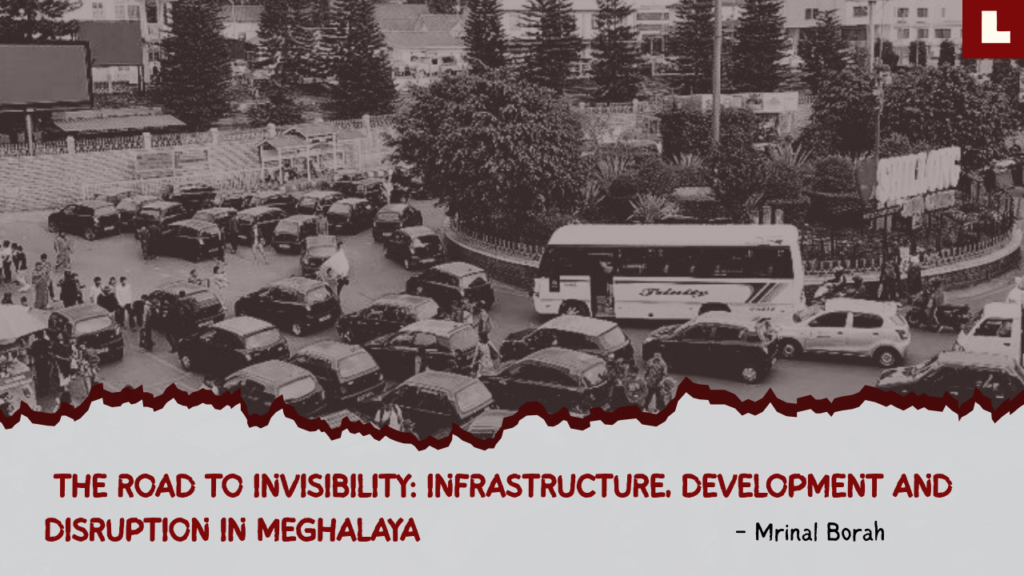
Roads, a term that is usually juxtaposed with the imagination of development in our vocabulary, are ‘things’ that create disruption, displacement, and dispossession. In Northeast India, the path of growth has been viewed through the lens of infrastructure building, which has become the centrepiece of the political language of development for incumbent parties in power. However, these practices do not take place apolitically, as is often believed; rather, these acts begin to disrupt the social-political life of the population living around the spaces where these projects are implemented. As observed in my year-long ethnographic fieldwork in Meghalaya among the Bhoi, the ‘greater common good’ is adopted even in local parlance. New cultural sensibilities and morals also circulate along these roads as gravel, pitch, and asphalt are layered upon them.
The Roadside Encounter and a decade of change
Our eyes witness several distinct sights as one travels into the land of the Khasis from Guwahati to Shillong through the winding highway that cuts through countless hills and passes over rivers and dams. However, one sight that inevitably captures attention is the shops that sell both pork and beef in the same establishment. On the roadside along the highway—for instance, in Mawlai, just at the entrance of Shillong City, such shops are abundant. This part of the road is also infamous for long traffic jams that can stretch for an hour just to cover a few metres. As I considered getting down to purchase pork, a non-Khasi driver from Shillong, out of concern, warned me that they use the same dao (knife) to cut and slice both beef and pork. He believed that, judging by my luggage, I was likely a new student, perhaps one who had recently come to one of Shillong’s educational institutions. Well, I played along and decided not to get down.
A decade back, such shops were prevalent in the iew of Byrnihat, Nongpoh, and Umsning, as these are the primary towns that travellers must pass through en route to Shillong. Nowadays, while travelling to Shillong, the Umsning Bypass is preferred, and such traditional meat shops in Umsning are also bypassed from the travellers’ view. The building of the new widened highway and bypass has offered travellers a new worldview, both literally and figuratively.
Fast forward a decade, and things have changed drastically: these shops, which were once located right on the roadside, have been relocated to the corners of new market spaces. Now one cannot see them while passing through these towns. For instance, in Nongpoh, the beef and pork markets have been placed in the inner parts of the market behind a shopping complex built by the Meghalaya Urban Development Authority. However, several Kong (women vendors) openly sell chicken and usually sit on the roadside of the service lane of the highway the entire day with relatively wider public visibility. Residents attribute this relocation to the widening of the old two-lane GS Road to accommodate a wider four-lane road with two service lanes. This relocation is particularly interesting precisely because beef and pork stores have been relocated to the corner of the market. While the local Dorbar usually permits shops of all kinds to operate in designated areas, the selection of specific locations for meat shops remains unexplained by locals.
The Relocation’s contrast with the Old Umsning Town
Things begin to look different as one travels along the old Gauhati-Shillong (GS) Road and stops at the old Umsning Town. It is noteworthy that Umsning town has sustained the culture of roadside pork and beef meat shops. The road-facing shops selling beef and pork in Umsning are often located together or in close proximity to one another, a visual landscape that has completely disappeared in the newly developed towns.
The transformation of Meghalaya’s food retail landscape along newly constructed highways reveals a profound truth: roads are not merely passive conduits of commerce and movement. Rather, they function as active agents of cultural negotiation and social reorganisation. The systematic removal of beef and pork vendors from the visible roadside to the hidden corners of market spaces speaks to a deeper process of cultural contestation, one in which infrastructure development becomes intertwined with shifting moral frameworks and perhaps religious sensibilities.
The contrast between the old Umsning Town, where traditional meat shops remain visibly positioned along the roadside, and the newly developed towns like Nongpoh and Byrnihat, where these same vendors have been relegated to obscurity, illuminates how infrastructure doesn’t simply transform economic relations; it fundamentally reshapes what communities see, how they consume, and ultimately, who they are. The construction of bypasses and widened highways has created a geographical logic where certain cultural practices become literally invisible to the passing ‘gaze’, while simultaneously elevating the visibility of alternative food commodities like chicken stalls, Dhaba and the bakeries.
Conclusion
The widened highway doesn’t just physically relocate meat shops; it fundamentally transforms how these cultural practices become visible or invisible to passing travellers. The material transformation produces what Brian Larkin would call as “sensorial and political experiences”. The highway appears as neutral development, but it actively structures social relations and excludes certain sections of the population from view.
This ethnographic observation from Meghalaya demonstrates that in Northeast India, development is never merely a technical or economic endeavour. Infrastructure building is inherently a cultural and political project, one that reflects and reproduces power relations among different communities. The roads that promise connectivity and progress simultaneously erase and marginalise certain ways of life, replacing them with sanitised versions more palatable to mobile consumers and modern sensibilities. Understanding this dynamic is crucial not only for scholars of infrastructure and society but also for policymakers and communities themselves, as they navigate the ongoing transformation of their cultural and economic landscapes in the era of rapid development.



It is not only in Meghalaya. In Assam too such relocation of meat shops, fish markets, tribal vegetable vendors in the process of road widening have become a common sight in Many places. the cultural project of Hindutva has many facets. Another important fall out of clever road widening politics is closing of all grounds traditionally hosting protest and cultural activities of dissenters and marginalized communities. Corporatization of public facilities is being used to silence dissenting voices. road widening and rebuilding cultural sights ad covering up natural beautiful sights like the Brahmaputra in the city of Guwahati or, covering the Dighali Pukhuri in the heart of Guwahati are all part of a political, economic and cultural design for hegemonizing design marginal communities. Well, marginal communities are not taking it kindly.