Discourses From the East

In India’s vast intellectual landscape, the Northeast is often described through absence missing from national debates, underrepresented in mainstream media, peripheral to dominant academic frameworks. But this language of absence hides a more complex reality. The Northeast is not simply overlooked; it is unevenly accessed. For scholars who attempt to study the region particularly in the social sciences the challenge is not just about writing against silence. It is about entering a field where access itself is structured, negotiated, and often withheld. Nowhere is this more visible than in the everyday practice of fieldwork.
The Field Is Not Neutral
Social science research in Northeast India is, by necessity, deeply field-based. It requires travel across difficult terrains; time spent in communities, and sustained engagement with people across social strata journalists, bureaucrats, student leaders, activists, and ordinary citizens whose lived experiences shape the region’s realities.
It is not the kind of research that can be conducted from a distance.
Fieldwork here means sitting in newsrooms and waiting for conversations that may never happen. It means approaching local reporters for interviews, only to be met with hesitation. It means negotiating entry into bureaucratic offices where files move slowly but trust moves even slower. It means returning, repeatedly, to the same individuals, hoping that familiarity might eventually translate into openness.
For first-generation researchers, this process is rarely straightforward.
Without institutional backing or inherited academic networks, they enter the field as unknown entities. Their requests for interviews are not just assessed for academic merit but filtered through layers of suspicion, hierarchy, and relational distance.
An email is not just an email. It is a test of credibility.
A request for an interview is not just a request. It is a question of legitimacy.
Networks as Gateways—and Barriers
The sociologist Pierre Bourdieu argued that access within any field is shaped by different forms of capital viz. social, cultural, symbolic. In the context of Northeast India, these forms of capital often determine whether fieldwork is even possible. Social capital who can introduce you becomes the difference between access and exclusion. Symbolic capital, your institutional affiliation, your mentor’s reputation signals whether you are to be taken seriously. In practice, this means that two researchers asking the same questions may receive entirely different responses.
One arrives with a letterhead from a prestigious institution, perhaps accompanied by a known intermediary. Doors open. Conversations begin. The other arrives alone, with intellectual curiosity but no recognizable backing. Doors remain closed or half-open at best. In a region where professional and social networks are tightly interwoven, access flows through relationships. Trust is rarely extended to strangers. It is inherited, transferred, or slowly built often over months, sometimes years.
For first-generation researchers, this creates an uneven terrain. Fieldwork becomes less about methodology and more about navigation of networks, hierarchies, and unspoken codes of belonging.
The Politics of the Interview
Interviews, the backbone of social science research are particularly fraught in this context.
Regional journalists, for instance, occupy a paradoxical position. They are both narrators of the Northeast India and subjects of academic inquiry. Their reluctance to engage with researchers is often interpreted as indifference or lack of cooperation. But this reading misses the deeper politics at play.
In a region long subjected to misrepresentation, the act of speaking to a researcher is not neutral. It carries risks of being misunderstood, misquoted, or subsumed into narratives that do not reflect lived realities. Refusing an interview, then, can be an act of control.
Yet this control is not exercised uniformly. Researchers perceived as credible because of their affiliations or networks often face fewer barriers. Their presence is legitimized before the conversation even begins. What emerges is a hierarchy of access, where the ability to conduct interviews depends not only on what one studies, but on who one is perceived to be.
Fieldwork as Emotional Labour
What rarely enters academic writing is the emotional dimension of this process.
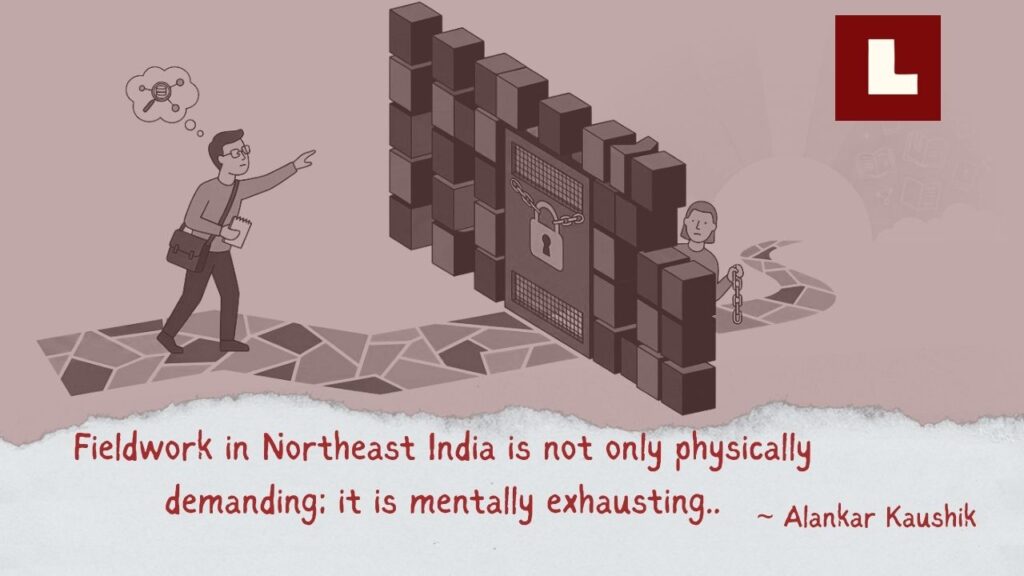
Fieldwork in Northeast India is not only physically demanding; it is mentally exhausting. Repeated requests followed by quiet refusals wear researchers down. Each interaction carries uncertainty. Every word must be chosen with care. And there is a constant awareness of being an outsider. Over time, these pressures deeply shape how research is conducted—and how the researcher experiences the field itself.
For first-generation scholars, this labour is intensified. They must not only design research questions and methodologies but also build the very conditions under which research becomes possible. They must learn how to approach individuals, how to establish rapport, how to negotiate refusals without closing doors permanently. This is work. But it is invisible work.
Academic institutions rarely account for it. Timelines for research projects often assume a level of access that does not exist in practice. Evaluation systems reward outputs papers, presentations, publications while overlooking the prolonged, uncertain process that precedes them.
Power and the Control of Knowledge
The philosopher Michel Foucault reminds us that knowledge is inseparable from power. In Northeast India, this relationship is not abstract it is embedded in the very mechanics of fieldwork. Access to information is not freely given. It is controlled, mediated, sometimes strategically withheld.
This control operates at multiple levels. Bureaucratic gatekeeping can delay or deny access to official data. Community leaders may regulate who gets to speak and who does not. Journalistic networks may decide which researchers are worth engaging with. For first-generation researchers, these layers of control accumulate. Each denied interview, each inaccessible document, each closed network is not an isolated obstacle. It is part of a broader system that shapes what can ultimately be known.
Layered Marginality in the Field
Identity further complicates this landscape. Many first-generation researchers come from marginalized socio-economic, linguistic, or regional backgrounds. In a fieldwork setting, these identities are not incidental. They influence how researchers are perceived sometimes subtly, sometimes explicitly. An accent, a surname, a university affiliation, these become markers of credibility or its absence.
This produces what might be called layered marginality. A researcher may be excluded not only because they lack networks, but because they do not fit the expected image of authority. Ironically, local researchers those with deeper cultural and contextual understanding may find themselves at a disadvantage compared to those backed by metropolitan institutions. The field, in this sense, is not just a site of inquiry. It is a site where hierarchies are reproduced.
Epistemic Injustice and the Cost of Exclusion
Philosopher Miranda Fricker’s concept of epistemic injustice offers a powerful lens to understand these experiences. First-generation researchers often face testimonial injustice: their credibility is questioned not because of flawed arguments, but because of their social positioning. Their requests for interviews are ignored. Their presence is treated with skepticism. But there is another, quieter injustice, the absence of recognition. The time spent building trust, the emotional strain of navigating refusals, the slow and uncertain process of gaining access, these are rarely documented. They do not appear in methodology sections or final publications. As a result, the narrative of research remains incomplete, presenting an illusion of smooth access where, in reality, there was struggle.
Toward a More Honest Sociology of the Field
What would it mean to take these challenges seriously? First, it would require acknowledging that social science research in Northeast India is fundamentally shaped by field conditions by the need for interviews, by the difficulty of access, by the centrality of relationships.
Second, it would demand a shift toward reflexive methodologies approaches that recognize the researcher’s positionality and the power dynamics embedded in every interaction. Participatory research, where communities are treated as collaborators rather than subjects, offers one possible way forward. It redistributes authority and creates space for more equitable engagement. But methodological innovation alone is not enough.
Institutions must also change. They must recognize that fieldwork in regions like the Northeast takes time time to build trust, to navigate networks, to understand context. Evaluation systems must expand to value these processes, not just the outputs they produce.
Who Gets to Know?
At its core, the question is simple, but urgent: Who gets to know and who gets to be known? First-generation researchers occupy a critical position in this landscape. They bring perspectives that are often excluded from mainstream academia. Their work challenges dominant narratives not only through its content, but through the conditions under which it is produced. Their struggles reveal the limits of a system that claims openness but operates through exclusion. And yet, they also point toward possibility. A more inclusive model of knowledge production one that values access as much as analysis, relationships as much as results is not only desirable. It is necessary.
Because until the politics of access is addressed, the story of Northeast India will remain partial shaped by those who can enter the field with ease, while others continue to stand at its edges, waiting to be heard.