Discourses From the East

Trade unions once occupied a central position in the Indian polity.It produced great number of national and regional leaders- VV Giri, George Fernandes, Guljarilal Nanda, Jyoti basu, P. Chidambaram, Golap Borbora etc. But Trade Unionism have slowly receded in the shadows after the 1991 liberalisation reforms .
The introduction of contractualisation and in-formalisation of workforce to make Indian markets more investment and business friendly have broken the backbone of Indian trade unions and with it the concept of collective bargaining. There existed a time not long ago when collective bargaining was considered as an important tool for broader social transformation . But now the same idea is considered as an impediment to development and spelled with resentment and anxiety.
The neoliberal state detests any form of workers struggle that demands for a dignified life. For decades, Indian Labour laws did a balancing act between the heavily disproportionate power relationship between Capital and Labour. It acted as cushion and shock absorbers for the trade unions. But on 21 November, the union government repealed 29 labour Acts , some of which were even older than 100 years. And notified the employer-investment-business friendly Labour Codes.
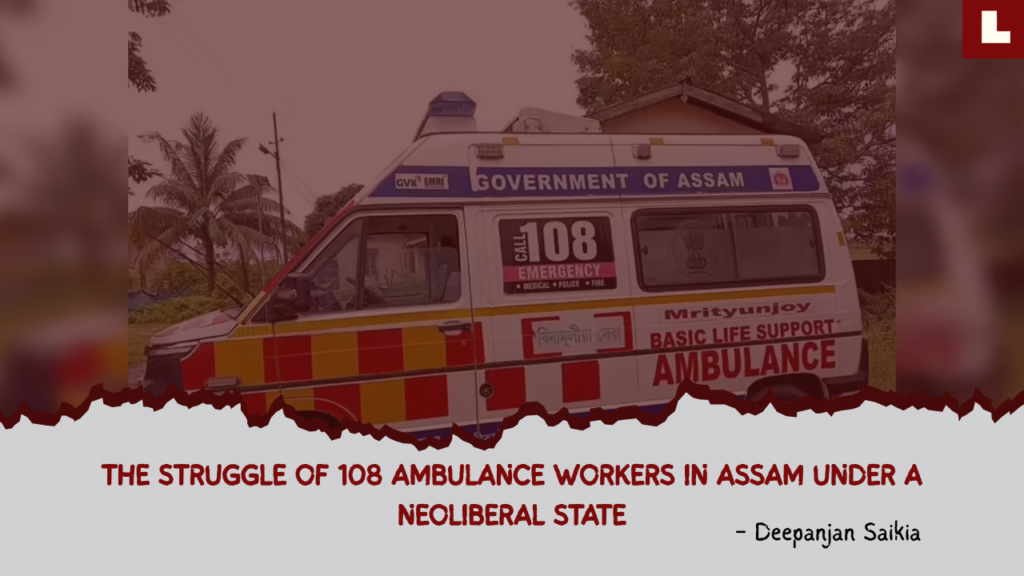
It is in this context, the 108 ambulance employees in Assam, represented by the All Assam 108 Mrityunjoy Employees’ Association, are currently engaged in a massive indefinite strike that began on December 1, 2025. These workers are demanding a fair wage, the payment of overtime and bonuses, and the implementation of better working conditions. The protest is centered at Chachal in Guwahati, involving approximately 3,000 workers, including ambulance pilots (drivers), Emergency Medical Technicians (EMTs), and Emergency Response Officers (EROs). A major flashpoint of this protest has been the termination of nearly 700 to 1,000 employees during the strike.It important to state that National Health Mission under Health & Family Welfare Department of Assam is the Principal employer of these protesting employees. The Chief Minster of Assam has directly evaded the governments responsibility by saying that the workers are protesting the against GVK EMRI ,I.e, the contractors and the workers have no qualms with the government.
The strike has entered its second month, but the Labour Department has still not called any conciliation meeting with the employer or the employees, thereby completely evading its statutory duties as mandated under the Industrial Disputes Act, 1947. The very objectives of Industrial Disputes Act, 1947, was to ensure industrial peace, promote amicable relations between employers and employees, and provide mechanisms (conciliation, arbitration, adjudication) for settling disputes peacefully, balancing social justice for all parties. But the role of Labour Department has led to complete breakdown of legal and institutional forum of Collective Bargaining in the state.It is also pertinent to state that the workers have not been paid their salaries for the month of November, despite having worked during that period. This has been done by the employer as a punitive measure against the workers for going on strike. A delegation of workers met the Labour Commissioner, apprised him of the situation, and submitted a memorandum seeking immediate intervention.It yielded no result, despite the fact that the Payment of Wages Act, 1936 (now subsumed under the Code on Wages, 2019), explicitly prohibits the withholding of wages. The last time such thing happened in our nation was just before the emergency, when the Indira Gandhi government suspended the Payment of wages Act,1936 to subdue the historic strike of 1 million railway employees in 1974. Around 1000 employees are illegally terminated while strike is going and to make the matter worse, new individuals are freshly appointed in some of those positions. Both of these acts are unfair labour practice under Schedule 5 of the Industrial Disputes Act,1947 and result upto 6 month of imprisionement . But still the Department shamelessly refuse to act and completely abdicate its fiduciary responsibilities. There are lesser parallels to be found of gross dereliction of duty by public servants .Rule of law and Industrial Democracy have collapsed in its face.
The attitude of the government is simple: live with whatever breadcrumbs we give you or perish. There is no room for any form of dialogue. Any kind of engagement with the workers will make the government look weak .The very idea that that democratic dissent can yield any form of positive outcomes is an anathema to the state.The amount that will be spent from the government coffers if the workers’ demands are met is not the problem. The problem is more ideological than fiscal. If the workers succeed in one-fourth of what they are asking, it will set a precedence for others to follow.It will pump life into the trade union movement which is gasping for air in Assam.
The workers have put up a valiant fight against the might of the administration. But this strike also exposed the sorry state of leadership of nationally affiliated trade unions. The All Assam 108 Mrityunjoy Employees’ Association is affiliated to AITUC( All India Trade Union Congress), India’s oldest trade union which is again affiliated with the Communist Party of India.The workers have been hoping from one office to other office, meeting one official to the other, only to be at utter dismay and confusion. It is no exaggeration to state that the AITUC leadership failed to provide the strategic direction necessary to channel the workers’ struggle effectively. Their long-term detachment from active labor movements has rendered them ineffective, evidenced by their failure to utilize even the most basic legal protections afforded by the Industrial Disputes Act, 1947. it reflects the overall state of apathy the trade unions are in today.
Also Read: The Road to Invisibility: Infrastructure, Development and Disruption in Meghalaya
Having said all this, it is the moral responsibility of all the progressive forces and conscious citizens to put their solidarity behind these 3000 workers who are at strike. These workers have on their own heroically stood their ground for past 31 days. But they are now in need of all kind of help- from lawyers to academicians , from media persons to intellectuals- they will need all. But most importantly they need the Trade Unions. Irrespective of affiliations, the trade unions must collectively stand up for these 3000 striking workers and revive back the once great tradition of trade unionism in our polity.