
Discourses From the East
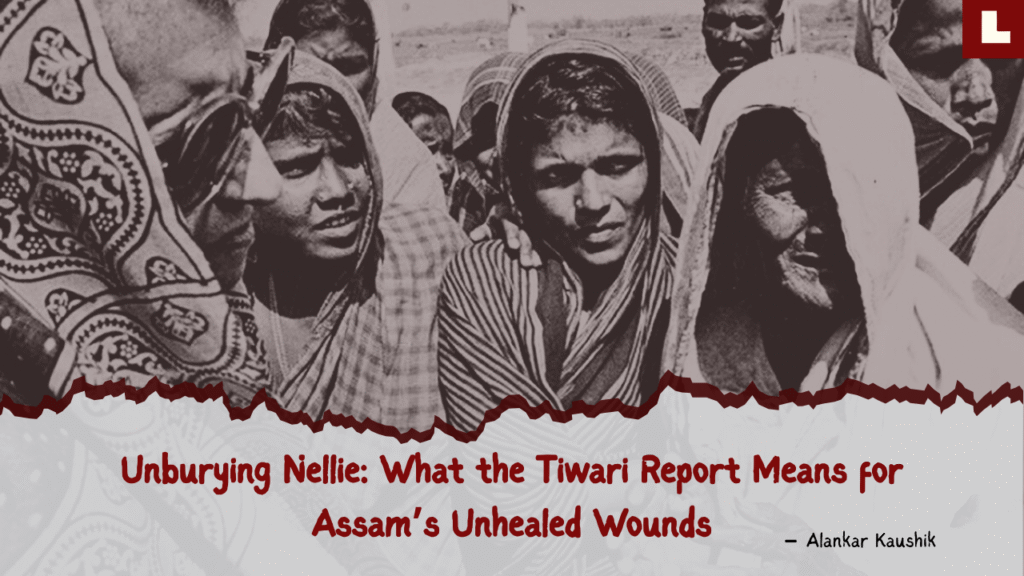

On October 23, the Assam government announced its decision to table the long-awaited 550 page long Tiwari Commission Report in the upcoming session of the Assam Legislative Assembly. The announcement immediately brought the Nellie massacre of 1983, one of the darkest chapters in Assam’s history back into public focus. The news has reignited conversations across media circles, civil society organisations, and among ordinary citizens, compelling many to revisit a past that continues to remain unresolved.
For me, this moment resonates deeply and personally. My doctoral research had engaged with the Nellie tragedy, particularly examining how the media narrated, framed, and, at times, silenced the event. Hearing about the report’s imminent tabling, I found myself drawn back to the archives, to those fragile newspaper pages that carried the first images and reports from Nellie. I began asking once more: Can we return to that moment and critically read how regional and national media constructed the event?
The narratives then were sharply divided. On one side, East Bengal origin Muslims were portrayed as victims; on the other, the indigenous communities were presented as the aggrieved. Each account seemed to carry its own justification, its own history of hurt. Yet, what lay between these opposing narratives : the silences, omissions, and editorial choices remains crucial to understanding how the tragedy was mediated and remembered.
This article grows out of that curiosity and commitment to revisit those mediated memories and to uncover what the headlines concealed. It is also an attempt to show how, through the lens of media studies, we might arrive at a more nuanced, plural understanding of Nellie. My research, grounded in archival work and oral testimonies, offers an original reading of the massacre as a contested site of media representation, rather than merely a footnote in Assam’s turbulent political history.
The Nellie massacre has long stood as one of India’s one of the most brutal episodes of collective violence. It unfolded in a few villages near Jagiroad on February 18, 1983, in the midst of the Assam Assembly elections, which the All Assam Students’ Union (AASU) and the Assam Gana Sangram Parishad had vehemently opposed. The elections were held despite calls for postponement over demands to revise electoral rolls to exclude alleged “foreigners.” The outcome was an orchestrated massacre of eastern-origin Muslims was both a tragedy and a mirror to the failure of democratic institutions.
Yet, as history reminds us, violence is not just about what happens, it is also about what is remembered, and what is silenced.
The Day the Press Looked Away
During my doctoral research I interviewed Bedabrata Lahkar, then a young reporter with The Assam Tribune to take his testomony. Lahkar was among the first journalists to reach Nellie by sheer coincidence. Even today, as he said, he recalls the acrid smell of burnt paddy fields, the cries of fleeing villagers, women, children, the elderly and the haunting chaos that swept through Damalbeel. Lahkar had set out from Nandan Hotel in Guwahati in a white Ambassador car, along with ABC correspondent Sharma and Indian Express reporter Hemendra Narayan, expecting to cover reports of a few burnt houses. What they encountered instead was unspeakable horror: nearly 1,500 men armed with daos and spears storming through the fields, trapping the terrified villagers between two charging mobs. Lahkar and his companions barely escaped with their lives, racing to Jagiroad police station before returning to Guwahati. There, shaken but resolute, Lahkar filed his exclusive story for The Assam Tribune, a dispatch from the heart of a tragedy that many would soon choose to forget.
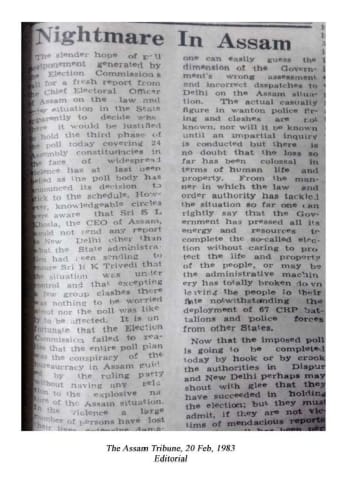
But the next day, the front page carried only a single-column report.
His editor, chose not to make it the lead story. Only after a PTI correspondent filed his report did the paper run a banner headline. “My exclusive story became a single column,” Lahkar recalled decades later. The silence of the newsroom became, in retrospect, the silence of an entire society.
The Assamese dailies that could have documented the truth were preoccupied with violence in Darrang. Others were silenced by fear, fatigue, or political caution. As Lahkar explained, “Most journalists were busy covering other districts; they never reached Nellie.” But the deeper story was one of institutional complicity, a censorship not of the gun, but of deference.
The State, the Press, and the Red Pencil:
To understand that silence, one must look at the uneasy relationship between the state and the press in those years. During the Emergency, the Indian government had already perfected the art of quiet control by using the Monopolies and Restrictive Trade Practices Act, control over newsprint, and advertising revenues as levers to discipline dissenting newspapers. As Rao and Rao famously observed citing Emergency times in India in the book titled The Press She Could Not Whip (1977): “Every newspaper, every news agency had a censor sitting in its premises, red pencil in hand.”
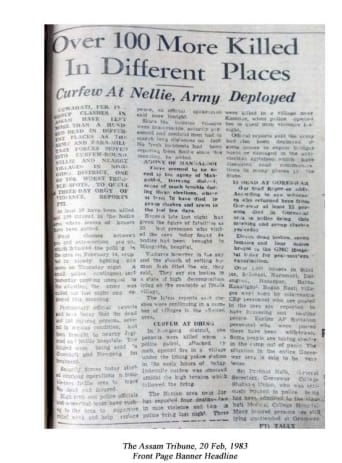
In Assam, this culture of control was localized through The Assam Special Powers (Press) Act, 1960, which empowered the government to prevent publications likely to “affect public order.” On January 7, 1983, just weeks before the election, the Home Department invoked this law to prohibit The Assam Tribune and Dainik Asom from publishing anything relating to the Assam movement that could “aggravate” the situation.
In effect, this meant the state could decide what was news and what was dangerous truth. The result was that the regional press reported the movement but not the massacre.
Whose Story Was It, Anyway?
When journalist Diganta Sharma of Saadin visited Nellie after many decades, the survivors asked him a question that cuts deep even today: “Will you be able to write our real stories?”
They had seen reporters before their faces, notebooks, cameras but their words had never reached print. The victims understood what media theorist Elisabeth Noelle-Neumann called the “spiral of silence.” In her 1974 essay, she argued that people tend to suppress minority opinions for fear of isolation. In Assam of the early 1980s, this silence was not individual but institutional. The dominant narrative that of “foreigners,” “illegal immigrants,” and “indigenous threat” drowned out voices of grief and guilt.
The media, consciously or not, helped reinforce that narrative. By echoing the rhetoric of the Assam movement, newspapers blurred the line between journalism and justification.
When Truth Was Treason:
The suppression of the Nellie story was also part of a larger pattern of press self-censorship in times of perceived crisis. Governments often invoke “responsibility” in media coverage, but as cultural theorist Philip Schlesinger noted, this can be a polite term for control. The question, as he put it, is always: how much responsibility before it becomes silence?
In the midst of this silence, one small newspaper dared to speak. Kalakhar, edited by Professor Hiren Gohain, a left-leaning intellectual voice during the Assam Movement. “All I remember of those ghastly events,” Gohain recalled, “was first a resounding silence, then reports of ‘disturbances’ suggesting mutual hostility.” He remembered how Arun Shourie’s India Today report was among the first to describe the scale of the killings not to heal, but to politically indict the government while sidestepping the ideological complicity of local elites.
Gohain’s Kalakhar sought to expose not only the chauvinism of Assamese nationalism but also the state’s duplicity the way truth was traded for “order.” His writings, largely lost now from public archives, remain testimony to what resistance looks like when truth itself becomes contraband.
Land, Power, and the Anatomy of Hate:
Scholars have long debated what caused Nellie. Some point to ideology, others to the politics of identity. But the deeper fault line was land. The east Bengal origin Muslims of Nellie had settled over decades, often buying land from local tribes. As they prospered, resentment grew. Land, that elemental symbol of belonging became the battlefield. What ideology did was provide moral cover for a material conflict.
The Tiwari Commission Report is said to have documented this complexity, though it remained sealed for decades. We know from scattered accounts that over 683 cases were filed after the massacre at the Jagiroad police station, charge sheets were submitted for 310, but not a single conviction followed. Justice was smothered under layers of bureaucratic dust. The survivors, many of them children, were resettled in refugee camps. Some were sent to the SOS village at Hojai, a living monument to a state’s moral failure.
Political scientist Monirul Hussain once observed that while the Assam movement began as a secular assertion of identity, it “turned non-secular in its expression.” The same movement that sought to defend Assam’s rights against the Centre ended up sacrificing its own humanity at Nellie.
The State of Exception:
Philosopher Giorgio Agamben would have called Nellie a “state of exception”, a moment when law is suspended and life is reduced to what he terms bare life. The Muslims of Nellie were not just stripped of citizenship; they were stripped of empathy. They existed outside the law, outside recognition. Their killing was neither crime nor accident, it was an erasure legitimized by silence.
Agamben’s framework is chillingly apt for Nellie. It reminds us that when governments use the rhetoric of crisis of threats, outsiders, and order they expand power by contracting rights. What remains after the exception is normalized is a society habituated to exclusion.
The Media and the Manufacture of the “Other”
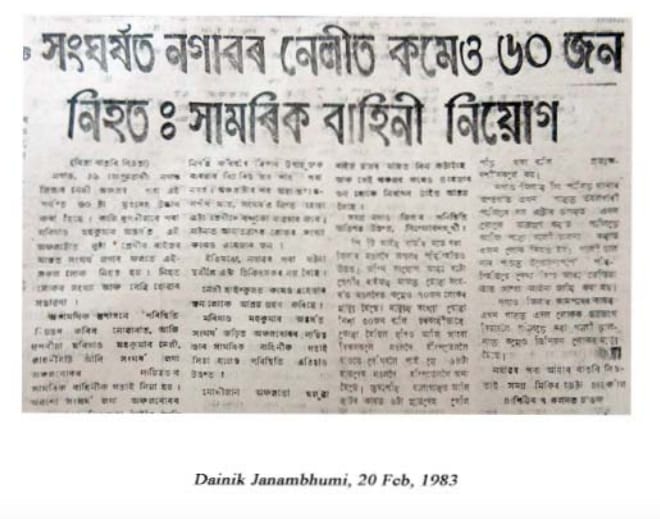
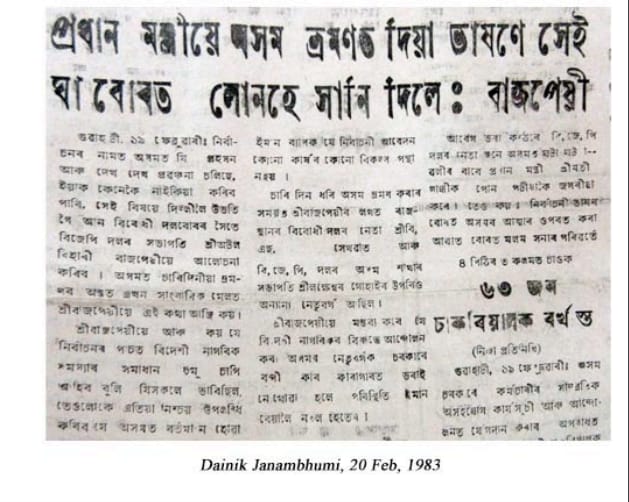
In the days following the massacre, Dainik Janambhumi published an editorial titled “Division of Hearts,” portraying Assamese people as victims of attacks by “foreign nationals.” A day before the killings, the same paper warned of “Razakars from Bangladesh” participating in Assam’s violence invoking ghosts of the 1971 war to paint a local conflict in foreign colours.
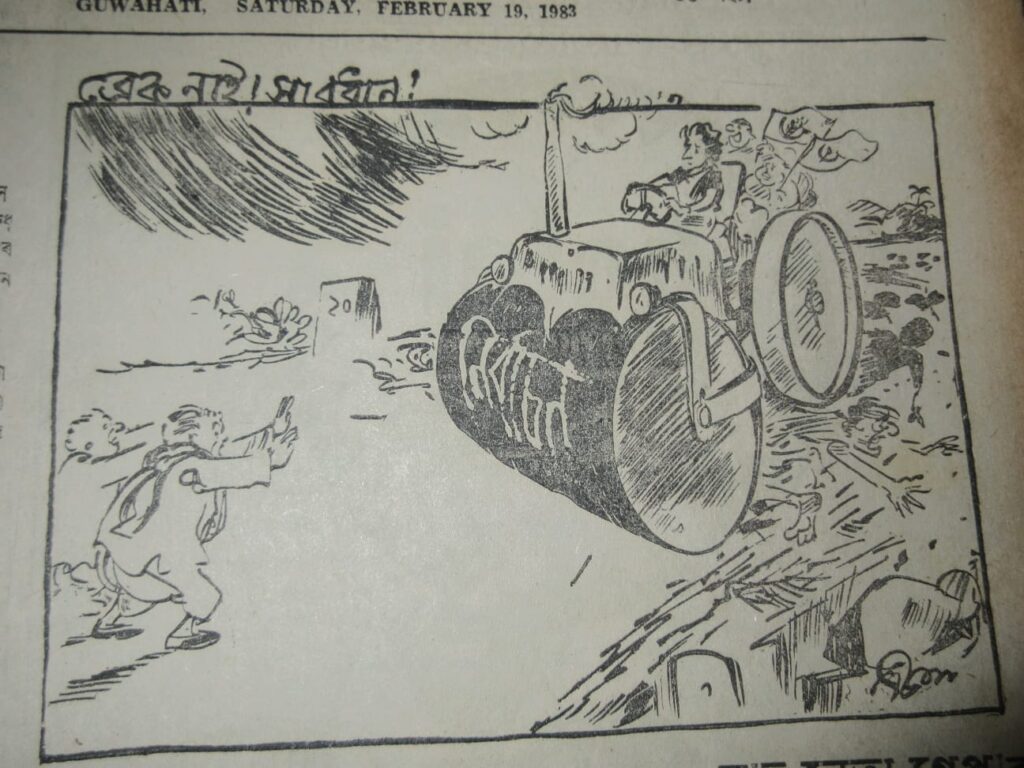
This was not just misinformation; it was myth-making. On February 19, the day after Nellie, Dainik Asom published a cartoon showing Indira Gandhi driving a roller labelled “Election”, crushing helpless people under it a protest against the Centre, yes, but also a deflection of responsibility from within Assam. The victims were missing. Their absence was the point.
Will the Report Heal or Haunt?
As the Assam Assembly prepares to table the Tiwari Commission Report, the question is not merely what the report contains, but what it signifies. Will it offer closure or reopen fault lines between “indigenous” and “outsider,” “Assamese” and “Bengali,” “self” and “other”?
Forty-two years later, the politics of belonging in Assam is still volatile. The debates around identity, language, and culture have resurfaced in new avatars in the citizenship discourse, NRC, and most recently, in the Zubeen Garg justice demand that polarized the state’s public sphere. In this context, the tabling of the report could become either a moment of introspection or a trigger for renewed polarization.
But perhaps the greater danger lies in using truth as spectacle in tabling the report not to confront guilt but to perform transparency. Truth, when weaponized, can wound deeper than lies.
What We Owe to Nellie:
Nellie is not just an event in history; it is a mirror that keeps asking us who we are. For too long, Assam has spoken of peace without confronting pain, of identity without confronting exclusion. The massacre was not just about communal violence, it was about the failure of institutions: the press that muted its conscience, the state that abandoned its citizens, and the society that rationalized brutality in the name of belonging. To table the report, then, is not enough. The real question is whether Assam and its press, its politicians, its people are ready to listen.
Perhaps, as the report is finally opened, it is pertinent to consider that peace cannot be built on forgetting, that truth, though painful, is the only path to belonging, and that in the end, the cry that should echo across the valleys and rivers of this land is simple and human:
“Mandir Bhi Lelo, Masjid Bhi Lelo: Magar Tum Hamare Lahu Se Na Khelo.”
The authors doctoral thesis is on : Violence and Assamese Print Media : A Study of Nellie Violence in 1983

[…] Also Read: Unburying Nellie: What the Tiwari Report Means for Assam’s Unhealed Wounds […]