Discourses From the East
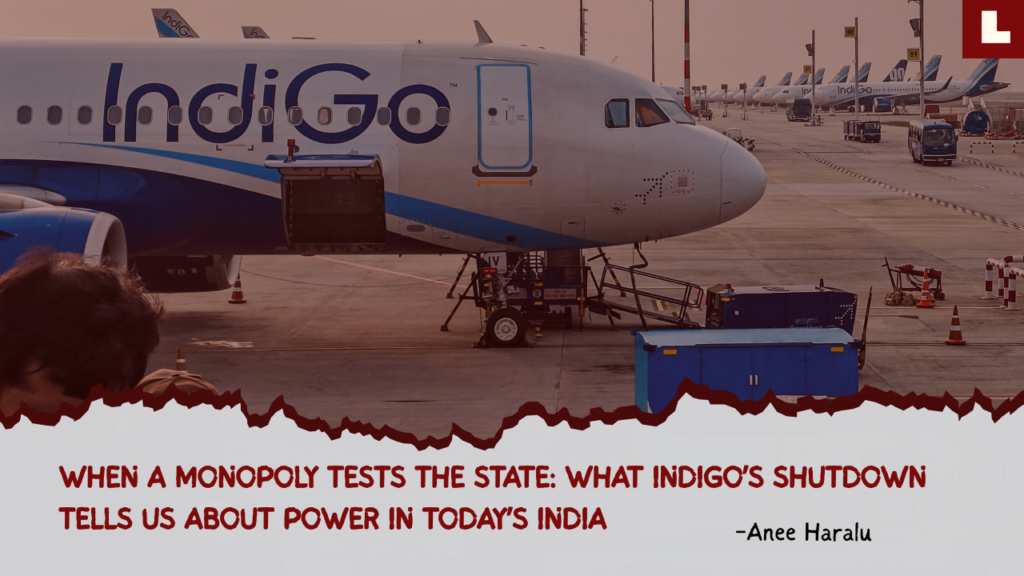

IndiGo did not run out of planes or fuel in the first week of December. It ran out of room to defy a safety rule. The new pilot fatigue limits came into force on 1 November. The rule was simple. Fewer night landings per week. Mandatory weekly rest. IndiGo knew that its night-heavy schedule could not survive this without a redesign. The airline chose not to redesign. It kept selling tickets for flights that could not legally take off. When the law collided with the timetable, India’s aviation grid broke. More than one thousand IndiGo flights were cancelled in four days. Entire days passed when Delhi airport saw almost no IndiGo departures. At the peak on 5 December, close to half of IndiGo’s daily schedule was gone. Thousands slept in terminals. People trying to reach surgery dates, visas, exams, funerals and international connections were stranded because a company did not want to adjust to the law.
This was not caused by fog or weather. It was caused by dominance. IndiGo controls the majority of India’s domestic air traffic. When a carrier that size collapses, the grid collapses. India has designed aviation around a single point of failure. When that point failed, mobility across the country snapped. Passengers could not move laterally through the system because every major city is connected more heavily to IndiGo than to any other airline. The dependence that looked like efficiency in normal times turned into paralysis the moment the dominant carrier refused to adjust to the law. And honestly, this collapse should not have surprised anyone who has watched how aviation policy has evolved.
The regulatory retreat that followed revealed how power works in today’s economy. IndiGo’s board includes former regulators, safety specialists and corporate governance names. If any board in Indian aviation should have anticipated an operational shock, it was this one. Yet the crisis was allowed to quietly gather energy. When the cancellations became impossible to hide, the regulator stepped in. Not to enforce the rule, but to loosen it. The Directorate General of Civil Aviation suspended critical portions of the fatigue-protection framework to help IndiGo get aircraft back in the air. The Ministry capped fares, ordered refunds and created a committee to investigate the airline’s planning failures. DGCA even offered its own flight operations inspectors, who are licensed pilots, to help fly IndiGo aircraft. The sequence tells the whole story. The state wrote a safety rule. A dominant airline did not comply. The public suffered. The rule was softened. A confident regulator does not behave like this.
There is a reason this did not feel new to many young Indians. For the last decade, monopoly has been marketed as development. It did not always sound sinister. Many people accepted it because it made life easier. Airports under one group. Telecom under one group. Payments under one group. Everything “integrated,” everything “streamlined.” It all looked neat from the outside. In the language of policy, dependence was rebranded as national strength. IndiGo’s shutdown exposes the fine print of that promise. A system that works smoothly only while the giant cooperates has no protection when the giant decides not to.
The economic architecture of the last decade rests on this logic. Public policy has consistently encouraged sectors to organise around one or two “trusted” conglomerates. Ports and airports increasingly around Adani. Telecom and retail increasingly around Ambani. Dominance has been treated as a virtue. The message delivered by the state is simple. If a company builds enough control over the grid, it becomes too important to regulate strictly. Policy will bend to keep it upright. IndiGo did not need to be Adani or Ambani to behave like a monopoly. It only needed the permission structure to exist.
The playbook is older than India. In the 1880s United States of America, railway barons controlled the country’s freight arteries. When state governments tried to regulate rates and safety, the barons retaliated by choking the flow of goods. Shipments were blocked or rerouted. The goal was to make regulation more painful than surrender. William H. Vanderbilt expressed the philosophy without shame: the public be damned. The backlash forced Congress to create the Interstate Commerce Commission to ensure private control of a critical network could not be used to punish the public when the law did not suit corporate interests.
Also Read: Reels, Elopements, and the Crossroads of Freedom in Assam
Shutdown as leverage first belonged to labour. In 1877 and 1894 in the United States of America, railway workers halted freight and passenger movement until governments intervened. In India in 1974, 1.7 million railway workers shut the entire system for twenty days to demand better conditions and pay. The logic was the same across countries. Stop the infrastructure to force the state to respond. What has changed today is the side using the tactic. Shutdown has migrated from labour to monopoly capital. The weapon that once confronted corporations now protects corporate power against regulation.
Seen on its own, IndiGo looks like an operational crisis. But in the political economy surrounding it, IndiGo looks like a stress test. If a dominant airline can make safety rules negotiable by triggering national chaos, then every dominant sector can attempt the same. A new pattern appears. Compliance becomes optional. Disruption becomes leverage. Public inconvenience becomes the currency of negotiation.
This is not about personalities or rivalries. It is about structure. Adani influences the state because ports, airports, coal and power cannot be allowed to stop. Ambani influences the state because telecom, retail and payments cannot be allowed to stop. IndiGo influences the state because air mobility cannot be allowed to stop. The sectors are different, but the logic is identical. The public will bear the pain long before the dominant company does. That makes the state bend first.
This is not a warning about airlines. It is a warning about citizenship. Safety rules exist because individual passengers cannot negotiate with corporations. Regulation exists because the law must defend the many against the few. When the government cannot enforce safety rules without risking a national shutdown, democratic authority weakens. Citizens turn into spectators while ministries and corporations negotiate under the pressure of disruption.
Also Read: Not Yours to Wear, Not Yours to Mourn
If disruption works, it will spread. The next shutdown will involve a sector that the country cannot afford to lose, even for an hour. Ports. Power. Telecom. Digital payments. If the state continues to build systems around private chokepoints instead of public resilience, every confrontation will turn into a bargain between a government and a monopoly. The public will never be at the table.
The danger is not corporate size. The danger is a political economy in which the state cannot apply laws to large companies without risking national paralysis. When that becomes normal, monopolies do not need lobbying strength. They only need the ability to switch a sector off. Power flows to whoever can stop the country fastest.
IndiGo exposed the weak point. The state has one opportunity to repair it. If it does not, the next confrontation will happen in a sector even more essential, and the stakes will not be about flight schedules or refunds. The stakes will be whether democracy still governs the infrastructure holding the country together.