Discourses From the East
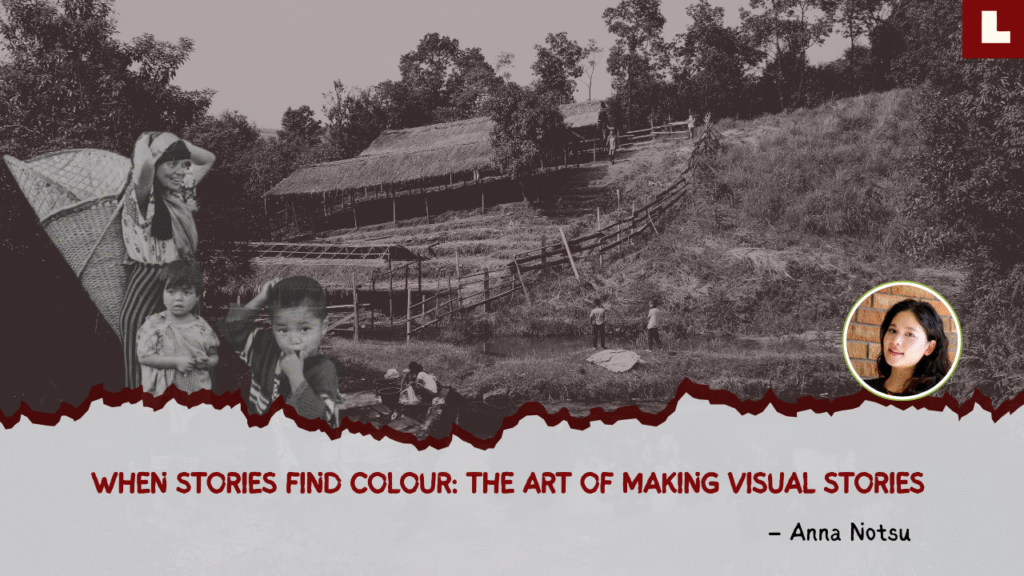

In India, as in many parts of the world, classroom teaching often remains a one-way process: teachers instruct, students listen. Even in art classes, children are told what to draw and how to do it. But what happens when they are asked to draw freely — to imagine without instruction?
At the beginning of February 2025, when their school holidays were coming to an end, over twenty Biate schoolchildren gathered in a classroom in Saipung village in eastern Meghalaya, ready to draw. This time, however, they were to listen not to teachers but to their own stories – stories they had collected from their parents, neighbours and elders in their own language, Biate. And this became a story about making a visual story.
On the morning of the drawing workshop, February 6, 2025, the house felt different. “You have a programme today, you should eat well,” said my Biate sister, noticing my nervous face. Saipung is the largest village of the Biate community in Meghalaya. I had been living with a large extended family that I now call my Biate family, dining and doing everyday routines together as if I were an additional family member. That day, still early in the morning, my little Biate sisters and brothers were already up, waiting for me to take them to the nearby school – the venue of the drawing workshop.
The classroom, unused since the last day of school two months earlier, was dark, dusty and dingy. Crumpled papers and old pencils lay scattered across the bare concrete floor, veiled in sand and cobwebs. Without my asking, a few neighbourhood children arrived with brooms and dustpans. Together we swept the floor and rearranged desks and benches, turning the classroom into a makeshift art studio.
Although the drawing workshop was scheduled for 11 a.m., no one – except those who had helped clean – arrived on time. What if no one came? Looking at the neatly arranged drawing materials on the tables in an empty classroom and the children laughing in anticipation, the thought that all these efforts might be in vain crept through my body. Even if some came later, would they be able to make any drawings in the short time we had?
Gradually, as if to reassure me, though shyly, more participants began to appear. By afternoon, over twenty schoolchildren of different ages, some even from outside Saipung, had turned up. But there was little time for me to savour this relief. The real challenge lay in the selected stories: they had to be read aloud for these children to draw, yet they existed in Biate and had been only quickly translated into English.
At my first attempt to read one of them, “Family and the Nathial Plant”, I felt nothing but sheer embarrassment. When I looked up at the end, I was met with silence and confusion. No one in the room quite understood the story, nor were they able to follow what I was saying. “Did you understand the story?” I asked, already knowing the answer. Silence. Not knowing what else to do, I asked, “Do you know the nathial plant?” Some nodded; others remained quiet. How are we ever going to make drawings like this? I thought to myself.
At that moment of despair, my friend, Benjamin, walked in: “Good afternoon, everyone! Hey sis, how is it going?” A teacher at a local school in Saipung, known for his friendly demeanour, he immediately took the original Biate text – the version that I could not read – and began, “Sangramhei Neh Nathial-Kung.”
Benjamin’s clear voice echoed through the soundless classroom. The children remained quiet, but this time, their faces were attentive, listening to and interpreting the presented story. When he finished, the silence lingered briefly before giving way to murmurs, then lively chatter. The voices grew louder as they began to discuss the story among themselves – and to paint it.
I could feel their seriousness. Many of them grabbed pencils first, making rough sketches before touching brand-new paints that they had been so excited about. Thin lines, erasures, more lines – they struggled with the pressure to produce “good drawings”.
They, too, were nervous. Accustomed to an education system where everything is demonstrated for them, they rarely had opportunities to freely draw something, without having to look at model images. Now they had to think about the story they had just heard, decide on a scene and express it through their own imagination. Had I asked them to draw a mountain or an apple, it might have been easier. But by not instructing them on how or what to draw, I had asked them to take ownership of the act of visualising the story.
Hours passed. Many still repeated the process of pencil sketching and erasing. Younger ones grew restless and frustrated; some started a playful paint fight; others asked for help; more children gathered just to watch. The classroom began to rattle as they struggled with the given freedom and the pressure to draw well.
Then, suddenly, popular music poured from the speaker that Benjamin had brought. Neighbours drifted in, some with their babies on their backs, to watch over the children participating in the drawing workshop. My Biate brothers and sisters also peeked in now and then. Just as I began to feel a flood of comfort numbing my tensed body, the children also began to fill white pages with colour.
Some divided the paper into four panels to show a change of scene, while others used the entire paper to paint the hills of Saipung. Two best friends painted the same scene differently. Most of them made more than one drawing. At the back of the classroom, a group of teenage boys, all in hoodies, worked in focused silence, each portraying a dedicated scene: a Biate bamboo house, traditional Biate attire, a man cutting the stem of the nathial plant. These drawings were not simply illustrations – they were interpretations, ways of thinking through the act of making a visual story.
With climate change, intensive logging and pollution from nearby coke factories, the environment in and around Saipung was changing alongside external factors. From time to time, people voiced their concern that they would one day run out of firewood – essential for their beloved hearth, the ritap, where stories were exchanged.
By collecting stories and drawing them, the schoolchildren visually narrated the story of their own environment, not only in their own language but through their art. In Meghalaya, a state known for its matrilineal traditions, the Biate community stands out for its patrilineality, distinct way of life, language, food and architecture. ‘We, the Biate, are one of a kind,’ my Biate brother often told me proudly. Through the children’s drawings, folkloric elements and visual storytelling are intertwined in unexpected and moving ways.
Now, the gathered stories and paintings are about to take on another step: making the first-ever Biate children’s book. Yet beyond the prospect of a book, what remains most vivid is that afternoon in the classroom – the shy laughter, background music, the moment the stories find their own colours. The children, who had previously waited to be told what to draw, began to listen differently – not to a teacher’s instruction, but to the rhythm of a story in their own tongue, to the shape of their own remembering.
The courage to draw from one’s own world is a subtle yet powerful act. It bridges the past and present, memory and imagination, and the telling and the seeing. In this process, the art of making visual stories becomes more than a creative exercise: it becomes a way of recognising relations – between people and plants, between families and landscapes, between story and storyteller. In the hands of these children, storytelling is not only ‘preserved’ – it is transformed, made contemporary, bridged to the future.
And as the Biate children’s book took form, I find myself returning to that unassuming beginning: a dusty classroom, stacks of blank paper, groups of children learning – perhaps for the first time – that their stories are not only worth telling, but worth seeing. Their drawings mark the start of something larger: a future in which Biate stories, language and ways of imagining the world can travel, be shared and be held.
At this workshop, I was neither a teacher, an instructor or a foreign researcher.
We called this project the Kîrzâi Project, meaning “returning.” Each story, each drawing, has now found its way home.
The forthcoming Biate picture book Khâmnu Khah A Vâr Im? (Is She Wise?) will be officially launched at the Shillong Literary Festival 2025. The publication of this book has been supported by the Delta on the Move Foundation and the Sauramandala Foundation.
Sauramandala Foundation is running a fundraising campaign to support the printing and distribution of Khâmnu Khah A Vâr Im? (Is She Wise?). We would like to bring the book back to the Biate community and celebrate its launch ceremony at the annual Nul-Ding Kût festival in January 2026.