Discourses From the East
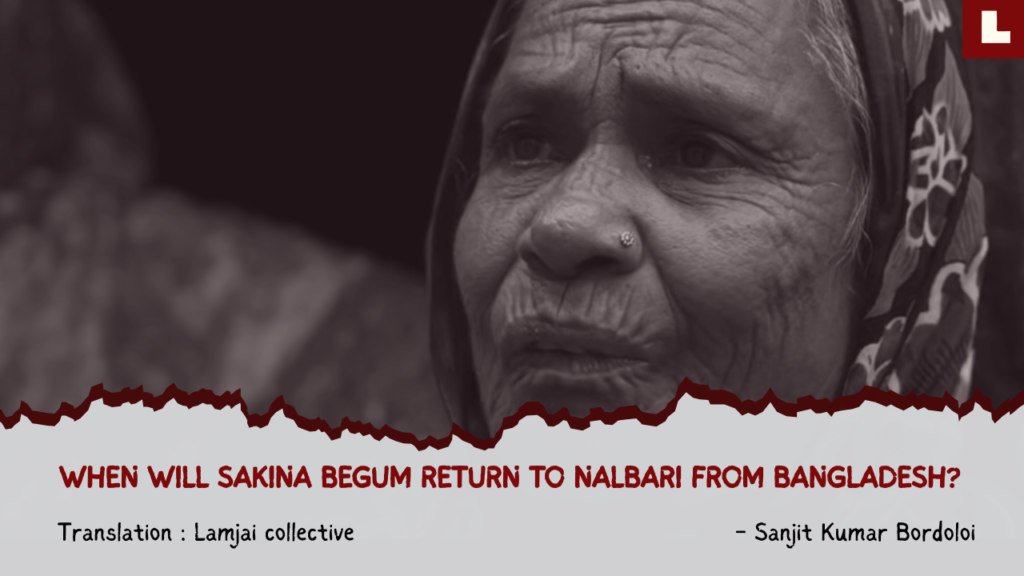

A 68-year-old woman. Sakina Begum. Her home is in Na’para, Haripur village near Nalbari town. Her father, Makbil Ali’s name appeared in the 1970 voter roll. Her name appeared in the 2005, 2011, and 2018 voter lists. Yet in 2012, because she did not have the “proper papers” in hand, Sakina Begum was declared a foreigner. From 2016 she was kept in the detention camp in Kokrajhar. In 2019 she received bail from the Supreme Court and was released, on the condition that she report regularly to her local police station.
On 25 May this year, her family learned that she had gone to the Nalbari police station to report. After that all contact stopped. She had vanished. Inquiries later revealed that on 26 May she had been handed over to the Border Security Force (BSF) in Panbari, Dhubri. At that time the Assam government was taking strict action on the deportation of “foreigners,” preparing to send more than a thousand Bangladeshi citizens without documents across the border. The unfortunate Sakina Begum was swept into that process.
Her family knew nothing. They did not know if she was alive or dead, or where she might be. Treated as a foreigner, the BSF pushed her into Bangladesh.
A woman named Jakia, 40 years old, living in the Bhashantek area of Bangladesh, found Sakina Begum in a helpless condition and brought her into her home. Through mobile video calls she connected Sakina with her family in Nalbari. The BBC Bangla learned of the situation and when they reported it, the case finally received attention. Shortly after, on 25 September, the Bangladesh authorities filed a case saying that Sakina Begum had entered the country without passport or visa, and she was arrested and imprisoned. Jakia applied for bail on her behalf three times and three times the Dhaka court rejected the appeal.
An ordinary domestic worker, spending her own savings to fight a legal battle for an elderly stranger from across the border, and offering her shelter until she can return home, shows a simple humanity. Only someone who has lived in poverty and helplessness can fully understand the pain of another in the same condition.
This case has been discussed nationally and internationally. In Assam, however, the expected outcry has been absent. The silence speaks for itself. Sakina Begum is Muslim and she is poor. Anyone who has watched the BBC news clips can tell she is not an “illegal Bangladeshi.” Her speech is the Kamrupi dialect of Nalbari, not Sylheti or Bengali. She is known to be from the Goriya community. Poverty likely meant she did not always have documents available. Since 2012, how much harassment has this elderly woman endured, and yet in Assam there has been no strong and consistent voice in her defence. What could be more tragic?
Sakina Begum’s story reminds me of a piece of writing by Homen Borgohain. In 1974, he wrote an article titled “An Open Letter to Hamida Khatun” at the height of the Dhubri famine. Relief camps were full, and people were dying slowly, crying out for a morsel of food. Hamida Khatun’s two children starved to death in front of her. Her husband, unable to bear the loss, lost his mind and disappeared. For seven days Hamida stayed alive on boiled banana stem, lying in the mud of the camp, coughing and barely conscious. Borgohain wrote after witnessing her condition:
“To describe this tragedy, I could have used intense emotional and dramatic language, because I am known to have some command over Assamese prose. But to use ornamentation while describing the indescribable misfortune of your life would be a sin.”
He then wrote:
“Hamida, you will not live to read this letter of mine. By now, the last remnants of your famine-worn body must have found place in the bellies of crows and vultures.”
From Hamida Khatun to Sakina Begum, half a century has passed, yet the shape of misfortune has not changed. A woman pushed to the edge, a state that looks away, and a society that remembers too late.
Meanwhile in Bangladesh, Jakia’s latest appeal for Sakina’a bail has finally been accepted. Now the question remains. Will this 68-year-old woman be able to return from Bangladesh to her home in Nalbari and spend the rest of her days with her family?