Discourses From the East
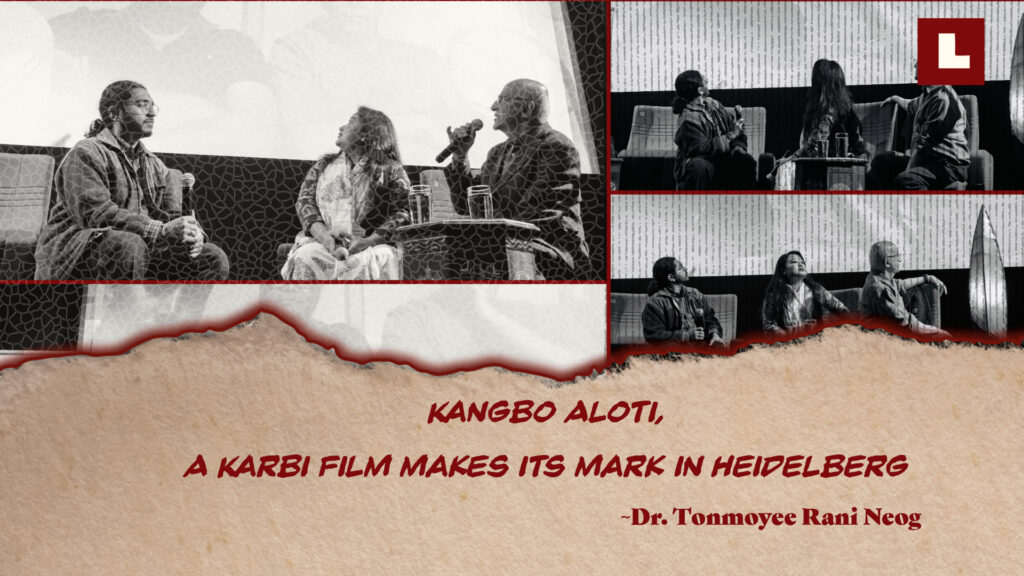

In Heidelberg, a Karbi-language film from Assam held a full theatre in silence. People had watched a story Kangbo Aloti (The Lost Path) from the hills of Karbi Anglong, spoken in a language none of them know, and yet they understood it. The global audience understood the fear in the eyes of a young man and the weight of the silence of a teacher. They could relate to the ache of a community living with violence, memory and uncertain futures.
Kangbo Aloti, directed by Khanjan Kishore Nath, was screened at the heARTblicke international film festival on 17 October. The festival had chosen it as its opening film. Its theme this year was “Stories Tell Us.” The film was shown at the Karlstorkino, a cinema that has long supported independent and politically engaged cinema. For a Karbi film to open an international festival in Germany is itself a statement. It is a matter of who gets to be heard, and where.
heARTblicke is a Germany -based film and cultural initiative that uses cinema, conversation, and community storytelling to explore experiences of crisis, migration, inequality, and social justice. Its 2026 Film Days, held under the theme ‘Stories Tell Us,’ brought together films from India, Tunisia, Egypt, the United States, and Germany. The programme opened with Khanjan Kishore Nath’s Indian film Kangbo Aloti (The Lost Path), followed by Leyla Bouzid’s Tunisian family film À voix basse (In a Whisper), Rania Stephan’s Egyptian tribute The Three Disappearances of Soad Hosni, Ambalika Khadria’s U.S. film 49 to 51, and Debarun Dutta’s Berlin-set The Delivery Guy. The festival closed with Samir Nasr’s Egyptian prison drama Sharaf, while locally made audio stories and short documentaries by Heidelberg residents connected these international works to everyday experiences in the city. Through its screenings, discussions, and workshops, heARTblicke presented cinema as a way to make hidden stories visible and encourage empathy and dialogue.
Kangbo Aloti crossed linguistic and geographical borders without asking its viewers to give up what made it distinct. It brought the realities of Karbi Anglong before a global audience. It allowed viewers to recognise emotions and dilemmas that felt familiar across borders. Kangbo Aloti had already been shown at the Kolkata International Film Festival, the Bengaluru International Film Festival and the Indian Film Festival of Stuttgart, where it won Best Feature Film. Its distribution rights were acquired by the London-based UK China Film Collab at Cannes in 2025. Yet, when it began its commercial release in Karbi Anglong on 17 October, much of the rest of Assam had still not seen it.
Kangbo Aloti follows Longsing, played by Harmony Bey. He is a young militant sent undercover to a village in Karbi Anglong. His task is to gather information and recruit support for an armed group. He must remain unnoticed. In the village, he meets Birensing, a teacher whose presence complicates his assignment. Birensing represents the possibility of education and a life not governed by fear. But the film refuses to make him a simple moral hero and does not portray him as a saint who rescues a confused young man. Instead, it asks a harder question. What conditions push a young person towards an armed militant group in the first place?
The answer is scarce schooling, unemployment and the pressure of organisations that claim to represent the community while demanding loyalty from its sons. There is the long history of political neglect too. The choice of Longsing or anyone else in the village to join an armed group is shaped by history, poverty, fear and the limited freedom available to them. This is where the film becomes powerful. It shows how political violence enters ordinary life: in a classroom, in a conversation between neighbours and in the hesitation before an answer and in the silence of a parent who cannot say what they fear.
The film is 108 minutes long. It is made in Karbi and has no songs. Kangbo Aloti asks viewers to watch it differently. It asks them to notice how a pause becomes an argument and a withdrawn hand becomes a sign of distrust.
The screening was followed by the panel discussion, “Histories of the Unresolved.” It brought together director Khanjan Kishore Nath; activist and writer Dr Harsh Mander; researcher and writer Dr Tonmoyee Rani Neog; and moderator Ayon Mukherjee. The conversation moved from the film to the longer history of land, autonomy and the unfinished political settlements of the postcolonial India. The panel treated the movie as a work of art that had opened an intriguing conversation.
Dr Neog asked Nath why he had made a film in Karbi when he does not speak the language natively. His answer described a method. Without fluency in the Karbi language, he relied on what could be seen and staged: landscape, physical space, silence, and the way people move and touch one another. He did not need characters to explain their politics in dialogue, and the film is stronger for it. The discipline was forced on him by distance, but it also makes the film’s political claims more credible. A village shows its condition in how people walk, wait, and avoid one another. This is an artistic lesson worth remembering. Indian cinema often mistakes dialogue for depth. Characters explain their feelings. Kangbo Aloti suggests another way. When a filmmaker cannot lean on a familiar language, the image must carry more weight. The result is a film that feels restrained but deeply felt. It allows the audience to arrive at emotion themselves. That is perhaps why people in Heidelberg responded so strongly to Kangbo Aloti.
State control runs through the film though very subtly. One of the strongest parts of the panel discussion concerned was state control through militarisation. Dr Mander spoke about state control as an everyday condition in most parts of Northeast India. It is present in check posts on ordinary roads and in convoys moving through villages on normal days. This is how control works. Sometimes it enters through habit. People learn to plan their lives around the possibility of danger.
The film captures this psychological condition without turning it into spectacle. It does not show violence for the sake of shock. It shows the anticipation of violence and how fear becomes part of the landscape. Mukherjee added that for communities living under prolonged militarisation, the state control is already present in movement, speech and memory. The everyday becomes political because the everyday has been militarised. This idea cannot be understood only through policy documents. It needs art and stories. It needs films like Kangbo Aloti that can show what it feels like to live with uncertainty every day.
The panel also spoke about the Armed Forces (Special Powers) Act, or AFSPA. The law applies differently across states and districts, but its shadow extends across much of Northeast India. AFSPA grants extraordinary powers to the armed forces, with limited accountability. It sustains a political order in which security is often placed above civilian rights. For many communities, it has taught a hard lesson that the Indian state can enter their lives with exceptional force, and there may be little consequence.
The Northeast is often discussed as a collection of separate administrative problems. Each state has its own insurgency, ceasefire, development scheme or political dispute. But AFSPA has helped create a shared condition. It has shaped how generations understand citizenship, belonging and power. This is why Kangbo Aloti matters beyond Karbi Anglong. It is a Karbi film, but its questions are not only Karbi questions. They are questions about dignity, representation and the right to live without fear.
The hill districts carry a long inheritance of unkept promises. This history cannot be reduced to a list of grievances. It concerns the repeated failure of the Indian state, and often of mainstream Assamese political culture, to honour commitments around autonomy, land, identity and political representation. Militant politics cannot be understood apart from this history. Insurgency grows in soil prepared by neglect, betrayal and the repeated denial of dignity.
The most forceful question raised during the panel was simple: who owns the land and who gets to decide this? Land is territory. But it is also ancestry. It is livelihood but also memory. It is burial ground but also belonging. To ask who owns the land is to ask who has the authority to define belonging. It is to ask who decides whose history counts. It is to ask who is allowed to remain rooted in a place, and who is treated as an outsider in their own home. These questions require a political settlement that takes indigenous autonomy seriously. They require the Indian state to stop treating autonomy as an obstacle to administration. Kangbo Aloti does not claim to have answers. But it makes the human cost of an unresolved question visible.
Films from Northeast India often remain confined to festivals, small halls or specialist audiences. They are praised as “regional cinema,” then quietly left outside the mainstream. It suggests that these films belong to a smaller India, while Hindi cinema belongs to everyone. But Karbi, Mizo, Bodo, Meitei, Assamese, Khasi, Nyishi and other languages are living languages. They carry memory, grief, land and belonging. When films in these languages are denied proper distribution, promotion and exhibition, India loses ways of seeing itself.
Indian public culture often treats the Northeast as distant, troubled or exotic. The region appears in national conversation mainly through insurgency, border security, or natural disasters. Its people are asked to explain themselves before they are allowed simply to tell stories. A film like Kangbo Aloti refuses that demand. Neither does it turn Karbi life into folklore or ask for sympathy by presenting its characters as helpless victims. It shows a young man caught between ideology and conscience. It shows villages living with checkpoints, armed authority and the memory of violence. It is difficult, strange, and artistic on its own terms.
After the Heidelberg screening, the panel was joined online by producer Ranjit Teron, Editor Sersumbi Terang and actor Harmony Bey. An audience member asked Bey what had drawn him to Longsing. Had he grown up amid the militant history of Karbi Anglong? Had he heard stories from elders? Bey answered that he had not lived those events. He had not witnessed that violence. What compelled him was the desire to know a past that had been handed down in fragments and silence. He inhabited Longsing through the script and his imagination. He was drawn to a history he had not witnessed, but felt he could not ignore.
This is an important truth about memory. It does not belong only to those who lived through an event. It also rests, often heavily, on those who inherit its consequences.
Bey’s Longsing is therefore an act of imaginative recovery. The actor reaches towards a past that remains unfinished. He asks what it might feel like to carry an ideology before discovering its human cost. In this sense, the film becomes a meditation on how history continues to shape those born after it. It shapes them through inherited fear, silence and unanswered questions.
India needs to stop treating cinema from the Northeast as a regional curiosity. It needs to fund it, exhibit it, preserve it and argue with it. It also means listening. A film from a hill district in Assam should not have to cross continents to prove that it matters. It should be able to speak at home, in its own voice, and be heard.
The lost path in Nath’s title is not only Longsing’s. It is also the path Indian public culture has failed to take: towards a cinema, and a politics, that can hear the periphery on its own terms. Until that happens, films like Kangbo Aloti will continue to find warmer audiences abroad than at home. And India will keep losing the chance to understand itself more fully.
Picture Credits: Muhammed