
Discourses From the East
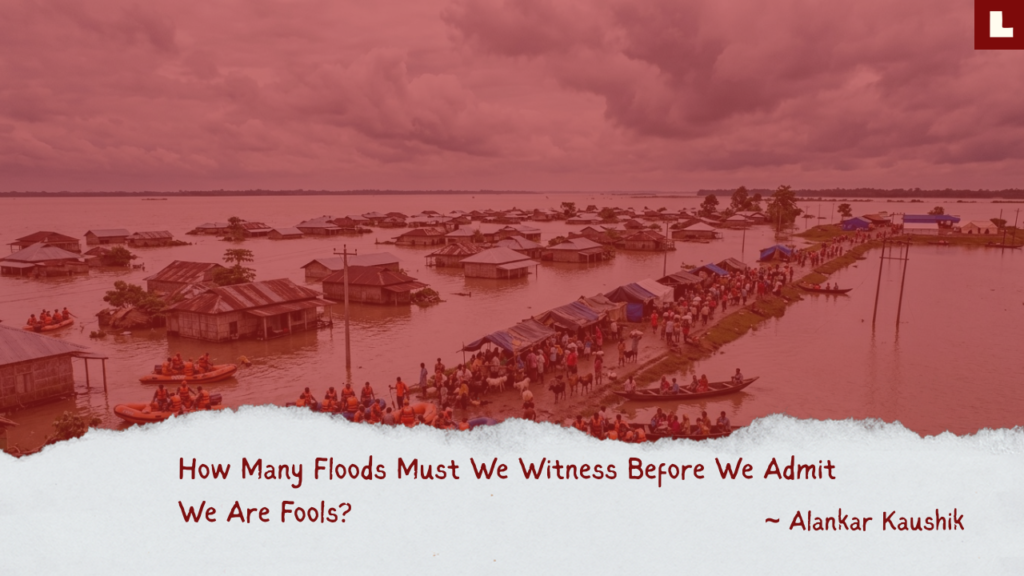

Every monsoon in Assam follows the same script. The rivers swell. Embankments breach. Villages vanish under water. Relief camps fill. Livestock are rescued, crops are lost, roads dissolve into silt. Then, after some weeks, the water recedes, the compensation is announced, the embankments are patched, and the state exhales until next year, when the script repeats almost exactly.
The extraordinary has become routine. And a routine catastrophe should trouble us more, not less, than a sudden one, because it means we have had every opportunity to learn and have chosen, year after year, not to.
So the honest question is not why does Assam flood? We know why. The honest question is: how many floods must we witness before we admit we are fools?
This is not an accusation against the people who live with the water. Farmers in Golaghat, families in Sivasagar, communities across Charaideo and Jorhat have shown a depth of practical knowledge about rivers and survival that no policy document can match. The foolishness in question belongs to those of us planners, industries, governments, and citizens at a safe remove, who watch the same disaster occur and continue to reproduce the exact conditions that turn a flood into a catastrophe.
When “natural” becomes an alibi
Rain is natural. Rivers are natural. The monsoon is natural. But a flood becoming a catastrophe killing people, erasing villages that never used to flood, displacing hundreds of thousands in a single season is not a fact of weather. It is a fact of land use.
Assam’s forests have been extracted for more than a century, first for colonial tea and timber, then for coal and oil. Its wetlands, which once absorbed and slowed the tributaries the way a body absorbs shock, have been drained, encroached upon, and paved. Its embankments, built to fight the river rather than accommodate it, have aged past protection while unregulated mining upstream keeps loading them with sediment. None of this is secret. Every disaster report names it in the same apologetic clause: “unplanned development.”
Calling the flood a “natural disaster” is convenient because it lets responsibility evaporate with the clouds. The rain becomes the villain, the river becomes an antagonist, geography becomes destiny and nobody has to answer for a lost wetland or a mining lease. But once we ask why the wetlands disappeared, why settlements were permitted onto active floodplains, why embankments keep failing in the same places, and whose profit these transformations served, the flood stops being natural and becomes political. It becomes the result of decisions. And decisions, unlike rain, can be changed.
The rift beneath the water
John Bellamy Foster’s concept of the metabolic rift describes exactly this mechanism: a mode of production that treats nature as an inexhaustible reservoir for extraction while ignoring its capacity always finite to regenerate and absorb shock. Assam’s landscape is a textbook case. The forest becomes timber. The hill becomes a mining site. The wetland becomes “unused” land, then real estate. The river becomes either an energy source or an obstacle to be controlled. In each case, the ecological function of the system its role in absorbing water, filtering sediment, buffering excess disappears from the ledger until disaster makes its absence impossible to deny.
The flood is usually described as nature’s failure. It would be more accurate to call it the success of a system that never accounted for nature to begin with. The river is not taking revenge. It is simply doing, in the only way physics allows, what a landscape stripped of its buffers will always eventually do.
The politics disguised as resilience
There is a specific kind of foolishness in doing the same thing every year and expecting a different outcome. We declare emergencies, distribute relief, repair embankments, and speak solemnly of resilience and then wait for the same rivers to rise into the same unprotected villages twelve months later.
At what point does repetition become policy by default? At what point does “preparedness” quietly become an admission that disaster has been accepted as permanent?
“Resilience” deserves particular scrutiny here. It is a legitimate concept when it names a community’s capacity to recover. It becomes dangerous when it substitutes for prevention, when the same populations are asked, year after year, to demonstrate resilience while the structures that manufacture their vulnerability go untouched. We praise the resilient farmer, the resilient child, the resilient village. We rarely ask why they are being forced, on an annual basis, to prove it.
Trauma does not recede with the water
The deepest failure in how floods are discussed is that we measure them only by their visible peak, the submerged house, the rescue boat, the body count and consider the story finished when the water goes down. But trauma does not follow the hydrological cycle. A farmer who loses a season’s harvest does not recover when the field dries. A child whose schooling is repeatedly interrupted does not simply resume where she left off. A family that has been displaced once does not regain, on schedule, its sense of belonging to a place.
Assam is no longer only a place where floods happen; it is becoming a place where floods are anticipated. Heavy rain becomes a warning sound. A rising river becomes a source of dread before it becomes a threat. The flood enters the imagination well before it enters the house.
This anxiety compounds with Assam’s other geological inheritance. The region sits in the country’s highest seismic zone, still carrying the memory of the 1950 earthquake that rerouted the Brahmaputra itself, and it continues to register tremors with unsettling regularity. A flood teaches people to fear water. Recurring tremors teach them to fear the ground. Together they erode something more fundamental than either hazard alone: trust in place itself. What does home mean once the wall might collapse, the embankment might break, the river might rise, and the earth might shake, all in the same uncertain landscape? Ecological damage of this kind cannot be counted only in hectares and rupees. There is a psychological ecology too, a relationship between people and the ground beneath them, and the rift running through Assam’s forests and rivers runs through its bodies and minds with equal force.
Who profits, who absorbs the risk
Assam has long supplied the wider economy with tea, oil, coal, and timber resources whose value travels outward while the ecological cost stays behind. This is the familiar pattern of environmental injustice: benefit is distributed widely; risk is concentrated locally. Those who profit from extraction are rarely those who live downstream of its consequences, and those who bear the consequences are rarely the ones with either the capital or the political access to demand a different arrangement. This makes the flood a story about class and power as much as about rainfall. Who decides where a city expands onto a floodplain? Who decides which wetland can be filled and which mining lease approved? Who is compensated when an embankment fails, and who is left to rebuild alone?
Living with the river instead of imprisoning it
For decades the dominant response has been engineering as conquest: build the embankment, strengthen it, repair it, build another. But a river is not a pipeline. It moves, deposits sediment, floods, and changes course as a matter of course, not malfunction. Trying to permanently cage a river tends to produce short-term protection and long-term fragility: higher, more brittle walls holding back a more pressurised channel, until the failure, when it comes, is larger.
The alternative is not to surrender to the water. It is intelligence about it: restoring wetlands, protecting catchment forests, regulating mining that loads rivers with sediment, rethinking settlement on active floodplains, and investing in early-warning systems and genuine seismic retrofitting at the scale the risk actually demands. The question that matters is not “how do we control the flood?” but “how do we dismantle the conditions that turn water into catastrophe?” That is a different, harder, and more honest question.
From relief to justice
Relief is necessary, but it is not justice. Rescue is necessary, but it is not prevention. Compensation is necessary, but it cannot substitute for ecological restoration. If the same communities are rescued from the same waters every single year, the problem is no longer that they need better rescue. The problem is that we have never seriously asked why they keep needing to be rescued at all.
The water will recede. It always does. What matters is what we do in the months it leaves us. Rebuild in the same vulnerable places, and wait. Or finally treat the flood as what it is not a verdict of geography, but the accumulated result of choices that remain, even now, ours to change.
The river has been speaking for years. The only open question left is whether we are finally prepared to listen.







Resourceful article.