
Discourses From the East
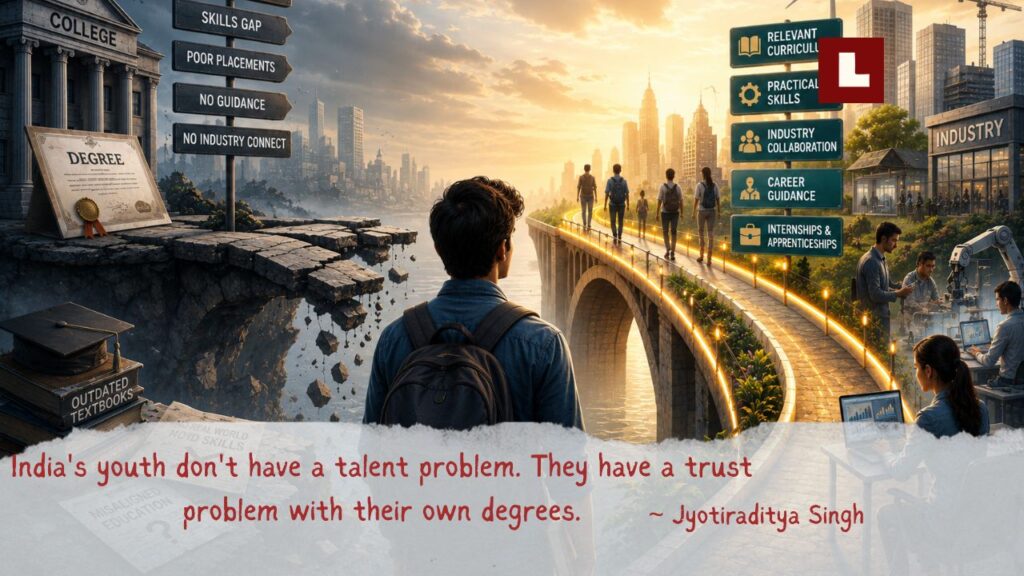

Every year, roughly fifteen million young Indians walk out of colleges and universities with a certificate in hand and a plan in their head. Most of those plans fall apart within months. Not because these young people lack ambition or intelligence, but because what they were taught and what the country actually needs from them belong to two different eras.
Walk into any campus placement cell and you will hear the same complaint dressed up in different words. Companies say graduates cannot write a clear email, cannot debug a simple problem, cannot hold a client call without a script. Graduates say they were never told any of this mattered until it was too late to fix. Both sides are right, and that is exactly the problem. Nobody built a bridge between the classroom and the cubicle, so an entire generation is left swimming across on its own.
The numbers make the gap impossible to ignore. India adds close to a crore of young people to its working age population every year, yet a large share of engineering and commerce graduates are considered unfit for the roles their own degrees promise them. Meanwhile sectors like renewable energy, healthcare support, logistics and skilled trades are short of workers. The mismatch is not about too many people chasing too few jobs. It is about the wrong people being trained for the wrong jobs, at scale, year after year, by a system that has not paused to ask if any of this still works.
Part of the blame sits with a curriculum that was frozen somewhere around the early 2000s and never quite thawed. Textbooks still teach theory that has little contact with how modern workplaces actually function. A commerce student can graduate without ever touching a spreadsheet formula used in a real finance job. An engineering student can finish four years without writing a single line of code that solves an actual business problem. Colleges keep producing what they know how to produce, regardless of whether the market still wants it.
But there is a quieter failure too, one that gets less attention. Career guidance in most Indian schools and colleges is close to nonexistent. A sixteen-year-old is asked to choose between science, commerce and arts based on family pressure, peer choices or vague notions of prestige, not on any real sense of where the world of work is heading. By the time reality arrives, three or four years and a considerable amount of money have already been spent on a path that leads nowhere useful.
The good news, and there is real good news here, is that fixing this does not require reinventing the entire education system overnight. It requires honesty first. Colleges need to publish real placement data instead of polished numbers designed to attract the next batch of applicants. Industry bodies need to sit at the table when curriculums are written, not just when hiring season begins. States that have started weaving vocational training and apprenticeships into regular degree programmes are already seeing sharper outcomes, and that model deserves to travel faster than it currently is.
Young Indians themselves are not waiting around either. A growing number are skipping the traditional four-year route altogether, picking up certifications in data analysis, design or digital marketing that take months instead of years and connect far more directly to a paycheck. This is not a rejection of education. It is young people doing the alignment that institutions refused to do for them.
India’s youth are not the problem. A system that trained them for a world that no longer exists is. Close that gap, and the same energy currently spent job hunting in frustration could power one of the most productive workforces the world has ever seen.
Author’s Bio:
Jyotiraditya Singh is a youth issues advocate, public speaker and political communicator from Jharkhand. He began engaging with youth issues at the age of 17 and has since worked on conversations around education, employment, skills, opportunities and youth participation in public life.






What a insightful article thanks a lot jyotiraditya , I have shared to most of my friends and groups.
I like how well you articulate your thoughts on education and employment gap
This is so true in India the Gao between employment and education is a far battle zone .
Thanks lamjai media I will start reading everyday article from your website. And thanks Jyotiraditya