Discourses From the East

Keep track of the errors of our forgetfulness; the fog steals our children while we sleep.
Flowers of rage spring up in the depression. Monsters are born there of nuclear anger.
Trees of ashes wave good-bye to good-bye and the map appears to disappear.
We no longer know the names of the birds here, how to speak to them by their personal names.
Once we knew everything in this lush promise.
What I am telling you is real and is printed in a warning on the map. Our forgetfulness stalks us, walks the earth behind us, leav-ing a trail of paper diapers, needles, and wasted blood.
An imperfect map will have to do, little one.1
…
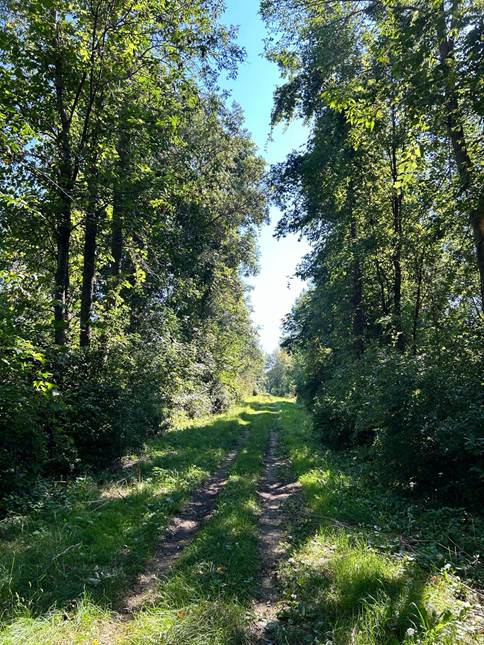
This trail bisects two farms in Cape Vincent, New York, my small hometown— population 2,675—just 1 mile from the Canadian border. The trail, where I start most morning runs when I visit home, divides a dairy farm to the North, and a black Angus beef farm to the South. Both have been operating for decades, their origins pre-dating my birth. At least in my childhood, these farms appeared to be facts of the landscape. I never questioned their constructed-ness, what it might look like without them. As a child, I don’t ever remember my parents thinking too critically about our proximity to these places, besides that their functioning was a sort of given economic bedrock in our small community. In the summer, the farms look like the bucolic Norman Rockwell prints that my parents lined our hallway with. In the winter, they are quiet, blanketed in a sheet of ice, made rock solid by endless months of freezing temperatures.
In my late teenage years and early adulthood, a burgeoning environmentalism took place in our household— influenced by a greater understanding of how the farms were affecting the quality of the St. Lawrence River, the giant waterway that served as our town’s backdrop, crown jewel, and a proudly shared resource with our Canadian neighbors. A local environmental non-profit was educating us all on the ways in which the farms were polluting the River. Specifically, we learned how nitrates and phosphorous present in cattle manure were seeping into the groundwater and making its way to the River via run off, triggering algal blooms. Ultimately, these blooms can lead to widespread fish kills and contaminated drinking water.
I don’t remember much at all from back then about who worked on these farms. It wasn’t until, quite honestly, after decades away from home, that I even became curious about who might be doing the arduous work of tending to these farms, who might actually be the economic backbone of our local community. I’m sure, back then, I’d tell you it was a family farm, operated by a white, likely Irish American, family, who looked like everyone else in our town. And it likely was.
But now, I know, even though I still never see them, that migrant farmworkers do much of the labor on these farms. I know because of my research, but also because of a March 2025 ICE raid in a neighboring community that made national news, as a mother and three children were taken by ICE in the night during a raid on a local dairy farm and swiftly sent to a detention center in Texas.2 Interestingly though, they were released from detention rather quickly, in large part due to mass protests in our region, one that, notably, consistently leans conservative and has overwhelmingly favored President Trump in recent years.
While the ICE raids were a major topic of conversation in March 2025, it didn’t ignite a larger conversation in our area about the presence of migrant farmworkers, the deplorable conditions in which they work, or how we might better welcome this growing part of our community. Instead, they, like so many before them, descended into a carefully guarded realm of silence. This, in the same way that we almost never speak about the Haudenosaunee peoples, whose lands we violently stole. In the same way that instead of acknowledging that brutal history, we instead lean into our brief history as a home to French nobility in the early 19th century, where many fled following the exiling of Napoleon. Every year, around Bastille Day, we host a French Festival, which is not French in any way save the name, but, through fried dough and Creedence Clearwater Revival cover bands, perpetuates the myth that the French founded our town, and before them, we were a land without a history.
Fresh courage glimmers from planets.
And lights the map printed with the blood of history, a map you will have to know by your intention, by the language of suns.
When you emerge note the tracks of the monster slayers where they entered the cities of artificial light and killed what was killing us.
You will see red cliffs. They are the heart, contain the ladder.
A white deer will greet you when the last human climbs from the destruction.
Remember the hole of shame marking the act of abandoning our tribal grounds.
We were never perfect.
Yet, the journey we make together is perfect on this earth who was once a star and made the same mistakes as humans.
We might make them again, she said.
Crucial to finding the way is this: there is no beginning or end.
You must make your own map.1
Author’s bio:
Anna Purcell is a first-year PhD student in the Department of Sociology at UCSC (University of California Santa Cruz), USA. Her future research interest is on pesticide poisoning in Latin America.
References:
1 Joy Harjo, “A Map to the Next World,” in How We Became Human: New and Selected Poems, 1975–2001 (New York: W. W. Norton, 2002).
2 New York Civil Liberties Union. “Detained Immigrant Family from Sackets Harbor Released from ICE Custody.” Press Release, April 7, 2025. https://www.nyclu.org/press-release/detained-immigrant-family-from-sackets-harbor-released-from-ice-custody