
Discourses From the East

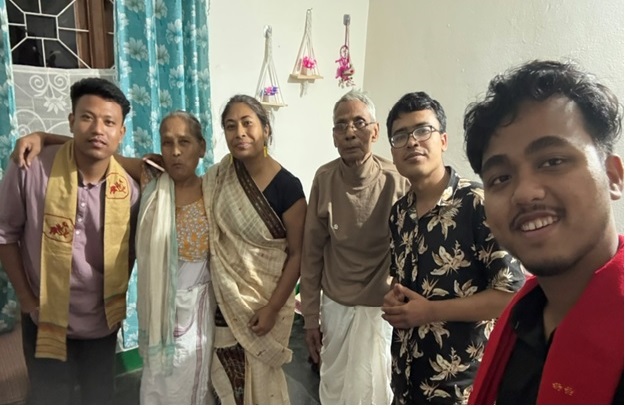
On 17 February 2023, together with Bijaya Sarmah and Pinky Biswas, I travelled to Baghjan Village to initiate a collaborative health survey with Baghjan Gaon Milan Jyoti Yuva Sangha and volunteers from Dibrugarh University and the Tata Institute of Social Sciences, Guwahati. The survey emerged from the villagers’ belief that health conditions had deteriorated following the oil inferno of 2020 which significantly contaminated the village’s soil, air, and water bodies. That afternoon, after touring the village and visiting a few oil infrastructures, we gathered in the gaonbura’s (village headman) courtyard. Over cups of tea, we introduced ourselves and then immersed in trying to locate the history of oil extraction in the village and the social consequences of hosting oil infrastructures and policies that accompanied. As our conversation unfolded, Jugeswari Hazarika, the gaonbura’s wife, joined us. After gathering as sense of what exactly were the kinds of stories and details we hoped to document she began sharing her account— the gradual transformation of the village she witnessed, people’s everyday struggles in the relief camps and the like. She filled in details, she felt her husband, the then village headman and her son (Monoj Hazarika, the present village headman and one of the petitioners of the Baghjan case) missed. It didn’t take us much time to realise that Jugeswari Hazarika was a leader in her own right. Deeply invested in her people and their concerns, her attentiveness and generosity revealed a form of leadership rooted in everyday acts of care, listening, and community-making.
That evening, none had imagined that the brief exchange would stretch well past midnight; absorbed in her stories, gathered around the fireplace. With her own rangdhali (vibrant and radiant) aura, effortlessly singing Bihu naam, peeling, chewing, and offering tamul, between conversations, she introduced us to the living cultural world of the village. Through personal vignettes, of how she met, fell for, and expressed her feelings during Bihu celebrations for Rajani Hazarika, the then gaonbura, she explained aspects of Moran culture — the significance and use of the saksoni mari, songs sung to initiate the festivities, those during the celebration, ones that mark its conclusion, and the ones traditionally sung by women and those by men. The joyful mood shifted as she spoke of the transformations following the oil inferno which became
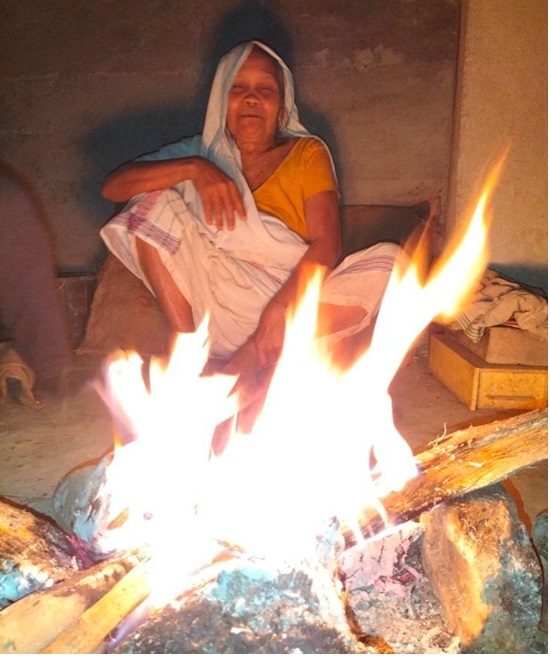
particularly apparent as she recounted the respiratory illness her husband developed after the disaster and of the unsettling period when a nebuliser, an equipment previously unknown, became a part of the household’s everyday. In Baghjan, many reported development of respiratory diseases owing to long exposure to the natural gas and condensate spill often referring to it as tel borokhun (oil rain). Her narration informed how disasters are experienced not only through altered landscapes but also through transformed bodies, homes, and everyday practices of care. Although we were beginning to feel the weight of the day, her energy seemed infectious. As we listened trying to understand the value of what she shared our fatigue form the days work dissolved, replaced by an unbound admiration of the knowledge she carried so much so that we stayed up longer to note what we feared forgetting. To that very enriching evening I owe her this obituary (in fact, my first) — for taking care and labouring to share the knowledge and wisdom she generationally learned and for the joy and beauty in nature and culture she unveiled.
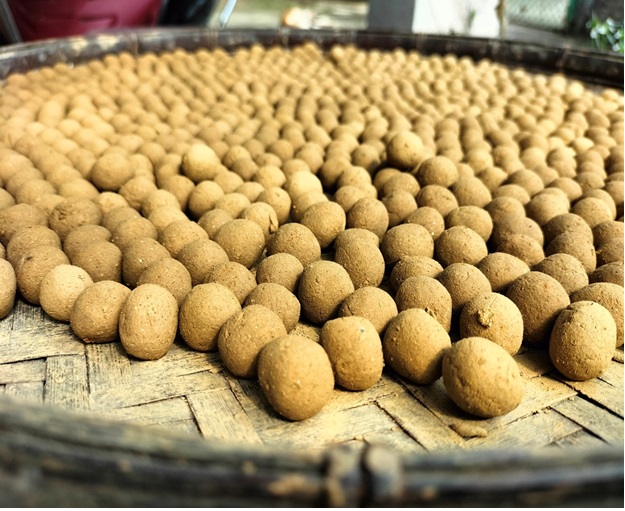
The next morning, as we stepped out of the house, we saw borma (as we addressed her), kneading moist soil in an unhurried rhythm with her practiced hands, rolling it into small balls carefully spreading them out in a dola to dry. By the following morning, the dola filled with batulguti,lay in the sun. In the rush, I barely paused to ask what purpose they served until the answer quietly revealed itself on the last morning. In the tea-garden backyard the house, I saw Borma’s daughter-in-law clad in white Moran mekhela, moving with a bow notching a batulguti, her mother-in-law made, and release it every now and then to startle the squirrels feasting on the betel nuts. I was moved by the relationship of solidarity, collaboration, and care it illuminated. The batulguti I had watched being shaped were part of a partnership, a shared economy of care and labour as one woman prepared and the other used them. The older’s experience and the younger’s agility; neither complete without the other, unfolded the collective nature of women’s work and inherited knowledge guided by competence, continuity, and mutual dependence. The sight felt surreal and I teased myself, telling Noihrit Gogoi, who led the survey with me, that it was now his responsibility to find me a mother-in-law who would make me batulguti. Looking back, I realize, what lingered in my memory was the slow unfolding of meaning; it was a quiet lesson on how women sustain households, landscapes, and one another.
This sisterhood and solidarity Jugeswari Hazarika shared with many other women in the locality, became more visible during my later visits when I saw her riding pillion with her
daughter-in-law, nieces, and other women from the neighbourhood attending Bihu performances, weddings, cultural functions, and public meetings in her own and neighbouring villages. These trips reflected her participation in the social and cultural life of the community. I witnessed this twice in 2025. The first occasion was during the village’s Bihu Uruwa celebration on 30 April 2025. Knowing that she was at the venue, I looked for her, eventually finding her thoroughly enjoying the Bihu performances sitting amidst a group of women. When we met, after exchanging warm greetings, she picked up a pair of saksoni mari that the bihuwas left and started playing them while singing flirtatious gos tolor Bihu songs. The following month, I met her again at one of her granddaughter’s Tuloni Biya, held in a neighbouring village at her natal home. She rode pillion on a Scotty with one of her nieces the previous day. On both the occasions I suggested that I dropped her home, but she declined. In her natal village, her family too suggested that she returned with me as a car would be more comfortable than a motorcycle or scooty. She was reluctant. Surprised by her ease, I asked, “Doesn’t your back hurt?” She replied that she was still strong and that wouldn’t want to miss such gatherings in the company of her family and friends and to be immersed in the festivities.
Each interaction with Borma (Jugeswari Hazarika), through her stories, songs, laughter, and moments of vulnerability she filled me and whoever accompanied with a profound sense of curiosity about the place, the people, and its practices. For the the abundance — of love, life, togetherhood, community, and solidarity she represented, we remain grateful. I should confess, a sense of denial, of the loss of our very rangdhali Borma, on the 21st of June 2026, seeps in even I undertook this task of obituary writing expecting it to help process the grief and news of her loss.



I loved reading Amrita Gogoi’s My Days And Nights Of Learning With Jugeswari Hazarika, Baghjan Village the way she wrote about a woman she genuinely came to admire which comes through in every paragraph. What moved me most is how ordinary the details of tea, tamul, a fireplace, someone singing while she peels betel nut and yet by the end you realise you’ve just read a full theory of gendered knowledge, disaster, and memory without a single academic word doing the heavy lifting. Jugeswari was never called a leader while she was alive. Nobody gave her that title. But by the time you finish reading, you don’t doubt it for a second.
I also liked that Gogoi doesn’t pretend to be a neutral observer. She admits she got attached. She stayed longer than planned, she went back more than once, she grieved when Jugeswari died. A health survey about soil and water contamination slowly turns into something else entirely, because Jugeswari’s voice pulls the research in a new direction, and Gogoi lets it happen instead of steering it back to her original checklist. She stays past midnight listening to stories nobody asked her to record.
That’s the real test of standpoint research is about the moment which questions the researcher; are you willing to be led by the person you’re studying? Gogoi passes it. She also doesn’t hide behind the usual researcher distance. She admits she was moved; she teases her colleague about wanting a mother-in-law who makes batulguti, she confesses her grief at the end. It’s honest, personal, and still rigorous, which is exactly the kind of research feminist scholars have been arguing for all along, not just writing footnotes about. That kind of honesty is rare in research writing, and it’s exactly what makes this piece trustworthy rather than less so.