Discourses From the East


Bikash K Bhattacharya -,
Jyotirmoy Saharia -
Translators’ preface:
This is a translation of the narrative “Pillai Sahab” from Ei Ran Ei Jivan by Kamaleswar Barua, a collection of narratives self-published by the author in Assamese in 1968. The volume is based on “true events and characters” the author encountered while serving as a military engineer in the British Indian Army during the Second World War. What lends the anthology particular interest is its generic novelty. Barua describes it as “a collection of kahini (narratives) about a few wartime characters.” In Assamese, the conventional term for a short story is galpa, whereas kahini does not denote a fixed literary genre: it may be fictional, but it may also take the form of a factual or historical account. Acknowledging this ambiguity, Barua clarifies in the preface that “the names of the characters have been fictionalised unless they are historically well-known figures,” and that he has “strove to remain true to the characters as best as [he] had known and witnessed them.” The preface thus establishes these kahinis as a distinct form of wartime memoir narrative rather than conventional autobiographical short stories.
“Pillai Sahab” is situated within the broader history of Indian migration to colonial Burma, particularly the economic and social worlds shaped by South Indian trading and banking communities such as the Chettiars, whose capital and commercial networks sustained Burma’s timber, agrarian, and credit economies under British rule. The Japanese invasion of Burma in 1942 and the subsequent collapse of imperial governance abruptly dismantled these transregional livelihoods, precipitating the mass displacement of Indian civilians some of whom had regarded Burma as home. Barua’s narrative emerges from this historical rupture, recording the human consequences of imperial collapse and wartime violence through an intimate, testimonial mode. In this respect, it aligns with works attentive to displacement, ethical life, and everyday endurance, such as Anand Pandian and M. P. Mariappan’s Ayya’s Accounts: A Ledger of Hope in Modern India (2014) and Debendranath Acharya’s Jangam: The Forgotten Exodus in Which Thousands Died (2018), translated by Amit R. Baishya. Together, these texts foreground marginal histories of migration and loss while tracing forms of moral resilience and hope that persist in the aftermath of colonial violence and war.
May 1942. I was in Pallel, a quaint hamlet about 26 miles southeast of Imphal in the state of Manipur. There, among thousands of refugees who had recently arrived from Burma, I had a chance meeting with the Pillai family.
Mr. Pillai’s full name is Krishnagovinda Pillai, whose father, after graduating, left for Burma to work in a well-known Chettiar family’s timber business. After a stint with the Chettiars in Burma, he floated his own business and began exporting timber from Burma to India and other countries. He made a lot of money exporting timber and bought properties in Rangoon and Mandalay, along with savings of several lakhs of rupees.
Krishnagovinda Pillai was born in Mandalay. A bright student since childhood, he attended a convent school in Rangoon and earned a master’s degree in Philosophy from the University of Rangoon (now the University of Yangon) before eventually joining his father’s business. After the passing of his father, as the sole successor, he inherited the profitable business. He married the only daughter of a renowned Rangoon-based Madrasi lawyer, who was also highly educated and held an M.A. in Mathematics from the University of Rangoon. The couple had two children: a daughter, Kamala, and a son, Govindaraman Pillai. Kamala, at the start of the war, was a sophomore medical sciences student at the University of Rangoon, and Govindaraman was an eighteen-year-old undergraduate student. A highly educated and well-established family, the Pillais were a source of pride among people of Indian descent in Burma. Local Burmese were quite fond of the family as well.
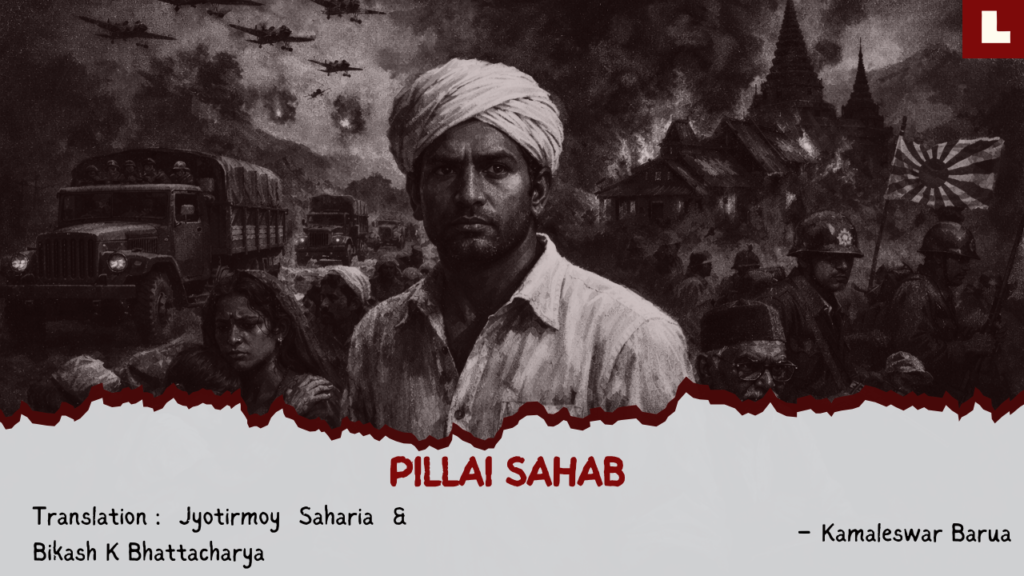
As the horrors of World War II began to unfold in Southeast Asia, the Imperial Japanese Army launched an attack on Burma, slipping through its northeastern frontier. Civilian life was disrupted within a span of a few days. Major Burmese cities such as Rangoon, Mandalay, Mawlamyine, Bhamo, and Akyab (now Sittwe) witnessed large-scale aerial bombings by the Japanese, turning houses, hospitals, schools, pharmacies, pagodas, mandirs, and masjids into rubble. Limbless carcasses of animals and humans were scattered across towns, leading to a complete nightmare. Following this invasion, the British began to cede control of Burma and withdraw their troops and citizens. Before leaving, they attempted to destroy oil refineries and other factories as much as possible by using a scorched-earth policy. The lives of people of Indian descent were filled with terror. They had to choose between two options: to stay in Burma or to return to India. Gradually, most of them decided to opt for the latter, realizing that Burma was no longer safe. Some affluent families near the port cities took ships to Calcutta, Madras, and Chittagong; others proceeded to enter India through Assam. Some headed toward Ledo by crossing the Hukawng Valley, and many others toward the Burmese border town of Tamu. There was no limit to human suffering—a catastrophe that rendered life worthless.
The Pillai family was living in Mandalay at the time. With a small amount of money and some jewellery, they decided to head for Tamu in their vehicle, leaving behind property in Burma worth millions of rupees and lakhs in bank deposits. On the road, they refuelled at an extremely inflated price but had to abandon their vehicle when it ran out of petrol. From then on, they had to walk long distances, camping out in the open for the most part. A thatched roof over their heads was considered a luxury. For food, they relied on small grocery stores along the road. In some places, there were designated ration distribution points set up by the authorities, which barely had enough for everyone. Nevertheless, the Pillais and other groups traveling with them managed to reach Tamu. After resting for a couple of days there, they crossed into Moreh in India and then proceeded to Pallel, hiking sixty miles through rugged, hilly terrain with utmost difficulty. It was here that I met the Pillai couple. Even though the journey from Mandalay in central Burma to Pallel in Manipur was nothing less than an ordeal, they had hardly any complaints and were at peace with themselves and the world. I was happy to meet them.
A few years later, I happened to meet Mr. Pillai in Dimapur. The war was still on. He insisted that I visit his place. By then, Mr. and Mrs. Pillai were the only ones left in the family. I began enquiring about their days following our meeting in Pallel. From Pallel, they arrived in Imphal and decided to stay in refugee camps for a few days to recuperate. At dawn one morning, they were awakened by the frightening sound of a siren. Looking up, Mr. Pillai saw several Japanese jets hovering in the sky. Scenes at the refugee camp were chaotic as people ran for shelter. The Japanese had bombed Imphal. The camp was also hit. Flying shrapnel from a bomb struck Kamala in the head, killing her instantly.
They then travelled toward Dimapur—sometimes in the backs of military lorries, other times on buses that broke down halfway, and most often on their already exhausted feet. They halted to rest at refugee camps in Kanglatongbi, Kangpokpi, Karang, Maram, Mao, and Jakhama before arriving in Kohima. To add to the ordeal, a cholera epidemic broke out in several places along the way. Several doctors had set up clinics offering cholera vaccines, but the injections were very expensive. In Jakhama, the three remaining members of the Pillai family took injections in exchange for a piece of gold jewellery each. However, after reaching Kohima, Govindraman fell ill. Despite care and treatment, the doctors in the refugee camp could not save him. Soon it became clear that the doctors who had administered the cholera vaccinations were, in fact, impostors without any medical certification. The refugees were forced to part with whatever valuables they could salvage in exchange for fake vaccines—a disaster indeed. Grieving the loss of their two children, the couple could only wish that the departed souls find eternal peace.
After a tragic few days in Kohima, they moved toward Dimapur, spending a few days at refugee camps in Zubza, Piphema, Ghaspani, and Nichuguard. Dimapur had, by then, transformed into the main stronghold of the Allied forces on the eastern frontier. Tents and temporary military housing units stretched seven to eight miles eastward toward Kohima. Soldiers with bayonets and guns stood guard day and night. Military officers and soldiers from the Allied forces gave the town a truly cosmopolitan look. A couple of months into their stay in Dimapur, the couple took up jobs at a military cantonment.
While traveling to Dimapur a few years after the culmination of the war, I met Mr. Pillai at a village near Bokajan by the river Dhansiri. I learned from him that they had worked at a military canteen for three years, until the end of the war. Being second- or third-generation Burmese Indians, they had no connection with their ancestors in Madras. Returning to Burma was out of the question. With nothing to call their own and nowhere to belong, they chose to stay in Assam. They bought a plot of land by the Dhansiri with their minimal savings from working at the canteen and established a residential school there. Mr. and Mrs. Pillai, along with a few local individuals, taught Mikir, Naga, and Kachari children, as well as the children of plantation labourers brought in by the British from eastern and central India. Apart from coursework, the students were trained in artisanal skills involving work with bamboo, cane, and wood. They were also imparted knowledge of farming and gardening. The couple’s selfless efforts produced many outstanding students. The institution also served as a center for matriculation examinations. Their sincere wish was that students graduating from the institution should not only focus on earning money but also strive to contribute meaningfully to the newly independent nation. However, this period of relative peace, after many turbulent episodes in their lives, did not last long. A year before I caught up with Mr. Pillai, his wife, who had been suffering from cancer, passed away. Mr. Pillai also stopped actively participating in the running of the institution. He formed a trust involving three local residents—a Mikir, an Angami Naga, and a Kachari gentleman—by signing a will and donating the institution to them. Mr. Pillai now spends his time training and counselling local youth. Locals address him as “Pillai Sir,” and everyone holds him in great admiration. I was pleased to meet him once again, now an old man with greying hair. His bright face, however, still evoked a sense of meditative fulfilment, as if he were little troubled by the tragic and untimely deaths of his daughter and son, the loss of his supportive wife, and the vast amount of hard-earned wealth left behind in Burma. The rolling green plains of the valley, the clear starry sky, and the Dhansiri breaking its banks during the monsoon give him great joy. He seems to love his slow-paced life, giving credit to the Almighty for everything. This humble yet resolute man will forever continue to inspire me.

Bikash K Bhattacharya
Bikash K Bhattacharya is a graduate student in the Faculty of Asian and Middle Eastern Studies (AMES) at the University of Oxford.