Discourses From the East


Pallavi Devi -,
Sabnam Ahmed -
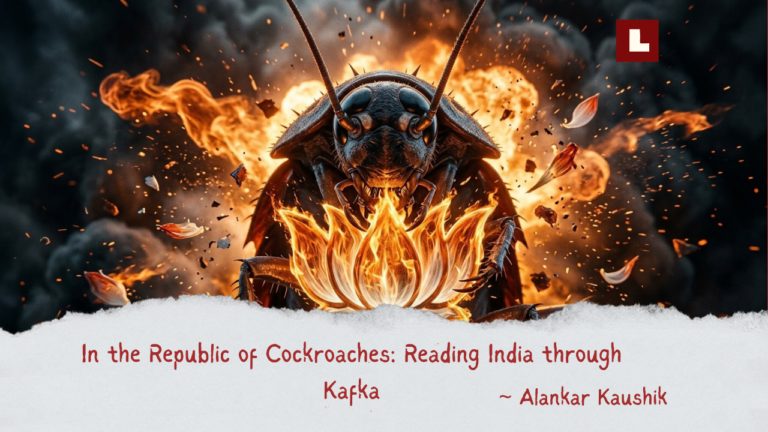
The Making of the Cockroach Janta Party
On the 15th of May, 2026, while presiding over a Supreme Court bench with Hon’ble Justice Mr. Joymalya Bagchi, the Hon’ble Chief Justice of India, Mr. Surya Kant, made an arguably careless remark by describing unemployed youth who use social media journalism or RTI activism to question institutional authority as “cockroaches” or “parasites”.[1] The hearing was regarding a petition filed by an advocate who was seeking the designation of senior advocate[2], and in the course of questioning the conduct of the petitioner, and raising concerns about the authenticity of law degrees held by some advocates, the CJI made what can be characterised as a hasty generalisation.
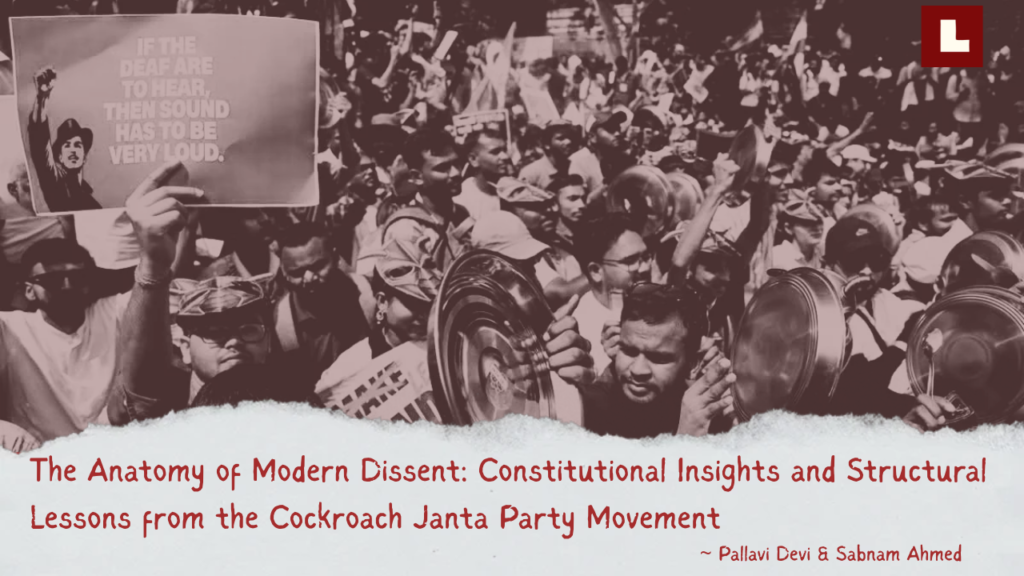
What followed was particularly interesting and could be considered as one of the first instances of such a response to a judicial remark. Instead of rejecting it or seeking its withdrawal through legal proceedings, many young people, student groups, and civil society members chose to reclaim the words used against them.
The idea found its first expression in Abhijeet Dipke, who turned to the social media platform X to ask what would happen if all the “cockroaches” came together. The post soon went viral, and the website which he created attracted around 50,000 people who signed up to express their support for the creation of a “Cockroach Janta Party” or “CJP”. The party’s Instagram account also gained 22 million followers. Dipke, who had recently completed his master’s degree at Boston University’s College of Communication, explained that the use of satire was a strategic move to highlight serious concerns surrounding freedom of expression, accountability, and the widening gap between the rulers and the ruled[3]. What began as a satirical online campaign soon spilled onto the streets through student mobilisations at Delhi’s Jantar Mantar.
[1] Ananthakrishnan G, ‘Some Jobless Youth in Law like Cockroaches, Become Media, Activists and Attack System: CJI’ (New Delhi, India, 16 May 2026) <https://indianexpress.com/article/legal-news/cji-surya-kant-youngsters-cockroaches-media-activists-rti-lawyer-10691246/>.
[2] Amisha Shrivastava, ‘Thousands Of Fraudulent Lawyers, BCI Won’t Do Anything; Need CBI To Verify Law Degrees : CJI Surya Kant’ (15 May 2026) <https://www.livelaw.in/top-stories/thousands-of-fraudulent-lawyers-bci-wont-do-anything-need-cbi-to-verify-law-degrees-cji-surya-kant-534320>.
[3] ‘COM Grad Turns Cockroach Insult of India Youth into Massive Online Movement’ (8 June 2026) <https://www.bu.edu/com/articles/com-grad-turns-cockroach-insult-of-india-youth-into-massive-online-movement/>.
Dissent and the Winds of Change
With the adoption of the CJI’s exact words as the formal identity of their newly formed party online, the youth engaged in a distinctive form of institutional dissent, which can be conceptualised as subversive legalism. Its conceptual basis is drawn from the existing idea of “uncivil obedience”[1] in which individuals use compliance as a tactic not merely to conform to institutional or legal authority, but to expose, question, or challenge the structures through which the authority operates. Although the movement initiated through the CJP does not strictly correspond to the conventional understanding of uncivil obedience, it provides a strong starting point for understanding the dissent involved.
In the present context, this conceptual framework is particularly useful because the dissenters did not reject the legal framework, but enthusiastically embraced the very label assigned to them by the judicial authority, and used legally permissible forms of expression, including memes, art, and costumes, to peacefully exercise their right under Articles 19(1)(a) and 19(1)(b) of the Constitution.
[1] Jessica Bulman-Pozen and David E Pozen, ‘Uncivil Obedience’ (2015) 115 Columbia Law Review 809.
A Threat to Civic and Legal Standing
In order to understand why this type of response by the CJP is significant, it is important to examine the constitutional implications of the label that came from the Chief Justice of India, who occupies the highest judicial office in the country. Although the remark did not form part of the ratio decidendi or constitute an obiter dictum of the court, its significance cannot be viewed merely as a personal remark. Such labels can undermine the civic and legal standing in the society of those on whom it was directed, making them appear as less worthy of being heard. In the case of unemployed youth, such characterisation shifts the vantage point from unemployment as a structural problem to the unemployed as the source of social disorder[1]. The Hon’ble CJI did, however, subsequently clarify[2] that his words have been misquoted and taken out of context, yet, in the era of digital footprints, narrative building, and live-streamed proceedings, judicial language can acquire a life of its own and shape public discourse. This dynamic explains why the movement treated the remark not as an isolated slight, but as a public challenge to their civic standing that required a visible democratic response.
[1] Gurdeep Sappal, ‘The Chief Justice Called Them Cockroaches. History Knows Where That Language Leads’ (The Wire, 16 May 2026) <https://thewire.in/law/the-chief-justice-called-them-cockroaches-history-knows-where-that-language-leads>.
[2] Ananthakrishnan G, ‘CJI Reiterates: Cockroach Remarks Only for Fake Law Degree Holders, Not All Youth’ (New Delhi, India, 25 July 2026).
The Constitutional Space for Resistance
The subversion of the label, however, subsequently raises a Constitutional question: to what extent does the Constitution protect such unconventional forms of expression? The right to freedom of speech and expression under Article 19(1)(a) is not confined to conventional or serious forms of political communication. It extends to expression that may be unpopular, satirical, or even critical, subject to the reasonable restrictions under Article 19(2).
The scope of this protection becomes clearer from the Supreme Court’s ruling in the case of S. Rangarajan v. P. Jagjivan Ram[1] in which it was held that there must be a proximate and direct nexus between the expression and the anticipated danger before the State can legitimately restrict it. This principle is important here because the constitutional value of an expression cannot depend simply on whether it is conventional, agreeable, or comfortable to those who encounter it. The Constitution does leave room for expressions that unsettle, challenge, or provoke the established authority, so long as they remain within the limits prescribed by Article 19(2).
Again, in Indibility Creative Pvt. Ltd. v. Government of West Bengal[2], the issue was regarding a film called Bhobishyoter Bhoot, which was a social and political satire. The Supreme Court observed that satire uses irony in order to scrutinise topical issues and to reveal the “absurdities, hypocrisies, and contradictions” of social life. At the same time, the Court made it clear that satirical speeches, like other forms of speech and expression, remain subject to the restrictions under Article 19(2). This understanding is complemented by the Court’s decision in Shreya Singhal v. Union of India[3] where the Court drew the distinction between discussion, advocacy, and incitement. It held that even discussion or advocacy of a cause, however unpopular it may be, lies at the heart of Article 19(1)(a), and that the power to restrict speech under Article 19(2) is attracted only when such expression reaches the level of incitement.
Therefore, the manner in which the protestors chose to respond becomes relevant not only as a matter of political strategy but also as an exercise of the fundamental right to freedom of speech and expression. Together, these principles show that satirical and unconventional expression online falls within Article 19(1)(a) unless it crosses into the restricted territory of Article 19(2), setting the stage for how digital satire moved into physical spaces.
From Digital Expression to Physical Assembly: Bridging Articles 19(1)(a) and 19(1)(b)
Moving from online satire to physical gatherings at Jantar Mantar brought Article 19(1)(b), i.e., the right to peaceful assembly, directly into play alongside Article 19(1)(a), raising the crucial question of where dissent may be expressed. Jantar Mantar became an important site for the movement’s physical protests with the permission of the Delhi Police in June 2026[4]. However, the later attempt to move from Jantar Mantar towards the Parliament in July 2026 was met by prohibitory orders under Section 163 of the Bharatiya Nagarik Suraksha Sanhita (BNSS) imposed by the Delhi Police[5].
From a constitutional standpoint, such regulation raises a question about the relationship between the right to peaceful assembly and the place in which that right is exercised. This concern had already arisen in the case of Mazdoor Kisan Shakti Sangathan v. Union of India[6], where the Supreme Court considered restrictions on demonstrations in Central Delhi, as well as regulation of protests at the Jantar Mantar. The judgement is relevant because in this case the Court recognised that while the State may regulate the place and manner in which protests are held, such regulations must also take into account the fundamental right to protest peacefully. The important requirement is that there should be a balance between the rights of protestors and the interests of the residents and the wider public. However, administrative authorities often use this balancing framework to keep the power centres from visible critiques.
When the CJP attempted its Chalo Sansad (March to Parliament) and moved beyond the designated protest site at Jantar Mantar, they challenged spatial limits placed on their right to dissent. A protest communicates not only through the words or symbols used by the protestors but also through the place where it takes place. A protest directed towards a particular institution may derive part of its meaning from the proximity to that institution, and dissent loses its efficacy if it is forced into spaces where it cannot be seen or heard by the institutions responsible for the grievance.
Regulating Dissent: The Question of Proportionality
The State’s response to the protest was not limited to just spatial quarantine; it involved the use of water cannons, tear gas, deploying Rapid Action Force (RAF) personnel, physical blockades, pellet guns[7], and sweeping detentions. Such measures, like other restrictions on fundamental rights, have to be assessed against the principle of proportionality[8]. This principle has been developed by the Supreme Court to ensure that the restrictions imposed on the exercise of fundamental rights to achieve a State objective are not greater than what is necessary[9].
As formulated in the judgment of K.S. Puttaswamy v. Union of India[10], and applied to public policing in the case of Anuradha Bhasin v. Union of India[11], any State interference with the fundamental rights must satisfy four conditions of the proportionality test. First, the restrictions must be imposed to achieve a legitimate objective. Second, there must be a rational nexus between the restriction imposed and the objective sought to be achieved. Third, the State must adopt the least restrictive measures only. Finally, there must be a fair balance between the intrusive act and the gain obtained from the act to achieve the desired objective.
However, the way in which the State responded to the CJP movement raises serious questions of proportionality, primarily on the third and fourth prongs. The deployment of DP-Dristhi, Ikshana surveillance vans and a Mobile Command and Control vehicle equipped with AI-assisted face recognition technology illustrates the extent of the measures adopted during the protest[12]. According to the Delhi Police, the intention behind using facial recognition technology and other biometric surveillance was only to scan criminals during the protest, not to automatically create and maintain profiles of protestors with no criminal background[13].
Even if the stated purpose of the surveillance was to identify persons with criminal antecedents, its presence at a protest may have a wider effect on the exercise of constitutional rights. This is because when the protestors know that their faces are being recorded and may be identified by the Police, they may become cautious about participating or expressing themselves openly. The effect of ‘being watched constantly’ may have a chilling effect on the exercise of the rights under Articles 19(1)(a) and 19(1)(b)[14].
Speaking of excessive force and the limits of proportionality, the use of pellet guns cannot be ignored. In Anita Thakur v. Government of J&K[15], the Supreme Court stated that even if a protest becomes unlawful due to lack of permits, the police must use minimum force. Hence, the use of riot control equipment against a peaceful assembly of students does raise serious questions about whether the State’s response was proportionate. Deploying surveillance vans with facial recognition and using pellet guns against student protesters raises acute questions over whether authorities used the least restrictive means and struck a fair balance between intrusion and public order.
Digital Blackouts and the Control of the Narrative
Another form of State intervention during the CJP mobilisations was the mobile internet shutdown around protest sites[16]. Modern digital activism relies heavily on the real-time co-ordination and live-streaming of updates. By disabling mobile data in certain areas, the authorities effectively disconnected protestors on the ground from the audience following the protest online. This raises concern under the principles laid down by the Supreme Court in Anuradha Bhasin v. Union of India[17].
The importance of digital connectivity in the context of the CJP movement, however, extended beyond mere communication or co-ordination. The online space also became a site where competing narratives about the protest were being created and circulated. The CJP used social media to present its movement as a peaceful and satirical response to concerns about irregularities in examinations, youth unemployment, and government accountability. At the same time, the protestors also criticised mainstream media for attempting to portray the movement in a negative light[18]. On the other hand, the State also sought to shape the information surrounding the protests. Delhi Police rejected several claims circulating on social media as false propaganda and also sought their removal, alleging that they were false and manipulated content related to the protest[19].
Thus, the digital dimension of a movement is not limited only to the question of internet access but also involves a wider contest over who gets to define the meaning of the protest, how it is presented to the public, and which version of events gains legitimacy.
Conclusion: Right to Unkillable Dissent
The Cockroach Janta Party movement highlights a recurring tension in Indian constitutionalism: while citizens continually invent creative ways to exercise Articles 19(1)(a) and 19(1)(b), administrative authorities remain quick to treat public assembly as a law-and-order problem. Measured against the Supreme Court’s proportionality jurisprudence, heavy-handed spatial, digital, and surveillance controls risk chilling lawful democratic participation. Ultimately, the CJP movement shows that the constitutional right to dissent is not a privilege given by State authorities but an important part of a functional democracy. The repeated invocation and display of the Constitution during the movement also showed how citizens can draw authority from the Constitution itself to question those in power. It became a source of strength through which the dissenters asserted their rights. In this sense, framing dissent as “unkillable” reflects the movement’s satirical and defiant turn rather than a formal legal doctrine, showing that while state measures may curb protest in the moment, the constitutional impulse to dissent endures.
Bibliography
Barik S, ‘AI Surveillance at Jantar Mantar: How Delhi Police Facial Recognition Works’ <https://indianexpress.com/article/explained/delhi-police-facial-recognition-ai-surveillance-jantar-mantar-10801778/>
Barik S and Manral MS, ‘Mobile Internet Snapped Again around Delhi’s Jantar Mantar, 6th Such Order in a Week | Delhi News – The Indian Express’ <https://indianexpress.com/article/cities/delhi/delhi-internet-shutdown-jantar-mantar-mandi-house-student-protest-10800501/>
Bulman-Pozen J and Pozen DE, ‘Uncivil Obedience’ (2015) 115 Columbia Law Review 809
Bureau TH, ‘CRPF “Verifying” Reports of Pellet Guns Used against Protesters in Delhi: Official’ The Hindu (24 July 2026) <https://www.thehindu.com/news/national/crpf-verifying-reports-of-pellet-guns-use-on-protesters/article71260997.ece>
‘Cockroach Janta Party Gets Delhi Police Nod to Protest at Jantar Mantar; Protest to Begin at 10am | Delhi News – The Times of India’ <https://timesofindia.indiatimes.com/city/delhi/cockroach-janta-party-gets-delhi-police-nod-to-protest-at-jantar-mantar-protest-to-begin-at-10-am/articleshow/131544026.cms>
‘COM Grad Turns Cockroach Insult of India Youth into Massive Online Movement’ (8 June 2026) <https://www.bu.edu/com/articles/com-grad-turns-cockroach-insult-of-india-youth-into-massive-online-movement/>
‘“False Propaganda”: Delhi Police Dismiss CJP Protester’s Death Claim, Warns against Misinformation | Delhi News – The Times of India’ <https://timesofindia.indiatimes.com/city/delhi/cjp-stir-delhi-police-calls-social-media-claim-of-protesters-death-false-propaganda-warns-against-misinformation/articleshow/132576648.cms>
G A, ‘Some Jobless Youth in Law like Cockroaches, Become Media, Activists and Attack System: CJI’ (New Delhi, India, 16 May 2026) <https://indianexpress.com/article/legal-news/cji-surya-kant-youngsters-cockroaches-media-activists-rti-lawyer-10691246/>
——, ‘CJI Reiterates: Cockroach Remarks Only for Fake Law Degree Holders, Not All Youth’ (New Delhi, India, 25 July 2026)
Inzamam Q and Dhawan A, ‘India’s Cockroach Revolution: How a Supreme Court Insult Sparked a Youth-Led Political Movement’ (FairPlanet, 18 July 2026) <https://www.fairplanet.org/story/indias-cockroach-revolution-how-a-supreme-court-insult-sparked-a-youth-led-political-movement/>
Kaushik S and Baiju A, ‘Protest Venue under a Web of Cameras and Facial Recognition Systems’ The Hindu (24 July 2026) <https://www.thehindu.com/news/national/protest-venue-under-a-web-of-cameras-and-facial-recognition-systems/article71263235.ece>
‘Lathi-Charge, Tear Gas, Pellet Guns: What Does the Law Say about Police Use of Force against Protesters? | Explained- Moneycontrol.Com’ (Moneycontrol, 28 July 2026) <https://www.moneycontrol.com/news/india/lathi-charge-tear-gas-pellet-guns-what-does-the-law-say-about-police-use-of-force-against-protesters-explained-13985320.html>
‘“No Permission”: Prohibitory Orders Imposed Ahead Of Planned Parliament March’ (NDTV) <https://www.ndtv.com/india-news/no-permission-prohibitory-orders-imposed-ahead-of-planned-parliament-march-11792725> accessed 25 August 2026
‘“One-Sided Picture”: Delhi Police To Supreme Court On Jantar Mantar “Crackdown”’ NDTV <https://www.ndtv.com/india-news/cjp-protests-at-jantar-mantar-delhi-cops-to-supreme-court-on-using-face-surveilance-cameras-11924819>
Sappal G, ‘The Chief Justice Called Them Cockroaches. History Knows Where That Language Leads’ (The Wire, 16 May 2026) <https://thewire.in/law/the-chief-justice-called-them-cockroaches-history-knows-where-that-language-leads>
Shrivastava A, ‘Thousands Of Fraudulent Lawyers, BCI Won’t Do Anything; Need CBI To Verify Law Degrees : CJI Surya Kant’ (15 May 2026) <https://www.livelaw.in/top-stories/thousands-of-fraudulent-lawyers-bci-wont-do-anything-need-cbi-to-verify-law-degrees-cji-surya-kant-534320>
‘What Police Use to Control Violent Protests: Inside India’s Riot-Control Arsenal’ The Economic Times (29 July 2026) <https://economictimes.indiatimes.com/news/india/indias-riot-control-arsenal-how-police-tackle-violent-protests-with-advanced-equipment/articleshow/132712130.cms?from=mdr>
Yadav D, ‘Media Distrust Emerges as a Key Theme among Cockroach Janta Party Protesters | Ground Report from Jantar Mantar’ (Hindustan Times, 6 June 2026) <https://www.hindustantimes.com/india-news/media-distrust-emerges-as-a-key-theme-among-cockroach-janta-party-protesters-ground-report-from-jantar-mantar-101780763292552.html>
[1] 1989 SCC (2) 574
[2] AIR 2019 SC 1918
[3] AIR 2015 SC 1523
[4] ‘Cockroach Janta Party Gets Delhi Police Nod to Protest at Jantar Mantar; Protest to Begin at 10am | Delhi News – The Times of India’ <https://timesofindia.indiatimes.com/city/delhi/cockroach-janta-party-gets-delhi-police-nod-to-protest-at-jantar-mantar-protest-to-begin-at-10-am/articleshow/131544026.cms>.
[5] ‘“No Permission”: Prohibitory Orders Imposed Ahead Of Planned Parliament March’ (NDTV) <https://www.ndtv.com/india-news/no-permission-prohibitory-orders-imposed-ahead-of-planned-parliament-march-11792725> accessed 25 August 2026.
[6] AIR 2018 SC 3476
[7] The Hindu Bureau, ‘CRPF “Verifying” Reports of Pellet Guns Used against Protesters in Delhi: Official’ The Hindu (24 July 2026) <https://www.thehindu.com/news/national/crpf-verifying-reports-of-pellet-guns-use-on-protesters/article71260997.ece>.
[8] ‘Lathi-Charge, Tear Gas, Pellet Guns: What Does the Law Say about Police Use of Force against Protesters? | Explained- Moneycontrol.Com’ (Moneycontrol, 28 July 2026) <https://www.moneycontrol.com/news/india/lathi-charge-tear-gas-pellet-guns-what-does-the-law-say-about-police-use-of-force-against-protesters-explained-13985320.html>.
[9] ‘What Police Use to Control Violent Protests: Inside India’s Riot-Control Arsenal’ The Economic Times (29 July 2026) <https://economictimes.indiatimes.com/news/india/indias-riot-control-arsenal-how-police-tackle-violent-protests-with-advanced-equipment/articleshow/132712130.cms?from=mdr>.
[10] AIR 2018 SC (SUPP) 1841
[11] AIR 2020 SC 1308
[12] Shrimansi Kaushik and Akul Baiju, ‘Protest Venue under a Web of Cameras and Facial Recognition Systems’ The Hindu (24 July 2026) <https://www.thehindu.com/news/national/protest-venue-under-a-web-of-cameras-and-facial-recognition-systems/article71263235.ece>.
[13] ‘“One-Sided Picture”: Delhi Police To Supreme Court On Jantar Mantar “Crackdown”’ NDTV <https://www.ndtv.com/india-news/cjp-protests-at-jantar-mantar-delhi-cops-to-supreme-court-on-using-face-surveilance-cameras-11924819>.
[14] Soumyarendra Barik, ‘AI Surveillance at Jantar Mantar: How Delhi Police Facial Recognition Works’ <https://indianexpress.com/article/explained/delhi-police-facial-recognition-ai-surveillance-jantar-mantar-10801778/>.
[15] Writ Petition (Criminal) No. 118 of 2007
[16] Soumyarendra Barik and Mahender Singh Manral, ‘Mobile Internet Snapped Again around Delhi’s Jantar Mantar, 6th Such Order in a Week | Delhi News – The Indian Express’ <https://indianexpress.com/article/cities/delhi/delhi-internet-shutdown-jantar-mantar-mandi-house-student-protest-10800501/>.
[17] AIR 2020 SC 1308
[18] Danita Yadav, ‘Media Distrust Emerges as a Key Theme among Cockroach Janta Party Protesters | Ground Report from Jantar Mantar’ (Hindustan Times, 6 June 2026) <https://www.hindustantimes.com/india-news/media-distrust-emerges-as-a-key-theme-among-cockroach-janta-party-protesters-ground-report-from-jantar-mantar-101780763292552.html>.
[19] ‘“False Propaganda”: Delhi Police Dismiss CJP Protester’s Death Claim, Warns against Misinformation | Delhi News – The Times of India’ <https://timesofindia.indiatimes.com/city/delhi/cjp-stir-delhi-police-calls-social-media-claim-of-protesters-death-false-propaganda-warns-against-misinformation/articleshow/132576648.cms>.

Pallavi Devi
Pallavi Devi is an Assistant Professor of Constitutional Law at the Department of Law, Gauhati University