
Discourses From the East
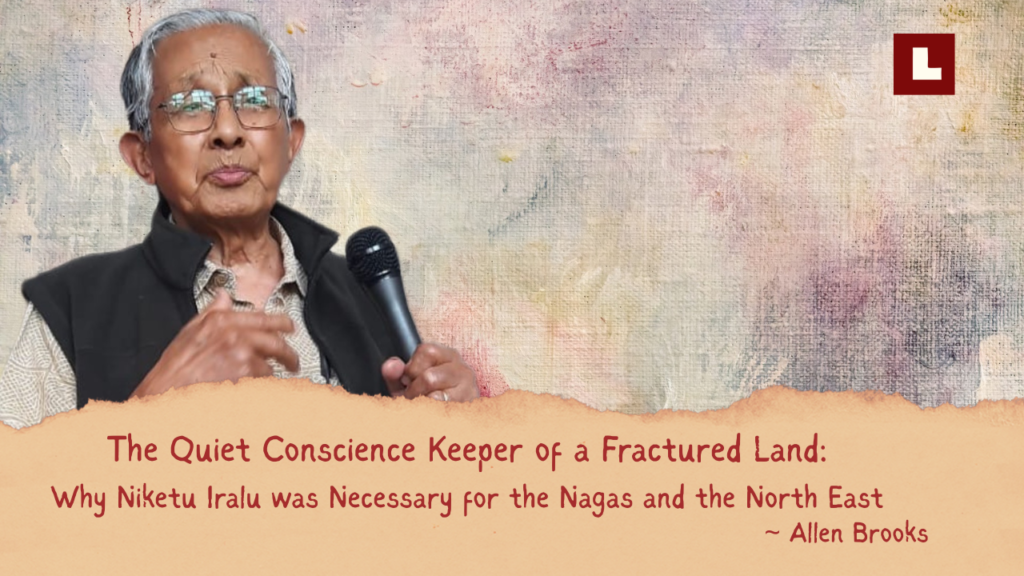

Sir Niketu Iralu stood as a rare and necessary moral anchor for the Nagas and the wider North East, precisely because he emerged from the very heart of the region’s deepest wounds and chose a different path to heal and find peace.
His birth in 1935 into a prominent Angami family—his father one of the earliest Naga doctors, his mother the elder sister of A.Z. Phizo, the towering figure of Naga nationalism—he grew up witnessing the transition from British rule, India’s independence, and the fierce Naga resistance that followed. He saw the Japanese advance into Kohima as a child, the hardships his family endured because of their Phizo connection (including his father’s imprisonment), the fracturing of village society by internal differences, and the long toll of violence, suspicion, and unresolved aspirations that have marked Naga and North-East life for generations. Many in his generation and circle were drawn into the armed struggle. He was not.
His encounter at Madras Christian College in 1955 with the ideas of Moral Re-Armament ( later Initiatives of Change ) redirected him. He came to believe that the greatest service he could offer his people was to allow himself to be changed first—to face his own share of wrong, to listen for the “ still small voice ,” and to build trust through personal honesty rather than through power or grievance alone. That decision took him across continents for decades of quiet work. When he returned to Nagaland in the mid-1990s, he brought with him a tested conviction: lasting stability in a region of more than 220 ethnic nationalities, many with cross-border kinship ties and histories of conflict, cannot be secured by political settlements alone. It requires people willing to see where they themselves have contributed to the brokenness and to practise restitution and reconciliation.
This made him indispensable. In a landscape scarred by inter-factional Naga killings, prolonged Indo-Naga negotiations, drug crises, and the ever-present risk that local grievances could ignite wider instability, Uncle Niketu offered something scarce: a credible, non-partisan moral voice rooted in the same soil as the conflict. He chaired the Naga Reconciliation Commission, became a central figure in the Forum for Naga Reconciliation, and helped facilitate covenants of common hope and reconciliation among divided groups. His home, Kerünyü Ki —“ House of Listening ”—in Sechü-Zubza became a space where people from opposing sides could sit, speak, and be heard without the pressure of public performance. He warned, especially during the Manipur crisis, that the same unexamined fears, insecurities, and failures of responsibility could spread across the North East if common stability was not deliberately built. He insisted that trust-building begins with self-examination and that blaming others is an incomplete response.
His importance lay exactly here: in a region still marked by unresolved political questions, ethnic suspicions, and cycles of violence, he embodied and taught the patient, often invisible work that formal peace processes frequently lack—the inner readiness to forgive and be forgiven, the courage to listen across divides, and the insistence that identity and aspiration need not lead to permanent enmity. He was a living bridge between the nationalist inheritance of his family and a different spiritual and ethical inheritance that prioritised human dignity and shared future over victory.
His death is therefore a profound loss for the entire North East. It removes one of the few remaining elders who commanded respect across factions, tribes, and generations; who could speak hard truths without bitterness; and who modelled, over a lifetime, the values of listening, personal integrity, non-violence, and persistent hope. In a time of continued conflict and instability, the vacuum left by such a conscience-keeper is not easily filled. The seeds he planted—through countless private conversations, public appeals, and the example of a life lived consistently—remain. Whether they continue to grow depends on how many are willing to walk the same demanding path of inner change and outward reconciliation that he chose and never abandoned.



A very good article from a good friend of mine 👍👍🙏🙏