Discourses From the East
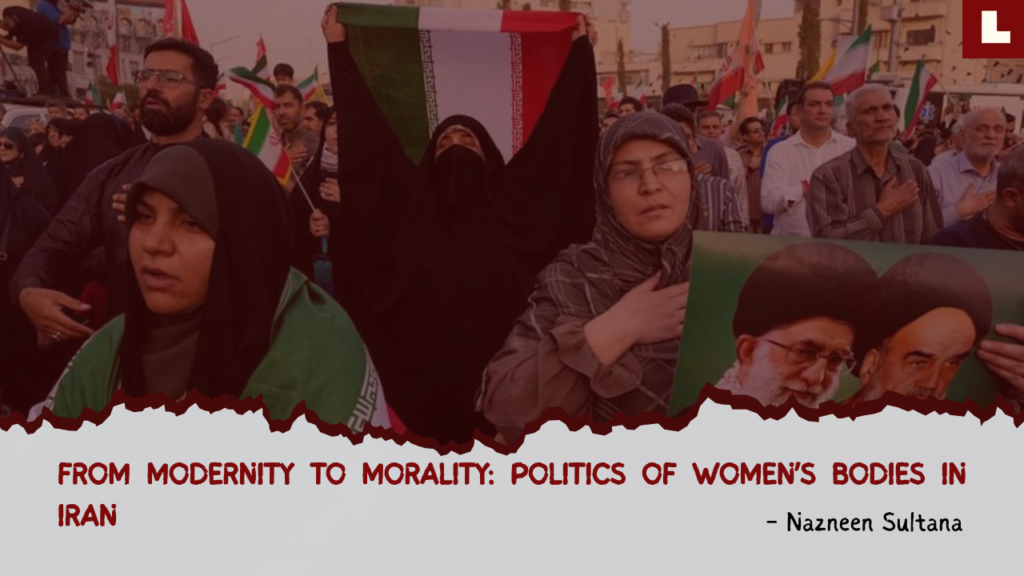

Against the backdrop of repeated political upheavals and regime transitions in Iran, the effects of these changes are often most visibly and acutely experienced by women. Whether articulated through shifting ideological discourses or enforced cultural hierarchies, women’s lives have consistently borne the imprint of dominant political visions. While such transformations undoubtedly carry broader political implications for society as a whole, it is women’s everyday existence; their conduct, appearance, and social roles that has remained subject to heightened scrutiny and regulation across successive regimes.
Contemporary Crisis and the Women, Life, Freedom Movement
In recent years, Iran has faced a deepening economic crisis that has sparked widespread protests across multiple cities, significantly undermining the legitimacy of the state. Although these protests were initially driven by economic discontent, they soon expanded in scope, with students playing a crucial role in amplifying dissent and foregrounding broader social and political grievances, most prominently the enforcement of compulsory hijab. Within this context, the arrest of Jina Mahsa Amini by the morality police and her subsequent death in the custody of Iran’s Gasht-e-Ershad (Guidance Patrol) in 2022 marked a critical rupture, transforming dispersed protests into a collective challenge to the regime’s gendered modes of control. Rather than prompting institutional accountability, Amini’s death was followed by an increasingly punitive and authoritarian posture of the Islamist regime towards women, reinforcing existing structures of repression, as observed by Sara Hossain (UNHR, 2023).
State-Led Emancipation and Coerced Modernity under the Pahlavi Regime
Scholarly interpretations of women’s rights under the Shah’s regime remain contested, revealing the limits of state-led emancipation when mediated through authoritarian power. While some accounts emphasise the expansion of women’s visibility in the public sphere particularly through limited economic autonomy and reforms in family law, other scholars argue that these changes amounted to a form of symbolic liberalisation rather than substantive gender equality. The Shah’s articulation of women’s freedom functioned less as a dismantling of patriarchal structures and more as a performative project of modernity, calibrated to secure legitimacy in the eyes of the Western world. As such, women’s bodies became central to the regime’s ideological self-fashioning rather than sites of autonomous choice.
The Pahlavi modernisation agenda also produced coercive outcomes for women who did not conform to its vision of progress. For those who identified veiling as a cultural, religious, or personal practice, the state’s prohibition of the veil translated into exclusion from public life. As reflected in an interview between George Liston Seay and Haleh Esfandiari, a journalist and former official of the Women’s Organization of Iran, there were instances where women chose to withdraw from public spaces rather than appear unveiled. Although the abolition of veiling expanded freedoms for some, it simultaneously entrenched new forms of regulation, creating a social divide between competing imaginaries of tradition and modernity.
The Shah’s regime thus instrumentalised the chador, not merely as a marker of tradition but as a symbol of regression to be eradicated in favour of Westernised aesthetics of liberation. Reza Shah’s formal ban on the chador and headscarves in the 1930s (Sinaee, 2022) exemplifies how the state substituted one form of patriarchal control for another, leaving little space for dissent or plural expressions of womanhood.
From Resistance to Regulation: Women under the Islamic Republic
It is within this context of coerced modernity that many women mobilised during the Islamic Revolution, adopting the chador and headscarf as deliberate political acts of resistance against the Pahlavi regime’s authoritarianism and cultural alienation. For some, veiling functioned as a counter hegemonic symbol, articulating dissent and reclaiming moral agency. In this moment, religion emerged as a key component within the ideological assemblage that shapes national narratives. The promise of women’s rights within an Islamist framework, articulated by Ayatollah Ruhollah Khomeini, generated hope for a political order that would restore dignity and choice to Iranian women. However, the establishment of the Islamic Republic marked not a rupture from bodily governance but its reconfiguration. New laws were enacted and existing ones revised, most notably the institutionalisation of mandatory hijab in public spaces, the segregation of educational institutions, and restrictions on women’s economic autonomy. Together, these measures reinscribed women’s bodies as instruments of ideological discipline, revealing how shifts in regime ideology did not dismantle patriarchal control but merely altered its form.
Also, with regard to women’s participation in paid work, the current regime has actively curtailed women’s working hours, advancing the claim that employment is acceptable only insofar as it does not interfere with women’s primary responsibility toward family and domestic life. This policy is justified through a familiar narrative that attributes marital breakdown and the erosion of family structures to women’s inability to devote sufficient time to the household (Aarabi & Shelley, 2021). Such reasoning echoes patriarchal discourses prevalent across various sociopolitical contexts and reinforces the positioning of women’s labour as secondary and conditional.
Women, Life, Freedom: Beyond the Hijab
The Women, Life, Freedom movement has garnered widespread international support; yet the movement extends far beyond opposition to compulsory hijab, constituting a broader political challenge to authoritarian governance and systemic repression. At the same time, it is important to revisit the historical heterogeneity of women’s lived realities in Iran. Women’s relationship with veiling has not been monolithic. For much of Iran’s history, women both Muslim and non-Muslim, did not uniformly veil, and women with and without head coverings coexisted in public and private spaces for centuries (Mojab, 1998).
Nevertheless, dominant Western feminist discourses have often reduced the veil to a singular marker of women’s oppression, producing the figure of the ‘Muslim woman’ as a homogeneous and perpetually subjugated subject. Such framings flatten the diversity of women’s lived realities and obscure the fact that coercion operates in multiple directions. Documented instances of women being forcibly stripped of their headscarves make clear that compulsion, whether to veil or to unveil, constitutes a profound violation of bodily autonomy.
In this regard, Saba Mahmood’s intervention is crucial for exposing the Eurocentric assumptions embedded within liberal feminist frameworks. Writing within postcolonial and feminist traditions, Mahmood challenges the equation of agency with resistance alone, arguing instead that agency can also emerge through embodied practices of religious devotion (Kapur, 2019). She demonstrates how practices such as veiling, modesty, humility, and shyness may function not merely as signs of subordination, but as modes through which women reinterpret norms, negotiate patriarchal structures, and participate more actively in public life. By foregrounding the relationship between ‘inner states’ and ‘outer conduct’, Mahmood reconceptualises agency as the capacity to inhabit norms in order to realise ethical and religious forms of subjectivity (Mahmood, 2005).
Power, Discipline, and the Regulation of Bodies
It is important to examine how the state regulates women’s bodies, particularly as political transitions and regime changes tend to register most visibly on women’s everyday lives. Drawing on Michel Foucault’s analysis of modern power in Discipline and Punish, the body emerges as a central site through which power is exercised and normalised. As Foucault argues, power relations operate directly upon the body by marking, training, and disciplining it, compelling individuals to conform to prescribed norms of conduct. In the Iranian context, such disciplinary power becomes evident in the regulation of women’s dress, mobility, and labour, where practices such as mandatory veiling, restrictions on working hours, and moral surveillance function not merely as legal impositions but as techniques of discipline. The notion of the ‘docile body’ thus helps illuminate how authority seeks compliance not only through overt punishment, but through continuous regulation that shapes women’s bodily behaviour, rendering it socially acceptable, productive, and ideologically legible.
Nation, Power and Gendering of the Body
Women function as cultural bearers of family, communitities and nation, frequently symbolised as custodians of tradition and honour (Mortada, 2010). In this symbolic role, women cannot be excluded from cultural analysis, even though they are often confined to the private sphere on the assumption that the public domain is inherently political and masculine. Paradoxically, women occupy a central position in nation-building projects precisely because their bodies and conduct are mobilised to represent cultural continuity and moral order.
This dynamic is particularly evident in the Iranian context, where women’s bodies have repeatedly been deployed as sites of ideological representation. In this sense, the human body extends beyond its biological existence to acquire a social and political meaning, shaped within relations of power. Through historical processes, bodies, especially women’s bodies are constructed, regulated, and subordinated under the guise of religious, cultural, or ethnic ideologies (Mishra, 2019). Simone de Beauvoir’s seminal assertion that ‘one is not born, but rather becomes, a woman’ underscores that womanhood is not a natural condition but a socio cultural production. Legal frameworks and social policies, in turn, directly and indirectly shape women’s capacity to exercise control over their bodies. Gender is constituted and performed through repeated bodily practices (Anleu, 2006), revealing how women’s bodies are disciplined and constrained through normative expectations. Consequently, the social and cultural regulations governing women’s bodies remain far more restrictive than those applied to men. Although this analysis centres on women, it is important to acknowledge that men are also implicated in nationalist projects, where they are often instrumentalised as warriors or protectors of the nation and its ideologies, a dimension that lies beyond the scope of this article but warrants closer examination.
If we examine contemporary developments in Iran, it becomes evident that gendered power relations continue to operate across different political regimes. Whether through the banning of the veil in the name of modernisation or the imposition of mandatory hijab to safeguard ideological sanctity, women’s bodies have consistently remained central to projects of political control. An analysis of women’s participation in movements, ranging from resistance against the Shah’s regime to ongoing protests today, reveals that women’s agency is neither singular nor linear. Rather, it is complex and multifaceted, expressed not only through overt resistance but also through negotiation and strategic accommodation, without legitimising state coercion. Across regimes, women have continually asserted their agency despite sustained efforts by both past and present authorities to reduce them to symbolic carriers of ideological belief. This leaves us to reflect on what it would mean to envision a political order that moves beyond inscribing political meaning onto women’s bodies.