Discourses From the East
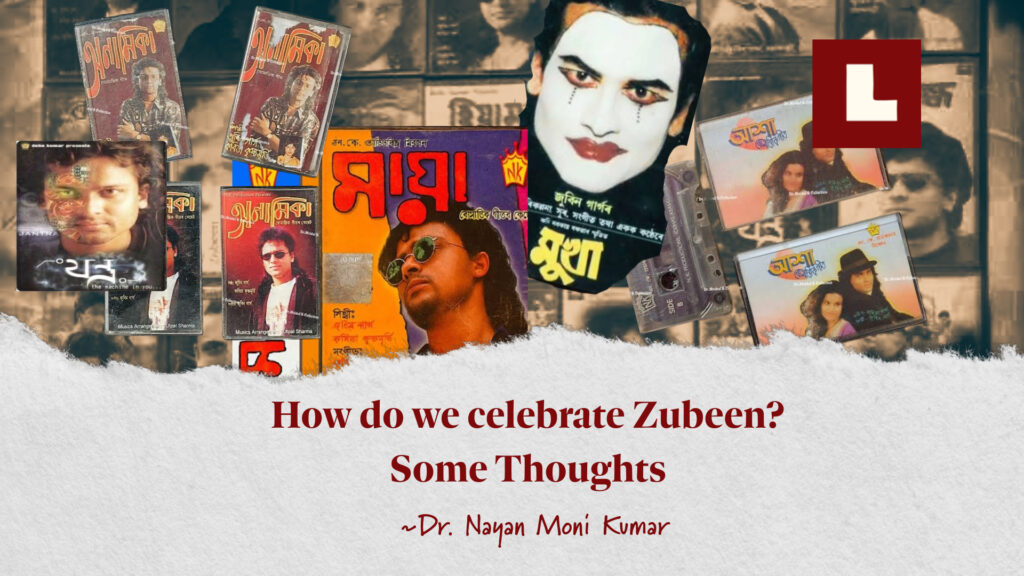

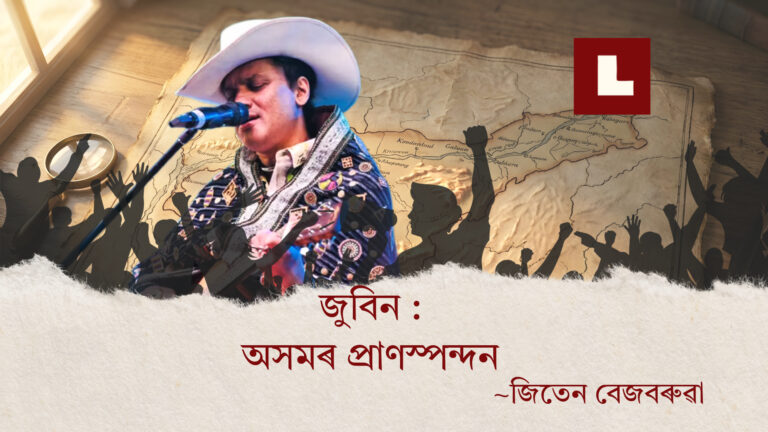
On the first death anniversary of Zubeen Garg, an image of him has been circulating online with the following line: Lived as an Atheist, Died as a God. This line captures the essence of a simmering debate that has been currently going on. For starters, this is not a new and Zubeen is not the only figure that been the subject of this debate. We live in a republic where living beings have been deified from ancient to the modern times. Gautam Buddha did not preach the existence of God but he himself was deified by his followers. Coming to the irony of our times, our politicians don’t even flinch to claim that our current Prime Minister is the 11th avatar of Lord Vishnu. Modern politics is full of instances about deification of leaders. In politics such developments are no rarity.
But what about others? What about sportspersons? Film stars? Musicians? In sports we have an example: Sachin Tendukar, who is revered as the god of cricket. When it comes to films, we can safely say that Rajnikanth has attained such a status. At least among certain fans, he has acquired such a status. The same deification has now happened with Zubeen Garg; to remind you, Zubeen considered himself as an atheist. Thus, popular personalities achieving cult like status or even semi religious status is not anything new if we see it in the broader light; of course the degree of ‘devotion’ may vary.
My concern in this piece is with the ongoing attempt to control the narrative by certain elites from the Assamese middle class.
A few prominent faces from the elite circle from the Assamese middle class were quick to jump in the fray and argue that Zubeen should not be deified because he himself was not a believer in god. Monoj Goswami made this argument. Prominent educationist Dinesh Baishya in a Facebook post has objected to the offering of prayers by Hindus (reading Namghoxa), Muslims (offering Namaz) and organizing other religious practices (maybe Naam-Proxongo? I am only guessing here as he does not mention about it). Both the arguments had its takers.
Where do we locate these arguments? Coming from the discipline of political science, I locate this within the broader debate of secularism (using the term here in broad sense to include the larger social processes and not just state religion binary). Both these arguments carry an underlying sense of superiority: one based on modern secular rationality. One that is logical, practical, evidence based. This line of thought argues that Zubeen can only be and should be preserved though scientific research, though institutional promotion, through academic engagement, through literary works, through theorization, through developing a pure institutional canon. This is not a wrong argument per se. In fact, such works will contribute immensely towards preserving the legacy of Zubeen Garg, in creating a cultural repository for the Assamese nationality. The problem is not in the measures per se.
The problem is in the assumed moral superiority of such measures. The problem is in the underlying contempt of the popular. Most importantly, the contempt is in raw, adulterated, uncontrolled emotions. The problem most importantly is the lack of control over the narrative. In the popular, Zubeen cannot be defined in one single sense: Zubeen is god, Zubeen is a communist, Zubeen is a Zubeen da, Zubeen is Luit Kontho, Zubeen is……
In rejecting the popular there is a complete denial of people’s aspirations. Why this needs to be emphasized upon is that Zubeen’s death anniversary almost coincided with the birthday of our Prime Minister Narendra Modi which was on 17th September. As a mode of celebration of the living god, our chief minister Himanta Biswar sarma urged the people of Assam to light earthen lamps. Now one may argue against the idea of deification as both Modi and Zubeen has been deified. But one must also acknowledge the fact that, both do not fall in the same continuum. Deification of Modi is a political project, backed by the state. Deification of Zubeen? A spontaneous outpour of raging emotions, betrayed by the state.
Any observer of the ongoing developments would know that Zubeen’s is not a political project (not yet!). It is people coming in together to celebrate his life. The shortcoming of the elite discourse is the ignorance (deliberate or otherwise) or a denial of the tolerance and harmony that the society has come to witness. In our country, where public spaces themselves have become communal, Zubeen Khetrohas emerged as a place of religious inclusivity. It wont be difficult for the pertinent observer to argue that When Zubeen died, the state witnessed a sudden halt of communal politics, even if only for a few days. Hindus, Muslims, Christians, people from all religious backgrounds mourned the loss of the icon. That was a rare social development. One can see the continuation of such harmonious tendencies in the multi-religious prayers being offered in the site. Merely rejecting it just because it does not suit ones’ sense of being secular/modern is obnoxious. It is a form of elitism that must be questioned.
Of course the concerns raised about the possible appropriation of Zubeen by communal forces is a legitimate one. But it is not exceptional. In a democracy public figures can be appropriated for political ends as democracy allows free flow of meanings in the public realm. Such free flow allows for deliberations, contestations, submissions and even rejections. But one must be careful about the attempts at controlling the narrative: that he should be celebrated only in a particular manner or form. Such controlling narratives are limiting, it holds a more dangerous potential to restrain, to limit. One can witness, such narrative control in the case of Bhishu Rabha, the cultural political icon who is now celebrated as Kola-Guru by the mainstream, while his political identity is shut out.
At this juncture Assamese society acknowledges that Zubeen was not merely an artist. His art was political. It had its limits and one must interrogate those contradictions too. But his political tone created friction with the ruling establishment. The deification of Zubeen Garg throws up a challenge to the current populist regime in a pertinent manner. In Assam’s politics the consolidation of Hindutva and the rise of Himanta Biswa Sarma have gone hand in hand. One has supported the other. The image of HBS has become so tall that it won’t be wrong to argue that, the popularity and the reach he enjoys today is unprecedented. Backed by traditional media and digital platforms, Sarma today is larger than life. The absence of another power/ideology to balance the rise of HBS is too visible. In this vacuum, the presence of Zubeen Garg’s deification assumes significance from a political perspective. There have been times when both HBS and ZG had acknowledged that their ideologies stand apart. Zubeen’s politics, despite its limitations give people an alternative imagination.
When Zubeen spoke ‘Mur kunu Jati Nai, Mur Kunu Dharma Nai, Moi Mukto’, it contains the potential to challenge to the Hindutva order. Of course, it will require much political work. But the ideological vacuum in Assam’s politics can be filled in by the celebration of Zubeen. Here must also consider a significant factor: the presence of social media while gives the ruling class much ability to control the narratives, social media itself is a site of contestations where counter narratives remain at work. In this regard, the sustenance of the ideas of Zubeen Garg can be seen as a possibility.
What I’m presenting here is an ideal version of political possibility. It can certainly go sideways. Like I argued, appropriation of Zubeen is a reality. His deification can become too rigid to become violent, exclusive or even intolerant. Those are all possibilities. But the beauty of politics lies in the fact that, possibilities works in multiple ways. I am hopeful, so may you be!