Discourses From the East
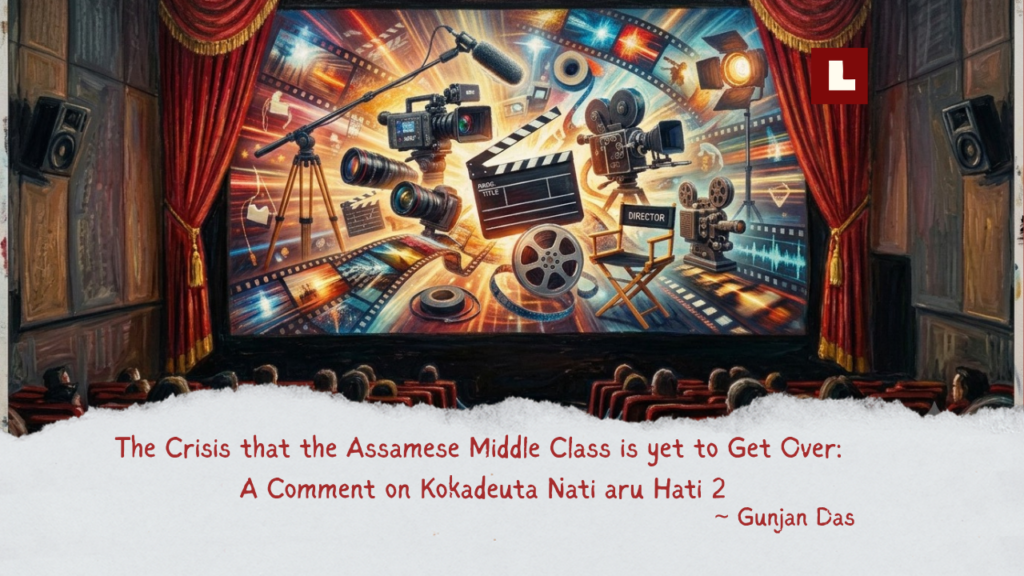

By the end of this piece, the reader may be as unsure as I am whether it is a film review or an attempt to unveil a social reality lying beneath the latest Assamese film Kokadeuta, Nati aru Hati 2, a sequel to 1983 film by the same name. Well, what connects both the films is perhaps only the name. What’s running in the theatres is an obnoxious mixture of the rural nostalgia of a waning middle class with the contemporary fast-paced masala action that has become an unavoidable seasoning in film-making, all thanks to Bollywood & Tollywood!
In the spirit of Tapan Das and Jatin Bora’s high-velocity duel scenes that are very much fast-moving, I too shan’t stretch this long and just say it straight – it is time the Assamese middle class moved on from its romance with the ‘rural’, a romance founded upon an image that contains a colonial-era mauzadari bhadralok dressed in the brightest and fairest dhoti, seleng and kurta, residing in a big bungalow with very precious, rare and old artefacts and a swing chair by the verandah and lots, lots of lagua-liksou (servants)! It is a guilty pleasure of that population that now confines themselves into Guwahati flats, having sold off its village land, and occasionally visits Anuradha cineplex to reminisce, with a sigh of “ah, those days! the days of our fathers!”, their lost grandeur they once enjoyed among the village ‘smallfolk’.
This is what Kokadeuta, Nati aru Hati 2 repeats. It follows the same template once applied by Munin Barua in his films like Hiya Diya Niya, Kanyadaan, Sarathi, Nayak, Priyar Priyo and appreciated by an audience that was fast urbanizing and getting introduced to the dilemma of balancing city luxuries and the nostalgia over the smell of the soil of their village – expressed in countless homecomings across the films (young son of a village bhadralok returning from abroad to his roots). This is the trope that reshaped Assamese film industry with its commercial films in the 1990s, at a time when neoliberal transition was remaking the social fabric: the rural-urban relations, the making of new middle class and cultural assertion in light of a western dream of luxury and mobility.
This template reflects a culture of hierarchy legitimized in the name of caste, identity and colonial legacy. The rich village bhadralok is often what remains of the erstwhile mauzadar family of a village (as played by Pranjal Saikia as the patriarch Prasanta Saikia in KDNH2). These families can be traced to an administrative system that Jenkins modernized in the 1830s and was later re-introduced as a method of collecting tax from the village cultivators (ryots). Those appointed were the native caste elites, erstwhile office-bearers of a fallen Ahom kingdom – a colonial method to avoid disruptions of the traditional hierarchy that was in place between the upper caste noble officials and the lower caste ryots. The films still portray this relationship between the rich families (who draw lineage to those colonial tax-collector families) and the villagers as a relationship based on amity, reverence and respect, hiding the actual relation of extraction and exploitation upon which it was once originated.
In KDNH2, unsurprisingly, the village folk are turned into an impersonal, passive multitude – always gathering in groups, peeping and gazing at Prasanta Saikia’s newly arrived grandson out of curiosity (what does an American grandson look like? And a Saikia, no less!), comically silly in their straightforwardness. The rich family is civilised, ‘bhadra’ and ‘sabhya’, while the poor villager is naive, humble, funny, and always ready to worship and serve them. A relation built on colonial middlemanship and extraction is depoliticised into one of traditional reverence, unconditional service, and almost a matter of faith. The irony is that such a relationship barely exists in Assam today and survives only on the silver screen – making it such an effective bait for a middle-class audience drawn to the theatre for a taste of that nostalgia. Directors and producers perhaps know this already.
This is not the only problem in the film however. In KDNH2, the love affair that slowly develops between the homecoming grandson Ankur and Tuhin shows how rural becomes the site of femininity, set against a masculine urban environment of work, wealth and constant change. A perfect Swades-like story – an urban guy returns to his roots and falls in love with a simple village girl. Tuhin is, then, the village personified – representing the stagnancy, natural beauty and the serenity of rural life, and passive recipient of change that takes place in the urban. The American boy Ankur comes to Kampur village and as he gradually starts to love his village and all its attributes, also begins to grow affection towards Tuhin, despite her silliness and simplicity. Tuhin represents the village that Ankur falls in love with despite growing up in the dopamine-high American culture. This is a recurring problem: these subtle turns in the stories show how, in popular cinema, gendered lens shapes how the rural/agrarian life is portrayed and fetishized from an urban middle class gaze.
Throughout the film, the comparison between American and Assamese culture is exaggerated just too much. Ankur repeats the rhetoric of America as the land of freedom and rights in front of his grandfather. Here the moral high ground is established: he is reminded that mere freedom will not emancipate him, he needs to be a responsible youth (meaning that he needs to respect his native culture and village) – the classic “duty over rights” narrative. The two cultures are set in contrast in a weirdly ironic scene of Ankur dipping the pizza into curd made from buffalo milk. It was around the time when Ankur was struggling and recovering from his drug addiction. But, but! A few minutes later, the movie goes on to add an item song at a club in Guwahati where Prastuti Parashar appears as the flashy, high-energy item girl. The traditionalist bias in favor of Assamese culture that the film carefully builds is ultimately contradicted by the item song that appears as an indispensable ingredient for the film’s box office success. The film relies exactly on the thing against which it tries to build its moral high ground of tradition and rural-life. This is simply a double standard.
Now I come to Brikodar, the incomprehensible mystical element in the film. The elephant Brikodar comes to rescue Ankur every time he is in danger, and in the final scene, Brikodar even joins the fight against the badfolks. The fight was between the patriarch of the rich Saikia family, Prasanta Saikia and his vengeful serviceman Birinchi (played by Tapan Das) over an age-old conflict about property share – a typical material conflict, testament to real village politics over property and service. But the entry of Brikodar as a savior of the rich family mystifies that material conflict. Brikodar appears out of nowhere and kills the villain Birinchi, and then disappears. The End! This is a dangerous ideological smokescreen. Popular cinemas, despite their political blindness, cannot avoid everyday human relations, conflicts and problems. It does cater to them. But in the process of attending to them, it mystifies them. The solutions turn impractical, mere fantasy. The film Jawan was very explicit about its take on corruption as a crisis of the country. But what did it do to that crisis? It created a rogue team out of it, and a hero to which only Shah Rukh Khan could do justice.
Kokadeuta Nati aru Hati 2 falls into the same series of films that often try to exploit its predecessor’s success and disappointingly fails to live up to its own expectations and promises. And time and again, films like KDNH2 reveal a crisis haunting the Assamese middle class – a class shaken from within. They fear their land being taken by an alien other (read ‘miya people’), or whine that people are not being truthful and loyal to their culture, heritage and language. While they mourn over their land slipping away from under their feet and their culture and language fading from relevance, they are also desperate to hold onto their position as the primary ideology-maker and leader of the Assamese community – whoever it may include. KDNH2 is one such latest attempt of this ideology-maker. It glorifies the hierarchical relations at the expense of a genuine introspection into how the relations hide a history of extraction and whether they exist in Assam today or not. These films reflect the desperate attempt of a class to survive itself by bringing nostalgia to its rescue.
Lastly, it is understood that today the middle class audience can’t avoid item songs and fast-paced actions, yet it’s too early for them to get over their fetishism of an ideal Assamese rural landscape. A commercially motivated attempt to make a pair of these two extreme images gives you Kokadeuta Nati aru Hati 2.