Discourses From the East
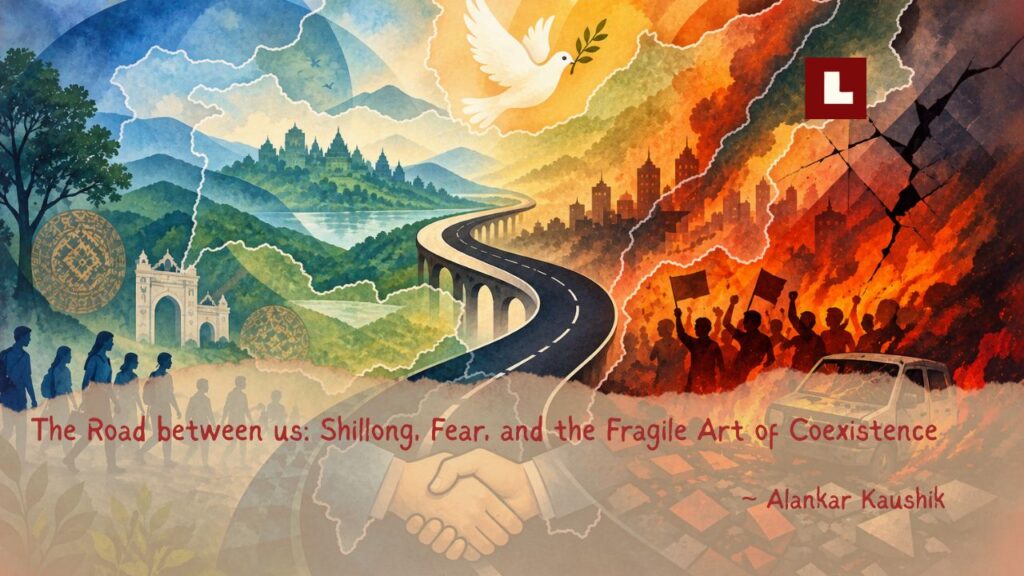

On most days, the road between Guwahati and Shillong is an unremarkable stretch of asphalt. It carries students rushing to classes, families attending weddings, patients seeking medical care, traders transporting goods, tourists escaping the heat of the plains, and workers commuting between two deeply interconnected states. It is, in many ways, a living symbol of coexistence in Northeast India.
Yet in August 2026, that same road came to represent something else.
Following a black-flag rally organised by the Khasi Students’ Union (KSU), Shillong witnessed a series of violent incidents that unsettled not only Meghalaya but the wider region. Vehicles were vandalized and allegations emerged that Assam-registered vehicles and Meghalaya government vehicles had been specifically targeted. What began as a political mobilisation around issues of indigenous rights, migration, employment, environmental concerns, and governance quickly acquired a wider significance. The violence triggered protests in Khanapara and Jorabat, disrupted transport services, and generated anxieties that travelled far beyond the streets where the incidents occurred.
At one level, this was a story about protest and law and order. At another, it was a story about something much deeper: the politics of fear, the fragility of coexistence, and the ease with which societies begin imagining one another as adversaries. More than a century ago, Bertrand Russell explored these questions in Why Men Fight. Writing during the First World War, Russell argued that conflicts are rarely driven solely by material interests. Human beings fight because they fear the loss of security, identity, influence, dignity, or belonging. Fear, he believed, is often more powerful than reason. This insight remains remarkably relevant in understanding Shillong’s recent violence.
The demands raised by the KSU reflect concerns that have long existed in Meghalaya. Questions relating to migration, local employment, environmental protection, land rights, and indigenous identity are not new. They emerge from genuine anxieties about preserving culture, securing opportunities, and protecting communities in a rapidly changing world. Such concerns deserve democratic engagement and serious policy attention.
It is equally important to recognise that Khasi anxieties did not emerge in a historical vacuum. Meghalaya is one of India’s smallest states, created in 1972 after a long political movement that sought constitutional safeguards for indigenous communities. For many Khasis, concerns about migration, demographic change, land ownership, and employment are shaped by a collective memory of being a numerically small community situated amidst much larger populations. Across the Northeast India indigenous groups have repeatedly confronted questions of migration, language, political representation, and cultural survival. In this context, the fear of becoming marginal in one’s own homeland is not merely a political slogan; it reflects an existential concern that has shaped indigenous politics across the region for decades.
Yet history also demonstrates that existential anxieties need not inevitably culminate in exclusion or hostility. Democracies are designed precisely to address such fears through institutions, dialogue, constitutional safeguards, and public deliberation. In Meghalaya, the constitutional protections available today, particularly those embodied in the Sixth Schedule, were earned through a prolonged historical and political struggle rooted in the desire of indigenous communities to safeguard their distinct identity, land, customs, and institutions.
The central question, therefore, is not whether Khasi concerns are legitimate, they often are but why, despite these hard-won constitutional guarantees, many indigenous communities in Meghalaya continue to experience a sense of existential insecurity. At one level, the very existence and endurance of these safeguards testify to the success of democratic institutions in recognising and protecting indigenous rights. Yet the persistence of such anxieties suggests that constitutional protections alone do not automatically generate a lasting sense of security.
If the Khasis, and other indigenous communities, continue to fear that these safeguards may be weakened, diluted, or insufficiently enforced, then the underlying concerns that shape public debates on identity, migration, and belonging are likely to persist. The challenge for democracy, therefore, is not only to provide constitutional guarantees but also to cultivate public confidence that these protections are robust, meaningful, and capable of addressing genuine concerns. Russell’s insight remains instructive: fear becomes dangerous not when it exists, but when it ceases to be questioned and begins to dominate public life.
Fear possesses a unique ability to simplify reality. Complex social and economic problems become reduced to identifiable targets. Structural issues become personalised. Communities begin searching for visible explanations for invisible anxieties. The outsider becomes the problem. The migrant becomes the threat. Difference becomes a source of suspicion.
Russell warned that when societies organise themselves around fear, they gradually lose their capacity for nuanced thinking. Every issue starts appearing existential. Every disagreement becomes a confrontation. Every compromise begins to look like surrender. Democracy, after all, is a political system; the human mind itself is not naturally democratic. The mind prefers certainty to ambiguity. It seeks confirmation rather than contradiction. It is more comfortable with familiar narratives than uncomfortable truths. We are naturally inclined to listen to voices that agree with us and distrust those that challenge our assumptions.
Russell understood this tendency long before the age of smartphones and social media. He observed that fear narrows human imagination and reduces the willingness to engage with alternative viewpoints. Today, social media amplifies this tendency in unprecedented ways. The Shillong violence unfolded not only on the streets but also on screens. Within hours, videos, photographs, and messages circulated across digital platforms. Most people experienced the event not directly but through carefully framed visual fragments. They saw damaged vehicles, angry crowds, emotional testimonies, and dramatic scenes of unrest.
The power of such images lies in their immediacy. They provoke emotion before reflection and create impressions before context. A burning vehicle can generate fear within seconds. A video clip can create outrage before facts are fully established. An image can become more influential than a detailed report. Yet visual evidence is rarely complete. Images show moments, not histories. They reveal events but often conceal causes.
Social media platforms intensify this problem because their algorithms reward emotional engagement. Anger travels faster than nuance. Outrage receives more attention than context. Fear generates more clicks than complexity. As a result, conflicts become highly visible while coexistence becomes invisible. Thousands of peaceful interactions between the people of Assam and Meghalaya occur every day. Students share classrooms, businesses share markets, families share relationships, and friendships cross state boundaries without a second thought. Yet these stories rarely appear in viral posts.
Violence is dramatic. Coexistence is ordinary. And because it is ordinary, coexistence often goes unnoticed. Perhaps the most revealing aspect of the Shillong violence was the symbolism surrounding Assam-registered vehicles and also government vehicles from Meghalaya. A registration number is, in reality, an administrative detail. Yet during moments of conflict, it acquires a different significance. The vehicle ceases to be a vehicle. It becomes Assamese or Khasi, outsider or local. The person inside disappears behind the identity attached to the symbol.
Russell repeatedly warned against precisely this process. Human beings become capable of hostility when they stop seeing individuals and begin seeing categories. Once people are reduced to labels, empathy becomes more difficult. Stereotypes replace human stories. The number plate becomes a border. And once borders are created in the imagination, they become much harder to remove from reality.
The reactions in Assam following the violence demonstrated how quickly such dynamics spread. Reports from Shillong generated fear among drivers, transport workers, and ordinary citizens. Concerns about safety were understandable. Yet fear possesses a contagious quality. It travels across regions, communities, and digital networks. What begins as a local incident soon acquires regional significance. Rumours multiply. Assumptions harden. Communities retreat into defensive positions. The cycle becomes self-reinforcing.
At this point, another actor often enters the story: the political opportunist. History repeatedly shows that moments of uncertainty create opportunities for those seeking influence. Fear can be converted into political capital. Anxiety can be transformed into mobilisation. Social divisions can become valuable political resources. This does not mean that every movement is insincere or that every grievance is manufactured. Genuine concerns often exist and deserve attention. However, genuine concerns can also be exploited. The politics of fear operates through a simple logic: identify a grievance, attach it to a visible target, amplify the threat, and then present oneself as the solution.
The result is that communities begin defining themselves not by what they wish to build, but by what they fear losing. Hope becomes less important than protection. Dialogue becomes less important than mobilisation. Cooperation becomes less important than confrontation. Russell regarded this as one of the central tragedies of modern politics. Societies possess immense creative potential, yet fear often prevents them from realising it.
The irony, of course, is that Assam and Meghalaya have far more reasons for cooperation than conflict. Their economies are linked. Their cultures interact constantly. Their futures are intertwined. The road between Guwahati and Shillong carries not only vehicles but relationships. The story of Northeast India is not merely one of difference. It is also a story of coexistence. The challenge today is to ensure that coexistence remains stronger than fear.
The lesson of Shillong’s August violence is therefore not simply about law and order. It is about recognising both the legitimacy of indigenous anxieties and the dangers of allowing fear to become the dominant language through which those anxieties are expressed. Democratic societies succeed not by suppressing fears but by creating institutions capable of addressing them peacefully. The Khasi fear of cultural erosion deserves to be heard. Equally, the fear generated among ordinary Assamese citizens following the violence deserves recognition. Neither fear should be dismissed; neither should be weaponised.
Perhaps this is where Russell’s century-old wisdom speaks most directly to our moment. The true challenge is not the existence of difference but the temptation to transform difference into permanent division. The greatest borders are often invisible. They are built inside the mind. Once those borders are accepted, every stranger appears suspicious, every disagreement becomes a threat, and every number plate becomes a symbol of separation.
The task before both Assam and Meghalaya is not merely to restore normalcy. It is to protect the far more fragile idea that has always sustained the region: the belief that people can belong to different communities, speak different languages, hold different histories, and still share a common future. For coexistence is not the absence of differences. It is the democratic decision not to let differences become divisions.