Discourses From the East
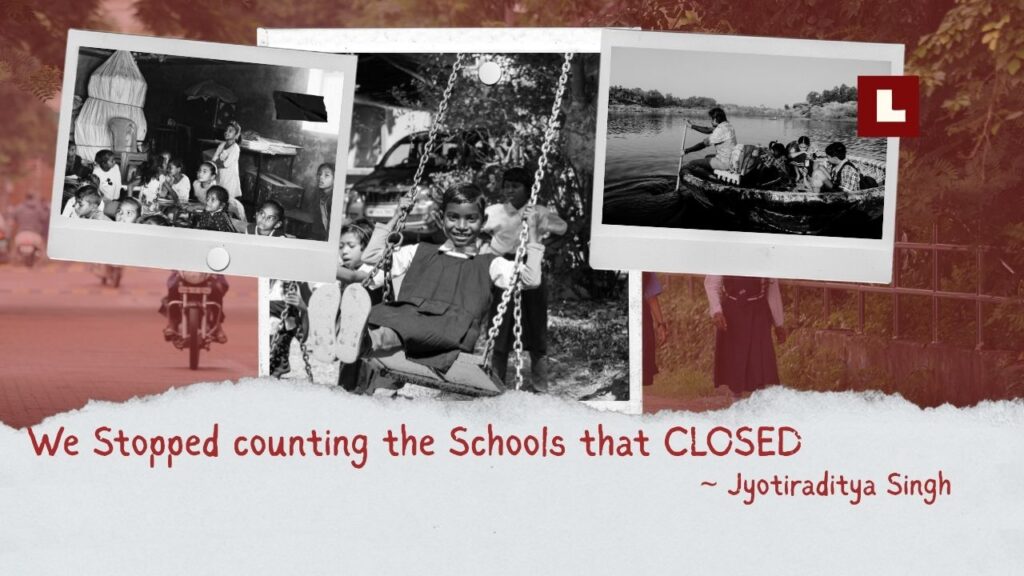

Twenty-five schools close down every single day across India. That number comes straight from a NITI Aayog report, and once you sit with it, the weight becomes hard to shake off. Over the last decade, nearly ninety-four thousand government schools have shut their gates in the name of ‘rationalisation’, which was an agenda of the New Education Policy, 2020 A NITI Ayog Report titled “School Education in India” noted that across the country enrolment has dropped by 2.26 crore students. Behind every one of those figures sits a classroom that has gonesilent, a blackboard nobody writes on anymore, and a village where children now walk further, or simply stop walking at all. The empty buildings have become a reflection of the environment across the country now, and it is attributed to a “smaller school-age population because of falling fertility rates, school consolidation, and challenges in retaining students at higher levels of education”.1
Ask why, and the answers pile up fast. Migration pulls families toward cities in search of work, leaving rural schools half empty. Private tuition centres and English medium academies lure away students whose parents believe government schools carry a stigma of poor quality. Teacher vacancies remain unfilled for years in many states, forcing single teachers to handle five or six grades at once. Infrastructure crumbles quietly: no toilets, no drinking water, no electricity, until parents lose faith and pull their kids out. The impact of sanitation on the girl child is higher in comparison to the boys, as nearly one lakh schools do not have a functional girls’ toilet, while nearly 61,540 schools do not have a girls’ toilet facility at all.
But here’s the part young readers should sit up for: this crisis will define the workforce you inherit. The economy of the country cannot rely on a population without education or a gender gap in education that could grow from the above numbers. A generation growing up without steady access to schooling cannot compete in an economy that increasingly demands digital literacy, critical thinking, and technical skill. Every shuttered school widens the gap between rural and urban India, between those who get a shot at college and those who never even finish class ten. The dropout rate among girls climbs even higher, since safety concerns and household duties often decide who gets pulled first when a nearby school disappears.
Government schemes talk big numbers, but implementation on the ground tells another story. Merging small schools into larger hubs sounds efficient on paper, yet it often means a six-year-old walking three extra kilometres each morning. Digital learning initiatives promise a fix, but rural connectivity remains patchy at best, leaving those same children locked out twice over. It becomes a safety issue for a girl child at the doorstep for education, even more in a society which has disturbing stories of harassment on the streets while walking to schools daily. A decade-old report by an NGO called ‘Breakthrough’ indicated that nearly 50% of the girl students are harassed while travelling to their schools.2 In 2025, a study done in Kanpur City, India, which was a cross-sectional study results indicated that “70% of participants agreed that security concerns significantly affect decisions regarding girls’ education. The main concerns included harassment (60%), road safety (25%), and fears of kidnapping (10%).” This report was even astounding when 30% of parents reported discontinuing their daughters’ education due to these fears.3
Youth voices matter here more than most conversations around policy for which the government is given credit . College students, young journalists, and first time voters carry real leverage to push local representatives toward accountability. The details of demands could be: demand for teacher recruitment drives, push for functional toilets and clean water before another building gets abandoned. Most importantly, it is necessary to track how education budgets actually is spent at the district level instead of trusting news headlines and the advertisements by the governments.
Education builds the backbone of any nation chasing growth, and India cannot afford to watch that backbone weaken school by school, village by village. The NITI Aayog numbers work as a warning bell, loud and clear. Whether the country listens, or lets another ninety-four thousand schools vanish over the next decade, depends on how loudly today’s youth choose to speak up now.
References:
- https:www.indiatoday.in/education-today/news/story/government-schools-india-94000-shut-10-years-enrolment-falls-2-26-crore-2944178-2026-07-09
- https://timesofindia.indiatimes.com/india/50-of-girls-sexually-harassed-on-way-to-school-32-stalked-study/articleshow/51130446.cms
- https://pmc.ncbi.nlm.nih.gov/articles/PMC12244807/#sec6