Discourses From the East
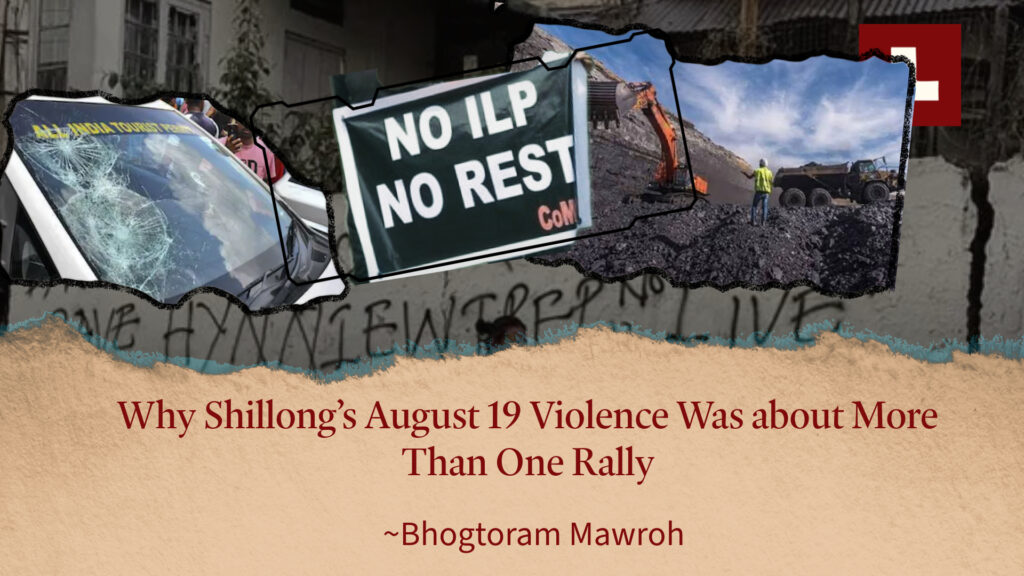

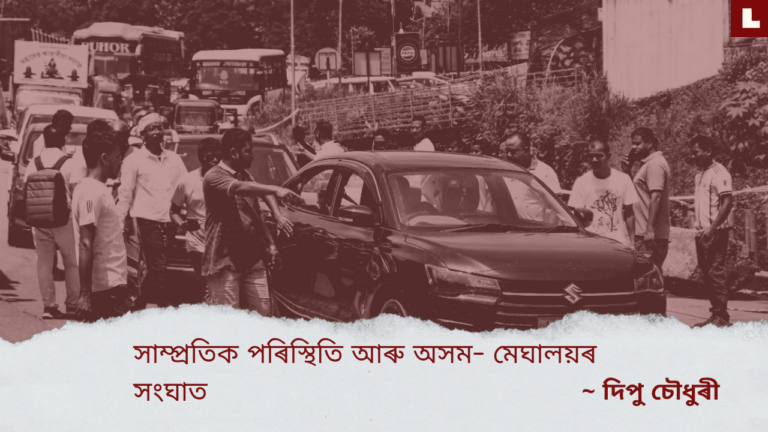
Shillong has become accustomed to incidents of violence during rallies organized by pressure groups. In 2022, when the FKJGP (Federation of Khasi Jaintia and Garo People) took out a rally to protest against the problem of unemployment, bystanders were assaulted and property was damaged. The risk of violence becomes especially heightened when rallies are organized by the Khasi Students’ Union (KSU), which is the most powerful among all the pressure groups. Founded in 1978, the group has been involved in agitation against a myriad of issues that are perceived as being threats to the safety and security of the local indigenous peoples’ community, i.e., the Khasi. This includes opposition to uranium mining, the introduction of railways, and the passage of the Citizenship (Amendment) Act, which sought to grant citizenship to non-Muslim refugees on the basis of religion, particularly those from neighbouring Bangladesh. Agitation on these issues has led to violence in the past, with lives also being lost. For example, in 2013, the ILP agitation took the lives of two persons in Shillong. The 2017 anti-railway agitation was also marred by many cases of violence in Meghalaya. Among them was a case of arson in which a petrol bomb was hurled at a house in Pynthorbah (close to the residence of the author). So, violence is nothing new in Shillong and does flare up every now and then. However, the violence on 19 August, which targeted Assam vehicles, was quite different. This time around, the issues were different, and the scale of the violence was unprecedented.
The KSU called for a public rally on 19 August, raising five demands: overhauling the MPSC and DSC recruitment systems to address corruption and nepotism and ensure fair appointments; implementing the Meghalaya Residents Safety and Security Act (MRSSA), 2016, until the Inner Line Permit (ILP) is enacted; implementing the amended Migrant Workmen Act, 2020; addressing structural and operational grievances related to recruitment at NEIGRIHMS; and cancelling the public hearing on the proposed Shree Cement projects in East Jaintia Hills. It was the last issue, i.e., the botched public hearing, which became a catalyst for the rally and, in many ways, contributed to the already existing anger that was responsible for the violence that took place on the 19th.
Shree Cement, a company based in Rajasthan, is proposing an integrated cement plant and limestone mining project at Lum Syrman, Nongkhlieh, East Jaintia Hills, at a cost of Rs 1,800 crore. The detractors of the project have claimed that the project will affect the heritage cave system, Krem Liat Prah, which measures approximately 30.4 kilometres in length, making it the longest natural cave in India. In the past, Lafarge, a French multinational company, had also planned to establish a mega cement plant around the same area, capable of producing one million metric tonnes of cement a year. However, once they realized the ecological sensitivity of the cave systems, they decided to withdraw from the project. Lafarge had already faced a lot of public scrutiny regarding its cross-border project that linked the quarries in Nongtrai (Meghalaya) to the manufacturing plants in Chhatak, Sunamganj, Bangladesh. So, the decision not to proceed with the Nongkhlieh project could have been an attempt to avoid getting into fresh controversy. But Shree Cement did not appear to be bothered about the possibility of any such controversy, and the public hearing at Nongkhlieh was meant to give legitimacy to the project. However, the local landowners and pressure groups, particularly the Jaintia National Council, had been adamantly opposing the project. So, when the date of the public hearing was announced, they wanted to take part in it and express their concerns.
The only word that adequately describes the public hearing held on 31 July 2026 is “sham.” The exercise was supposed to be conducted with all the stakeholders and not just those who supported the project. However, according to reports, even senior officials and scientists of the State Pollution Control Board were not present at the hearing. Instead, the roads were deliberately dug up to prevent people opposed to the project from attending the hearing. This was accompanied by incidents of violence and stone-pelting. In one particular instance, a Jaintia Students’ Union (JSU) ambulance was ambushed on the night of the 30th, a day before the public hearing. The JNC and the JSU have accused the state government, the police, and Shree Cement of orchestrating intimidation, road sabotage, and violence in the lead-up to and during the public hearing. JNC central president Sambormi Lyngdoh even released a video in which he accused the government of bringing police personnel from Garo Hills to detain JNC leaders and prevent locals of Elaka Nongkhlieh and Elaka Sutnga from participating freely.
The KSU had given a 15-day ultimatum to the government to arrest the culprits who committed the violence and cancel the public hearing. It also demanded the suspension of and initiation of departmental proceedings against the Deputy Commissioner and the Superintendent of Police of East Jaintia Hills, along with officials of the Meghalaya State Pollution Control Board, alleging that they failed to ensure a fair hearing. The rally on 19 August was called when the government did not accede to the demands. But why were the Assam tourist vehicles targeted if the anger was against the government?
In the last few years, tourism has boomed in Meghalaya, but many do not feel that it has benefited the local community. Prominent among them are the tourist taxi drivers, who have claimed that it is the Assam-based drivers who are taking away all the profits. In 2024, the All Khasi Meghalaya Tourist Taxi Association (AKMTTA) organized a public rally in Shillong to challenge the state government’s policies on tourism and local transport. The demanded that there should be restrictions on commercial tourist vehicles and cabs from Assam and other outside states from ferrying passengers directly to local sightseeing spots within Meghalaya. Outside vehicles should park at hotels or designated entry points, requiring tourists to hire local Meghalaya taxis for local attractions. However, the demand did not stem only from concerns surrounding a loss in earnings but was also a result of the years of harassment faced by Meghalaya drivers in Assam.
In reaction to the vandalisation of Assam-registered vehicles during the 19 August rally, all vehicles entering Meghalaya were blocked by the Assam-based associations, including tourist vehicles. This was a shock to their Meghalaya counterparts, who claimed that they had received an assurance that the vehicles would not be blocked. Therefore, in response, the Meghalaya-based associations also announced their own counter-blockade. And then, in an interview, Antrolias B. Marak, president of the All Shillong Tourist Taxi Association (ASTTA), revealed that harassment by Assam against drivers from Meghalaya had become endemic.
Antrolias stated that drivers from Assam have regularly told their counterparts from Meghalaya that they should not come down to Assam. Drivers from Meghalaya also do not get parking spaces inside the airport or outside the railway station and are thus deprived of earnings from passengers who are looking to visit the state. On top of this, when the taxis are parked in Guwahati or Khanapara, people would discreetly take photographs of their number plates without the drivers’ knowledge. Later, when the drivers go to the transport office to renew their papers, they are told that they have been served with a challan and have to pay a fine that can range from 20,000 rupees to 40,000 rupees. He reiterated that these are not mere allegations but facts. The harassment was specifically intended to compel drivers from Meghalaya to stop their operations and allow drivers from Assam to capture the entire business. So, anger against Assam’s harassment of drivers from Meghalaya had been building up for many years, and it explains some of the violence that took place at the rally on the 19th, in which Assam-registered vehicles were targeted. But the primary anger against Assam stemmed from another source.
Ever since Meghalaya became a state, there have been boundary tensions with Assam, which have often led to violence in Shillong. The latest incident took place in 2022, when five Khasi farmers, viz., Thal Shadap, Sik Talang, Chirup Sumer, Tal Nartiang, and Nikhasi Dhar, were killed by Assam Police and Assam Forest Guards when they entered Meghalaya and, according to Conrad Sangma, the Chief Minister of the state, “resorted to unprovoked firing.” This follows the years of harassment faced by Khasi farmers.
According to Patricia Mukhim, author, commentator, columnist, and Editor of The Shillong Times, the residents of Mukroh have been living in fear for a long time. They shared that “they live in fear while going to their rice fields because the Karbi Anglong forest guards harass them all the time and make them pay for their produce, which includes non-timber forest products like broomsticks and hay. The villagers of Mukroh claim that all the land now under the West Karbi Anglong District Council is their ancestral land. They say that when they go to their fields, they are on tenterhooks until they return home.” In the last few years, there has been a resolution on certain disputed sites between the two states. But disputes over Block I, Block II, Langpih, Khanduli, Psiar, and Barduar are yet to be resolved. Mukroh falls in Block I. Meghalaya claims that Mukroh is in West Jaintia Hills district, while Assam says the village falls under the Jirikinding police station area in West Karbi Anglong. A look at the official records, however, reveals that these areas were always under the jurisdiction of the Khasi polity, which, unlike most parts of Assam, which were under direct colonial rule, had an independent to semi-independent status with the British.
The Khasi traditional polities are organized around the Hima, below which are the Elaka and Raid, followed by Shnong. The Elaka in Jaintia Hills are still administered by the Doloi, who wielded a great deal of influence. That the villages under Block I and Block II were administered by a Khasi Doloi is confirmed by the 1961 District Census Handbook: United Mikir and North Cachar Hills. On page 129, it is clearly mentioned that the villages under Block I and Block II were under the jurisdiction of different doloiships — viz., Nartiang, Lalung Nanglung/Nanglong, Mynri, Nongjngi, Jynthong, Shilliang Myntang, Nongphyllut, Rallaing, Shangpung, and the Mynriang Sirdarship. One of these villages is Mynser, where U Kiang Nongbah, one of the greatest Pnar Khasi freedom fighters, is believed to have hidden during his rebellion against the British. He was finally captured after being betrayed and hanged. Assam, however, maintains that these areas were relinquished by Meghalaya when it attained statehood, a claim denied by the Khasis. So, every now and then, violence erupts along these disputed sites.
After the killing of the Khasi farmers by Assam Police and Assam Forest Guards, an inquiry committee was instituted, but to date, no one has been prosecuted. This created the perception that the culprits would never be punished. This is what happened in Langpih as well. In 2010, four Khasi villagers, viz., Columbus Hujon, Charles Lyngkhoi, Dennis Nonsiej, and Ekros Rani, were similarly killed in a firing by Assam Police. Till date, no one has been prosecuted. So, anger was building after the Mukroh killings. A month before the public hearing for the Shree Cement project, there were reports of Khasi farmers in Lapangap were prevented from working in their fields. Then, around the same time when Himanta Biswa Sarma was the chief guest of the Behdeinkhlam festival organized in Jowai, his Border Protection and Development Minister, Atul Bora, told the state Assembly that Meghalaya occupies 3,441.86 hectares of Assam land across five districts – Kamrup, Goalpara, Cachar, South Salmara-Mankachar, and West Karbi Anglong. To many Khasis, this appeared to smack of arrogance, where, instead of trying to mend relations, the Chief Minister seemed more intent on encroaching on their land. Considering the fact that Assam has been having conflicts with almost all of the states in the Northeast, this confirmed the widely held perception of Assam’s high-handedness and arrogance.
On the surface, the rally on August 19 had nothing to do with Assam. It was aimed at the state government, which since then has continued to come under petrol bomb attacks on multiple occasions. The first of the attacks followed soon after the public hearing and since then has continued intermittently, with a couple of government offices being attacked. However, the people who took part in the rally were also holding a grudge against the high-handed attitude of Assam, which has actually become a very volatile political issue over the last few years. It has appeared in the statements and press releases of many political parties as well. This is compounded by the attacks on Christian institutions under BJP-ruled states, which create a sense of unease among the predominantly Christian population. The BJP-ruled government in Assam is also in favour of the CAA, which is considered to be a big threat to the indigenous peoples of the region in general and Meghalaya in particular. In fact, the threat of influx, whether from across the border or from different parts of the state, has always been an endemic source of angst for the people in the state. In many ways, this has led to xenophobia and racism against those considered “outsiders” despite having resided in the state for many generations. Exclusionary ethics has long permeated Meghalaya’s political discourse and is becoming even more virulent.
All of this, when combined with the concerns around profits from tourism and especially the anger at the killings of Khasis along the border, created a situation in which violence was not very far away. In fact, apart from the disturbances discussed earlier, Shillong has witnessed many incidents of large-scale violence in the last few years, viz., the storming of the Governor’s house during the CAA protests, riots around the Them Motor issue concerning the relocation of the Dalit Sikhs, and violence and arson during Independence Day following the encounter of former HNLC (a banned militant outfit) leader Chesterfield Thangkiew. In fact, there was a much less well-known incident of some people trying to snatch the weapons of armed personnel in Laitumkhrah, with the police vehicle being torched in the process. So, Shillong and Meghalaya have been simmering for some time now, and the violence on August 19 was just another expression of it. There is every chance it won’t be the last. Till then, we will have to just wait and hope that the next one is not bigger.