Discourses From the East
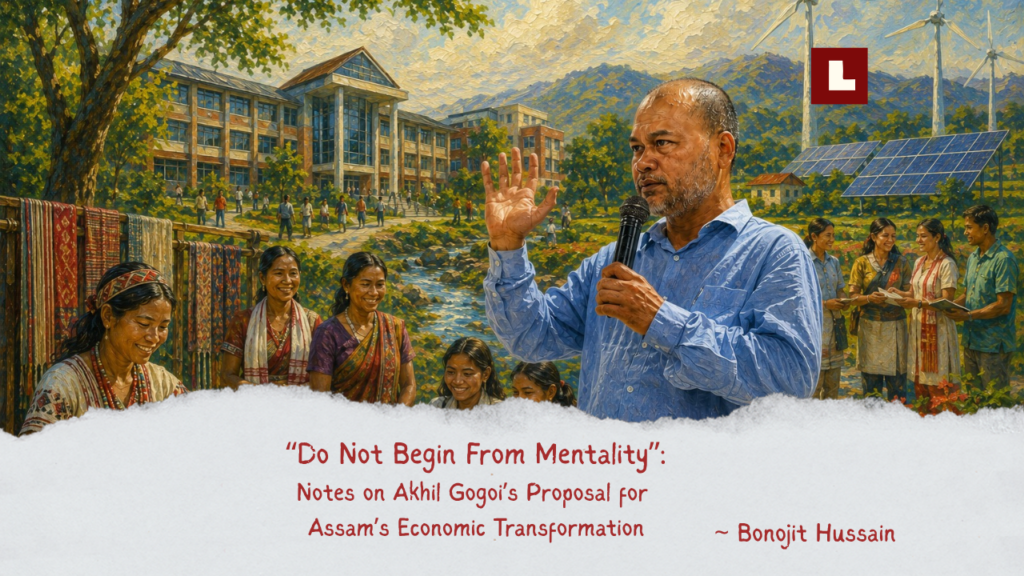

On 3 July, at Silpagram in Guwahati, Raijor Dal’s youth organisation, Jatiya Juba Bahini, marked its fourth foundation day with a special lecture by Akhil Gogoi titled “অসমৰ অৰ্থনৈতিক ইস্তাহাৰ” or “Assam’s Economic Manifesto.” Several independent thinkers, intellectuals and activists were invited to engage with the lecture. I was one of them.
Before the lecture began, Gogoi handed me a copy of the paper and asked me to be a harsh critic. That request itself was important. Assam politics rarely asks for criticism before a speech. Usually, leaders want applause after they have spoken. Gogoi wanted the argument before the lecture began.
The lecture matters because it tries to add economic design to a politics shaped by protest. That is not a small shift. For too long, our political language has moved between identity, grievance, subsidy, sentiment, and election management. Gogoi was trying to ask a larger question: how can Assam reorganise its economy and build productive power?
[Watch Akhil Gogoi’s full speech here]
The problem is not that the proposal lacks imagination. The problem is that it sometimes has too much confidence in design. It assumes that technology, clusters, mission-mode governance, professional training, and market capture can reorganise Assam’s economy from above.
The lecture ran for nearly two and a half hours and ranged from village-level industries across Assam’s 26,000 villages to professional training, technology, employment, export strategy and market capture. I cannot deal with all of it here. Gogoi’s framework has five broad parts: Sewuj Swaraj (Green Swaraj), Gram Swaraj (Village Swaraj), Nagar Swaraj (Urban Swaraj), Pechadari Assam (Professional Assam), and Bazar Dakhal (Market Capture). My comments are limited to Sewuj Swaraj, Gram Swaraj and Bazar Dakhal, because these are where the proposal most directly meets land, water, cultivation, village institutions, production and markets.
Gogoi identifies feudal mentality, tribal mentality or tribality, and consumerist mentality as constraints in Assam’s economic development. I am not engaging here with the argument about consumerist mentality, partly because it would require a separate discussion of consumption, welfare, debt, and aspiration. In these notes, I focus on the first two: feudal mentality and tribal mentality or tribality.
His concern is not simply cultural. He argues that because of these mentalities, money in Assamese society does not get transformed into productive capital. It is spent, saved, consumed, or held, but not sufficiently reinvested in production, enterprise, and market power. This is an important question. Why does surplus, where it exists, fail to become productive capital? But I think Gogoi’s answer confuses the surface with the structure.
What appears as feudal mentality is often the expression of older land relations that still survive in changed form. Informal patronage, dependence on local big men, insecure tenancy, adhi cultivation (share cropping), informal credit, ethnicity, caste and community hierarchy, control over irrigation, fear of social sanction, and dependence on local officials all produce certain forms of behaviour. From above, these behaviours may look like lack of initiative, fear of risk, dependence, or suspicion of collective work. But they are not simply mental habits. They are produced by material relations.
The same problem arises with the word tribality. If it means subsistence logic, kinship obligation, limited market dependence, collective norms, or limited accumulation, then it becomes a dangerous shortcut. To be clear, hill, forest, tribal, and community-based economies do have distinct histories of land, reciprocity, authority, and ecological use. But those must be analysed as concrete social relations, not reduced to a vague cultural deficit called tribality.
The issue is not a feudal mind or tribal mind. The issue is that land, credit, markets, bureaucracy and risk are organised in ways that make productive investment difficult. Money may exist, labour may exist, even surplus may exist, but the conditions for turning them into secure productive capital are often absent.
So I would put it differently. Do not begin from Assamese mentality. I am using “Assamese” here in the broadest possible sense. Begin instead from Assamese relations. By relations I mean the actual arrangements through which rural life is organised: who owns land, who cultivates, who lends, who borrows, who works for wages, who migrates, who depends on kinship, whose unpaid labour keeps the household running, who reaches the market, who deals with the local state, and who bears the loss when the crop fails. In other words, these are the social relations of production, exchange, and reproduction.
Take the cultivator on government land. On paper, such a person may be an encroacher. In practice, the household may have lived there for generations, paid some form of tax, voted from that address, received welfare benefits and improved the land over. But the claim remains suspended. The household cannot fully invest, cannot fully borrow, cannot fully plan, and cannot convert labour or savings into secure productive capital without fearing eviction, dispute, or arbitrary pressure. It also cannot fully refuse the local official or political broker. If such a cultivator avoids long-term investment, is that feudal mentality? If such a cultivator does not behave like a confident entrepreneur, is that tribality? No. This caution comes from what I have elsewhere called Assam’s regime of ambiguity, where the state recognises people enough to govern them but not enough to secure them.
The same is true of adhi cultivators, insecure tenants, and households dependent on informal credit. What appears as mentality is often the surface expression of a relation.
This matters because agriculture is not a box separate from everything else. A rural household is not only a farming unit. The same household may combine farming, wage work, welfare income, petty trade, debt, migration, cattle keeping, kinship obligations, and market consumption. Within this household, women’s labour often holds together food, care, seed, livestock, petty trade, and daily consumption, even when policy language treats the farmer as male. A household does not grows paddy because it gives the best cash return. It grows paddy because paddy gives rice, straw, fodder, social legitimacy, seasonal rhythm, and some control over hunger. I have elsewhere called this the ecological ledger of the peasant household.
This is where many policy proposals fail. They treat the field as an economic surface. But the field is also a social and ecological surface. After harvest, the same field may become grazing ground, a place for gleaning, a source of wild greens, a pathway, a cattle space, and a temporary commons. What appears fallow from the road may not be empty in village life.
This is why Gogoi’s three-crop proposal needs a harder look.
In the written paper this appears more generally as multiple cropping through irrigation, machinery, and land pooling. But in the lecture he put it more directly: farmers should cultivate three crops, paddy, mustard, and maize. If farmers do three crops, land revenue will be waived. If land lies fallow, farmers will have to pay three times the revenue.
This is a dangerous way to frame a real question.
Paddy, mustard, and maize in one annual cycle may work in selected areas if irrigation, drainage, machinery, storage and market support are in place. But it cannot become a general theory for Assam.
Paddy, mustard, and maize belong to different ecological regimes. Paddy needs standing water or reliable moisture. Mustard needs dry and well drained soil. Maize needs nutrients, timely moisture, drainage, and careful management. To grow all three in a tight annual cycle, cultivators need control over both water and dryness. Assam’s problem is that water does not obey such neat calendars.
We do not face only water scarcity. We face unstable water. Flood, dry spells, late rain, sudden excess rain, waterlogging, sand casting, and drainage failure can all appear in the same agricultural year. Before Assam plans three crops a year, it must ask what kind of water year the cultivator is actually living through.
More importantly, any economic programme framed today must take climate change seriously. The question is not only whether paddy, mustard, and maize can be grown under present conditions. The question is whether these crops will remain ecologically viable in the same way over the next decade or two. Paddy faces unstable water, heat stress and uncertain transplantation windows. Maize is vulnerable to moisture stress, high input costs and pest pressure. If climate volatility deepens, a rigid crop calendar built around paddy and maize may become obsolete before the infrastructure around it is even built. A serious economic manifesto for Assam must therefore ask not only how to increase production, but what kind of production can survive the climate that is coming.
There is also an economic question. Three crops mean three rounds of seed, fertiliser, machine use, labour, pest management, harvesting, drying, transport, and sale. Gross output may rise. Net income may not. A farming household does not live on gross production. It lives on what remains after cost, debt, labour, and risk.
If everyone grows mustard and maize because a policy pushes them, who will buy? At what price? Where will it be stored? Who will process it? When will payment come? Without procurement, oil extraction, feed mills, storage, and price support, three-crop intensification can create three market crises instead of one.
Cropping intensity is not an economic theory by itself. A third crop is useful only if it adds net income without increasing ecological debt and household risk beyond control. The language around punishing fallow land should be avoided. Fallow is often adjustment, not idleness.
The proposal speaks of assured irrigation and flood control. But in Assam, flood control too often still means stronger embankments. Gogoi even suggested in the lecture that planting bhimkol, a deep-rooted local banana, along embankments will prevent breaches. Bhimkol may have value in stabilising soil in specific locations, and as a supplementary measure it deserves a place in local practice. But after 150 years of colonial and postcolonial hydraulic engineering that has tried to discipline a flood-pulse river system against its own nature, it is too simplistic to imagine that embankment failure can be resolved by planting along the edges. The breach and erosion problem is not external to this engineering history; it is partly produced by it. Embankments are not neutral walls. They change silt movement, drainage, wetlands, fisheries, and river behaviour. They may protect one area while trapping water in another. They often produce a cycle of protection, breach, repair, contracts, and renewed vulnerability.
Assam’s rural economy cannot be rebuilt on the assumption that water can first be controlled by engineering and then agriculture can proceed. Water itself is the centre of the political economy. I have argued elsewhere that Assam’s irrigation crisis comes from two mismatched inheritances: an embankment-first flood-control regime and a pump-based irrigation imagination borrowed from Green Revolution regions.
A serious Sewuj Swaraj must therefore mean more than green commercial farming and multiple cropping. It must begin from climate resilience. It must include floodplain management, drainage, wetlands, silt, fish, raised storage, crop choice by land type, and honest risk mapping. Some land can take three crops. Some land should take two crops. Some land may need one crop and a commons period. Ecology cannot be commanded by a crop calendar.
Land pooling is one of the strongest ideas in the proposal. Fragmented holdings make irrigation, mechanisation, storage, and market planning difficult. Pooling land can reduce cost and increase bargaining power. But land pooling is not only an economic arrangement. It is a social contract.
Who pools land with whom? Who decides the crop? Who controls the machine? Who keeps the accounts? Who bears the loss? What happens when one household needs urgent cash? What happens to adhi cultivators? What happens to women’s labour? What happens to landless workers who depend on seasonal farm work? Who settles disputes?
These are not small questions. They decide whether land pooling survives beyond the first meeting.
This is where Assam’s cooperative history matters. We have seen state-backed cooperative imagination before, including during the Sarat Sinha period. Today, the same dream often returns under the name of FPOs. The name changes. The social problem remains.
Cooperatives and FPOs usually fail not because the economic idea is always wrong. They fail because the social architecture is weak. In many villages, those who already control land, credit, machines, party access, or market links are the first to capture the new institution. At the beginning there is enthusiasm, registration, meetings, maybe some subsidy or grant. Then village society enters: mistrust, faction, elite capture, weak accounts, political alignment, uneven labour contribution, ethnicity, caste and community tension, and unequal risk.
This brings us to Bazar Dakhal, market capture. This is one of the most important parts of the proposal. Gogoi is right that production alone is not enough. The crisis of Assam’s agriculture is not only in the field. It is in the road between field and plate.
But the proposal’s market imagination looks mostly outward: pan India, Northeast, Southeast Asia, Europe, America, global branding, export, GI tags, QR codes, AI routing, blockchain traceability. Some of this may be useful for selected high value products. But before Assam captures global markets, it must ask a simpler question: who controls Assam’s own food market?
Right now, much of Assam’s domestic food market is controlled from outside. Vegetables, fish, eggs, poultry, packaged food, spices, edible oil, processed products, snacks, and everyday consumption items flow in from outside the state. Rural Assam produces, but it has to buy far more than it can produce for itself. As a result, a part of the surplus generated through rural production often flows outward through these supply chains. The Assamese peasant household is not only a producing unit. It is also a consuming unit inside a market largely controlled from outside.
So Bazar Dakhal cannot only mean exporting joha rice, bhot jolokia, muga, eri, kazi nemu, or organic tea. It must also mean reclaiming Assam’s own everyday market: rice milling, mustard oil, fish supply, poultry feed, vegetables, fruits, spices, dried foods, school food, hospital food, hostels, government canteens, urban retail, and district markets.
If Assam cannot organise and capture its own domestic food market, talk of capturing Europe or Southeast Asia will remain fragile.
AI routing, blockchain traceability, QR-coded organic certification and KPIs may have a role in some high-value supply chains. But technology cannot substitute for trust, land security, functioning procurement, honest accounts, cold storage, fair grading, and timely payment.
Even this more grounded task of reclaiming Assam’s domestic market, however, must face the limits of what a state government can actually do inside the Indian Union.
The proposal at times hints at a larger imagination, something like market socialism, with social control over infrastructure, planned clusters, and collective bargaining power. I am not going into that aspect in details here; it lies beyond the scope of these notes. But it is worth stating the obvious: such an imagination, however powerful, has to contend with the fact that Assam is not a sovereign country. It is a state within the Indian Union.
This means that any programme to reorganise Assam’s domestic market cannot rely on the full set of tools available to a national government. Assam cannot build a protected national market, impose tariffs against outside goods, control inter-state commodity movement, direct national banks like a sovereign development state, or decide trade policy, customs, and currency. Yet even within these constraints, a state government is not entirely without room to manoeuvre. It can build a limited protective architecture. This could include procurement preferences for local producers, state-backed branding that privileges regional goods, public purchasing rules that prioritise local supply for schools, hospitals, hostels, and government canteens, support for local processing, regulatory pressure on mandis and wholesale markets, and credit support through cooperative banks and state-level financial institutions. The ambition must pass through the actual powers available to a state government, but it must also push against their limits.
In practical terms, market capture in Assam has to mean something specific: state procurement, storage, processing, branding, wholesale market reform, credit guarantees, public purchasing, cooperative auditing, producer-dealer contracts, and producer networks. These are not small instruments. But they require a state apparatus that is willing and able to use them.
The same question applies to the state itself. If Raijor Dal comes to power, will the agriculture department, revenue officials, panchayat offices, block staff, procurement agencies, and local bureaucracy act in fundamentally different ways? Or will the same machinery continue through files, rent-seeking, delay, favour, fear, and political instruction? This is not a minor matter. If the whole programme depends on Gogoi’s personal will, it is not institutional transformation. It is leader-centred governance. Assam needs institutions that work when the leader is not in the room.
None of this makes the lecture or the proposal unimportant. On the contrary, they are important precisely because they opens a necessary debate. Assam politics needs economic imagination alongside protest. It needs to ask how production, market, land, water, and labour can be reorganised.
But economic transformation, at least in its rural and market core, cannot be engineered only through clusters, machines, cropping targets, dashboards, and slogans of market capture. It has to begin from the relations that already organise rural life: tenancy, debt, kinship, labour, women’s work, petty trade, land insecurity, flood risk, bureaucratic behaviour, and the ecological ledger of the peasant household.
Sewuj Swaraj, Gram Swaraj, and Bazar Dakhal will matter only if they are tested against the actual terrain of Assam’s rural life: land relations, water, climate, labour, household survival, village institutions, markets, and the state. Otherwise, they may become another top-down plan in the name of the cultivator. Three crops should be made profitable where they are viable, but fallow should not be made morally suspect. Land pooling should be built, but only with trust, accounting, consent, and dispute mechanisms. Market power must be created, but first we must ask who controls the village institution created in its name. Assam can talk of global markets, but it must also ask who controls its own food market. Agriculture cannot be reformed as if it stands apart from these relations. The real starting point is not mentality. The real starting point is relations.