Discourses From the East
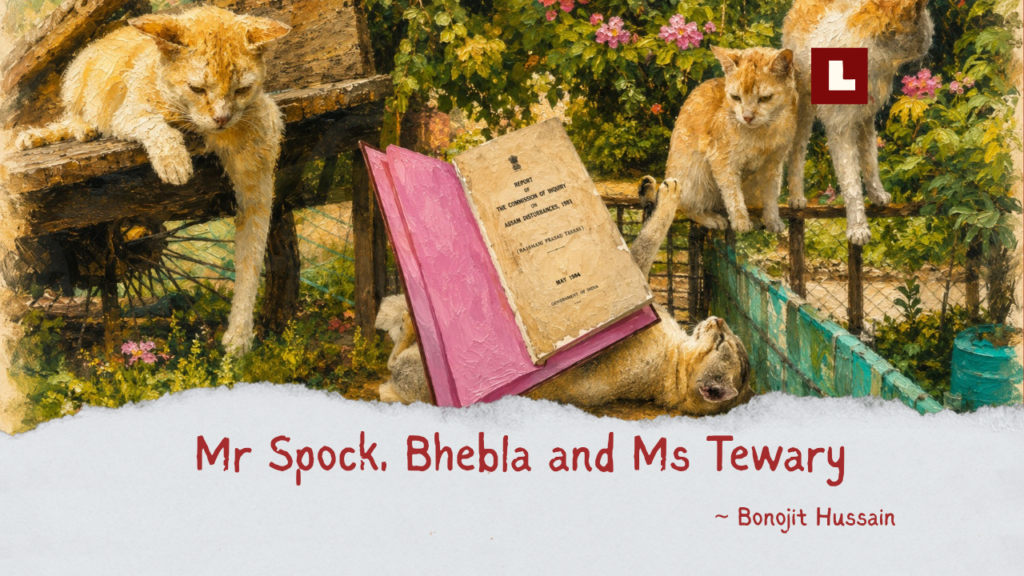

Around nine every night, Bhebla goes to my cousin’s house.
A little further down from my gate, the road turns right. Three homesteads away, on the left corner, is my cousin’s house. I eat dinner there every evening between nine and half past nine. Bhebla knows this. He does not wait at my house. He waits there, on a green plastic chair on their verandah.
The verandah has changed over the years. The floor is cemented now. There are green plastic chairs against the wall, a window beside them, a door further inside, and sometimes a goat standing there too. Nobody treats this as unusual.
Bhebla is five and a half years old. He spends most nights outside. He may remain somewhere in the homestead for part of the night, but usually he is out. He returns anytime between four and seven in the morning and announces himself loudly.
Sometimes, especially when he returns at night, it is a low, conversational sound.
“Mooaa. Mooaa.”
At other times, particularly once he sees that I am awake, it becomes:
“Eeeaahow. Eeeaahow.”
Then I have to get out of bed.
I live alone in my ancestral house in Baridatara. Tara lives in Delhi and manages to come here two or three times a year.
When I came back to live here six and a half years ago, nobody had lived in the house for almost twenty years. The backyard had turned into a garbage dump. The poultry house did not exist. The small pond was little more than an old dug-out. Over the years, the place slowly became habitable again, for me as much as for everything else that arrived.
Before Bhebla claimed the concrete beneath the bougainvillea arch near my gate, there were Mr. Spock and Bablu.
I had been away for around ten days. When I returned, a feral cat had appeared around the house with three kittens. The mother soon left the kittens behind. One of them died shortly afterwards. The remaining two were both male. We named them Mr. Spock and Bablu.
Mr. Spock was named after the Vulcan from Star Trek. From then on, everyone simply called him Mr. Spock.
They followed me everywhere. If I went towards the farm fields, they came behind me, jumping, running, stopping, then running again. If I walked through the yard, they crossed my feet. If I went to the village shops, they followed me there too.
In the village, cats are generally frowned upon. They enter unguarded kitchens, steal fish and pieces of chicken, knock over utensils, and disappear before anyone can catch them. People do not usually look at a cat and think entertainment. But Mr. Spock and Bablu changed that for a while. People watched them as much as they watched me.
Bablu was the macho one. Mr. Spock was the fragile one.
Every ten minutes or so, Mr. Spock would sneeze and green phlegm would come out of his nose. That condition remained until the night he vanished. The moment you made eye contact with him, he climbed onto your lap. My blankets were always covered with small white spots of dried phlegm.
Behind the house is the backyard. There is the poultry shed, the tool shed, fruit trees, a pond and a giant mango tree. My father, now eighty-six, says the mango tree was already there in his grandfather’s time. His grandfather had died before he was born.
Mr. Spock and Bablu would suddenly race towards it. Nothing visible started the race. One moment they would be near the house, and the next they would be running straight towards the tree.
They would reach the trunk together, grip the bark, run ten or twelve feet up, turn, jump down and race back towards the house.
Then they would do it again.
They did not seem to be chasing anything. It was simply a game they had invented for themselves.
At the base of that giant mango tree, beside the poultry shed, is a pond. At that time I was culturing stinging catfish there. Every morning and evening, I would stand beside the pond and whistle.
The fish had learnt the sound.
For a few moments after the whistle, the surface would remain still. Then the water would begin to shift. The catfish would rise one after another, gathering near the edge for food.
Mr. Spock and Bablu would sit beside me and stare into the water.
Sometimes one of them would stretch out a paw, touch the surface for a second and pull it back. The fish would break the water again. The cats would continue to stare.
One evening, a friend from Guwahati happened to be there. I stood beside the pond and whistled. The catfish rose to the surface. He stood staring at the pond, flabbergasted.
The cats watched the fish. My friend watched the fish. I fed the fish.
There was also an older tom in the neighbourhood. I called him Mr. Cat, although I hated him. He was a notorious kitchen raider.
Mr. Cat was not a stray. He belonged to a father and son five homesteads away. The father called himself a fakir and claimed to cure jaundice by making people wash their hands with his “special” mix of mango-bark extract and lime. The son was a trained imam who claimed he had tamed a jinn and regularly exorcised ghosts. It was perhaps inevitable that their cat specialised in raiding kitchens.
At night, I would hear utensils falling somewhere and know that Mr. Cat had entered another kitchen. I would also know that he would soon come after Bablu.
The first quarter of the poultry house serves as my tool shed. A branch of a mango tree used to touch the tarpaulin roof. Bablu began spending his days there. He would climb onto the roof and hide among the mango leaves. From below, he was almost invisible.
Perhaps he believed Mr. Cat could not reach him.
I believed so too.
But Mr. Cat had discovered another route. A star-fruit tree leaned towards the poultry shed on the other side. He would climb through its branches and reach the roof from behind.
Soon Bablu vanished.
There was no body and no explanation. He simply stopped returning.
After Bablu disappeared, a new kitten showed up. He was scrawny, perhaps three or four months old. Mr. Spock, then around eight months old, took him under his wing. Much later, during one of Tara’s visits, she would name him Bhebla. For the moment, he was simply the small kitten Mr. Spock had taken around with him.
Mr. Spock had also brought him to my cousin’s verandah. Bhebla was still small enough to sit pressed against the floor while Mr. Spock watched over him. The verandah had not yet been cemented.
Years later, Bhebla would wait on that same verandah, on one of the green plastic chairs.
With Bablu gone, Mr. Cat began coming after Mr. Spock.
When Mr. Spock was around a year old, he was sleeping with me one night. Sometime during the night, he disappeared.
He never came back.
I never found out what happened to him.
A few days later, I was sitting on the sofa late at night. Bhebla came quietly and sat on my lap.
There was no announcement. He did not jump around. He came in, climbed up and sat there.
As he grew, Bhebla would stay with me until around midnight. Then something would change in him. He would become alert. He would keep looking outside. His tail would go between his legs. Then he would run towards the other end of the village.
Mr. Cat had attacked him on many nights while I was asleep. Bhebla knew the older tom would come. He would wait as long as he could and then run.
That pattern continued for some time. In the evening, he would stay near me. Around midnight, he would become restless. Then he would leave.
When Bhebla was around a year old, the confrontation finally happened in front of me, in broad daylight.
It was a winter noon. I was working near the tool shed. Bhebla was sitting at the kitchen back door, looking outward at the backyard.
Mr. Cat was coming through the hole in the fence near the neighbour’s handpump, his body still half caught between the two sides. Bhebla was directly in his line of sight. He began making a low, guttural rumbling noise.
My first instinct was to find a stick. If I could intercept Mr. Cat, Bhebla might escape through the house.
Bhebla lowered himself until his chin almost touched the ground. His ears pointed forward. Then he sprang at Mr. Cat. The next moment there was loud screeching. Mr. Cat was pinned, half buried in the mud beside the handpump, Bhebla on top, his teeth showing, his back arched up, his tail stiffly pointed towards the sky.
I was barely thirty feet away. I ran forward, bending to grab anything close to a stick. By the time I reached them, Mr. Cat had already stopped fighting. Bhebla went inside the kitchen. I stood at the scene for a few seconds, watching Mr. Cat walk away, his body drooping, his coat heavily smeared with mud, his tail pointing towards the ground.
When I walked into the kitchen, Bhebla looked at me for a second and got back to licking his wounds. He had a deep gash on the right side of his chin and some scratches on his forelimbs.
Later, walking past the fakir and imam’s house towards my mustard fields, I saw the father and son bathing Mr. Cat. The imam looked at me. He smiled and said, “Your cat did this.”
I half-heartedly smiled back and kept walking towards the mustard field.
After that, Bhebla never left me for more than a day.
Women in the village sometimes accused Bhebla of killing chicks. My cousin’s wife always defended him. He had never touched her chickens or chicks. Once, I had just returned from Guwahati when a neighbour complained to me directly. I did not argue about the cat. I reminded her that her cows and goats wandered into my fields often enough. Then I asked whether she also expected me to put a tether around my cat’s neck.
The village mosque stands a little west of my homestead and is visible from the front yard. On summer nights when I cannot sleep, I sometimes step outside to smoke. At two or three in the morning, I often see Bhebla perched calmly on the half-wall of the mosque verandah, looking out into the dark.
Winter nights are different. Around midnight, Bhebla comes home and sleeps on my blanket, tucked behind my knees. I am a little over six feet tall, but I sleep sideways, folded into a zigzag.
Mr. Spock slept differently. He always came close to my chest.
The first time Bhebla brought a feral cat home, I did not realise there was a second cat on the bed. She had quietly settled behind my knees beside him. For a while, she would sometimes come with Bhebla, sleep there for a few hours, and both would disappear before Mr. Cat began his nightly rounds. At other times, she stayed away and watched me from a distance.
Three years ago, I cut away the bottom of the kitchen’s back door so that Bhebla and, later, the feral cat could come and go freely even when I was not in the village. When I leave for several days, I fill an automatic dispenser and leave a bowl of water beside it.
When I am home, the dispenser remains empty. Food goes onto a plate.
Bhebla is perfectly capable of eating by himself. That is irrelevant.
If he comes home before I wake, he keeps shouting until I get out of bed and stand or sit beside him. Only then does he eat.
Throughout the day, he eats small amounts several times. If I am around, he often refuses to touch the food until I accompany him to the plate, pat him and say, “Kha.”
Around eight-thirty or nine every morning, he performs another ritual. He enters the front yard with a growl, walks a few steps, and immediately rolls onto his back with all four legs pointing towards the sky.
Then I have to massage his neck and belly.
He lies on the concrete with his stomach exposed, one leg loose, the other lifted, his tail curved near his body. He has presented the next item of work.
This is not optional. If it rains in the morning and the ceremony is postponed, he completes it later.
Every morning, I also inspect his ears and remove ticks and fleas. Over time, this too has become part of the ritual. He turns his head and lies still while I fold the ear back, check inside, and clear them out. He permits the procedure.
He sits near the doorway with his body turned away from the house, as if the outside still requires supervision. There are days when the old tom is visible in him. He comes and goes as he pleases. He disappears into the village at night. He returns with scratches and gashes.
On summer afternoons, he usually moves under the bougainvillea arch. When the shade disappears, he shifts beneath my white car parked beside it.
Then, at other times, he climbs onto my lap and sleeps pressed against my chest.
At night, unless it is raining heavily or he is caught up in some territorial war, Bhebla never misses his place on the green plastic chair on their verandah.
Mr. Spock had once brought him there.
Last week, another small kitten appeared on the same verandah. He was white and very young.
Bhebla had brought him there.
My cousin’s wife and children took him in. Seeing the kitten there, I remembered Mr. Spock behind the small Bhebla, the unfinished floor, and the paddy sacks stacked behind them. Now the grown Bhebla had brought another kitten to that place.
Then there is the feral cat Bhebla brought home.
For almost two years, she did not completely trust me. She would come for food, disappear, and return, never quite letting herself get close. She must be around four years old now.
For a long time, she had no name, though occasionally I would address her as Mommy-ji.
She has had five litters, each time giving birth in my neighbour’s granary. When the kittens were born, she would come and lead me there, going ahead, then looking back, then continuing, until I followed. The kittens would be inside.
With earlier litters, after they had grown a little, she would move them from the granary to my tool shed. Then, after another month or so, she would finally bring them inside the house.
This time, she bypassed it entirely.
She brought the two kittens directly into the kitchen and chose a cardboard box beside the spare bed. She does not allow anyone near the box except me.
The first time she had a litter, there were seven kittens.
My neighbour threw them out.
I brought them into the tool shed.
Before the next litter, I tried a different method.
The whole family is cunning, and I would say dishonest in almost every possible way, but very God-fearing.
One day, the woman was chatting with me in front of the house. At that exact moment, Bhebla arrived and began rubbing his face against my feet.
I started telling her Quranic stories about cats and said that cats are companions of angels. Then I added that I might not go to the mosque, but Bhebla does not seem to mind. Cats do not rub themselves against just anyone’s feet.
Bhebla continued rubbing against me.
Since that day, the feral cat has never had any problem in their granary.
Last November, the Chief Minister of Assam suddenly announced that the government would table the Tewary Commission Report in the Assembly and make the report publicly available. It was an old inquiry into the Assam disturbances of 1983, unpublished for decades. A journalist friend brought me a copy, a thick red-bound volume of 548 pages. We planned to release it publicly before the government did. For days, I read nothing else.
She would not let me read in peace.
She lay beside it first. Then she lay across it. Then she slipped half under the open cover, with the red binding resting over her body and the old title page exposed beside her.
The report remained open. She slept.
Tara happened to be here then. She looked at the cat sleeping under and over the Tewary Commission Report and said, “Let us call her Ms. Tewary.”
The name stayed.
One night recently, I was sitting alone, thinking about Bablu, Mr. Spock, Bhebla and Ms. Tewary.
Then Bhebla came home with his usual voice.
“Mooaa. Mooaa.”
Ms. Tewary rose from the cardboard box and joined him.
They ate together, side by side, the old tom who had once run through the village with his tail tucked in, and the feral cat who had once taken almost two years to trust me.
Bhebla went out again into the dark village.
Ms. Tewary returned to the cardboard box where the kittens were sleeping.
I went to bed.